The Economy: A Look Back and What’s Ahead

Last Week

The most important thing that happened last week economically was that expectations for Fed tapering of QE were pulled forward a bit—from the previous “consensus” of mid-2014 to the early part of 2014— thanks mainly to an FOMC statement that wasn’t as “dovish” as expected plus a Jon Hilsenrath sentence that stated a December taper remains “on the table.”  Interestingly, this change in expectation came despite decidedly mixed economic data.

Starting with the FOMC statement from last Wednesday, it seems most are calling it slightly “hawkish,” but that’s really only because it didn’t feature any material downgrade of the economy in the commentary (as was widely expected).

Looking at the actual statement, it was hardly changed from September, although the two important takeaways were that the FOMC noted the labor market had slid a bit and also somewhat celebrated that interest rates had declined.

Both changes are, on balance, slightly “dovish.” So even though the market didn’t trade that way, I think the meeting didn’t really change anything with regard to when the Fed will taper QE (and certainly didn’t materially pull it forward, as they remain data-dependent).

Outside of the FOMC, as I said, economic data was at best mixed. Early in the week, things looked somewhat grim:

  • The manufacturing indicator of the September industrial production report was weak and August was revised down.
  • Pending home sales dropped 5.6%, the biggest monthly drop since April 2011.
  • The October ADP employment report missed expectations at just 130K jobs added, and the September figure was revised lower as well.

These reports were especially disconcerting because they implied the economy was seeing a slowing of growth before the government shutdown, as this data was from before October.

Later in the week, though, the data surprisingly turned better.  Chicago PMI, which isn’t usually a watched number, caught people’s attention. It exploded to a multi-year high, and the details of the report were equally strong.  And, on Friday, the national ISM manufacturing PMI increased 0.2 to 54.4, beating expectations of a small decline.  So, if anything, the beginning of the week was considered “dovish” but turned “hawkish” as the week went on.

I’m spending time talking about how the market interprets the data (hawkishly or dovishly) because right now it’s as important as the actual data itself.  As was the case prior to the government shutdown, the question of “When will the Fed taper QE?” remains the single biggest driving factor in the markets (for bonds, the dollar, commodities and equities).

The first three assets have traded (and will trade more immediately) to shifting “tapering” expectations, as we saw last week.  But, although stocks won’t trade off daily shifting of tapering expectations, it very much remains to be seen if stocks can rally in a “QE-less” world.

Ultimately, if the Fed has to taper QE and the economy isn’t very strong, that could usher in “stagflation” and be a rally-killer.  So when and how this whole thing works out remains the key to any medium-term outlook for equities.

This Week

There aren’t many economic releases this week, but the October jobs report is Friday and clearly that’s important from a WWFD (What Will the Fed Do?) standpoint, although this jobs report will be taken with a hefty grain of salt given the government shutdown.

Also on Friday is the “Personal Income and Outlays” report, which is particularly important because it gives us a look at the Fed’s preferred measure of inflation—the core Personal Consumption Expenditures deflator.  Stubbornly low inflation has been a growing concern of the Fed’s for some time, so a weak core PCE deflator will be “dovish.”

Also on the calendar this week is the first look at Q3 GDP on Thursday (expectations are for close to 2%), weekly jobless claims (this report will be overshadowed by the  October report Friday) and ISM Non-Manufacturing (or service sector) PMIs (Tuesday).  Really, though, those reports won’t move the needle much with regard to WWFD. (GDP is more a media favorite than anything anyone really trades off of.)

Outside of the jobs report, arguably the other “highlight” of the week will be the ECB meeting Thursday.  The euro plunged last week (and the Dollar Index spiked) on a very weak inflation reading, and speculation is high as to whether the ECB will cut rates to fend off a hint of deflation potentially hitting the “Continent.”  Given the falling euro’s effect on the Dollar Index, this meeting has implications for the commodity markets particularly.

The Economy: A Look Back and What’s Ahead

Last Week

With the drama in Washington successfully postponed, focus last week turned to the question of “How much damage has the shutdown and drama done to the economy?”

While it’s still early, based on last week’s data, the answer so far is “definitely some” because economic data almost universally missed expectations last week. Perhaps more disconcerting than that, though, were the weak jobs and durable goods reports. These are from September (and pre-shutdown), and they imply that the economy may have been losing momentum before the last round of drama in Washington.

With regard to WWFD (what will the Fed do), the soft data last week further solidified March 2014 as the “consensus” date for the first tapering of QE. However, many analysts think it could come as soon as January, depending on the data.  But, from a Fed standpoint, last week was marginally “dovish.”

The September jobs report showed 148K jobs added, with a net 9K positive revision for July and August, which was well-below expectations of 180K.  As mentioned,  this data was compiled before the shutdown, and the bottom line is that the jobs market remains largely stuck in neutral—adding between 150K and 200K jobs/month, as it has been doing over the past quarter.  Progress in the labor market has clearly stalled.

Manufacturing data was also disappointing. October flash manufacturing PMI, which is inclusive of the shutdown, missed expectations. New orders, the leading indicator in the report, fell to a multi-month low.  Although, importantly, the PMI did stay above 50—signaling continued expansion in the manufacturing sector—the pace of that expansion is slowing.

On Friday, the September durable goods report was also weak.  The headline number was a beat, but as always with durable goods, you can ignore the headline and instead look at the “New Orders for Non-Defense Capital Goods Excluding Aircraft.”  NDCGXA fell 1.1% in September (so, before the shutdown). This will raise some concerns that businesses are now starting to reduce spending and investment amidst all this uncertainty, which puts our 2% growth rate at risk.

Bottom line is the economy remains a major concern, and also the single-most-important catalyst for higher stock prices. (More QE won’t make the market go substantially higher; we need real economic growth.)

Interestingly, the stock market didn’t sell off in reaction to last week’s data, and that’s because it’s impossible to try and figure out how much of the weakness in the economic data was just temporary (because of the shutdown) and what was more structural.

And, we can expect the market to continue to largely “ignore” weak data for the next few weeks, given the noise from the shutdown.

The economy returning to above-trend growth (meaning 3%-plus) remains the key to substantially higher equity prices. If the data stays soft into December, the dynamic in the market will change, and not for the better.

This Week

This week’s highlight is undoubtedly the FOMC meeting Tuesday/Wednesday.  I’ll give a more in-depth preview of what’s expected, but at this point no one expects any tapering of QE, and in all likelihood this should be a relative non-event.

I would expect the Fed’s commentary on the economy will be downgraded given the government shutdown, and on balance the risk is that the meeting is perceived as “dovish.” But really, the only thing that people are trying to figure out is when will the Fed first taper. Given the data, it looks like the answer is “not in 2013.”

Away from the Fed, we get several key economic reports. These will be watched, but don’t expect the market to necessarily trade off them like we’d normally see, given the “noise” in the data and all that’s happened in the economy since September.

We get more insight into the state of the manufacturing industry with industrial production this morning and the final Institute for Supply Management’s manufacturing PMIs Friday.  In light of the soft durable goods report (and flash PMI), these pieces of data will be watched to see if they confirm the slowing growth we’ve seen in other recent manufacturing and business investment reports.

On the consumer side, September retail sales will be released tomorrow morning.  Recent data have implied consumer spending is slowing a bit, but consumer confidence readings in the wake of the shutdown have plunged lately.

This will keep concerns high that the consumer might materially slow down as we approach the holiday season.  It hasn’t happened yet, but that’s a legitimate concern for the market, because as the American consumer goes, so goes the U.S. economy.

Finally, this week would normally be “jobs week” but because of the shutdown, the October jobs report has been delayed till next week.  But, we do get the ADP jobs report Wednesday, so look for that number to potentially move markets more so than normal. That release will include the period of the October shutdown, and will offer a preview of how much damage was done to the labor market by the shutdown.


Sevens Report Chart of the Day: Chinese Markets Gap Lower

Screen Shot 2013-10-24 at 10.49.50 AM

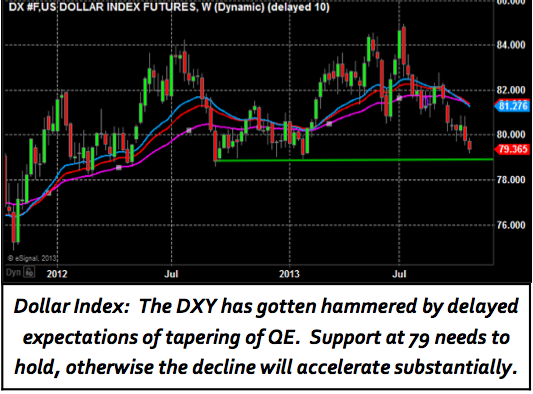
Sevens Report Chart of the Day: Dollar Index continues to Decline

Screen Shot 2013-10-23 at 11.11.31 AM

Is Crude Oil Forecasting an Economic Slowdown?

Screen Shot 2013-10-22 at 11.23.32 AM

Current Economic Overview and Three Key Questions Facing the Market

Last Week

Although last week was dominated by the temporary resolution in Washington, there were two important takeaways from the domestic and global economic data that was released.

First, last week was important with regard to Chinese data and their economy, and largely the results met expectations (which is a positive).  Q3 GDP met expectations, rising 7.8%.

The Consumer Price Index was a touch higher, but mostly because of vegetable prices. Importantly, it’s not high enough to have the Chinese government start to remove economic stimulus.

Plus, industrial production and retail sales data for September met expectations. Finally, commodity imports were surprisingly strong, implying there is underlying strength in the Chinese economy.

From a market standpoint, this data was important because it further reassures the markets that the Chinese economy isn’t seeing a significant slowdown in the pace of growth. (Meaning ,there is little risk of a Chinese economic “hard landing.”) From an investment perspective, it implies the “global economic recovery” investment thesis remains valid, which is positive for cyclical stocks, multi-national industrials, global industrial miners and transportation stocks.

Second, here in the U.S., we got our first look at the state of the economy in October via the Empire State and Philly Fed reports. The takeaway is that the shenanigans in Washington did have a negative effect in the near term, but the manufacturers surveyed in the reports continued to see positive momentum building beyond the temporary government shutdown.  We know that because, while both headline indices declined from September levels, the new orders index (a leading indicator) rose for both reports—again implying that the government shutdown hasn’t significantly altered expectations of activity in the future.

So, to word it simply: For the next several weeks, the market will be wondering: “How Much Damage Did Washington Do?”

And, although it’s still early, both the Empire State and Philly Fes surveys gave us an answer of “some, but not a lot.”

If that answer proves valid, then that’s bullish for risk assets into year-end.

This Week

This week will be very important in providing more insight into the three key questions before the market:  1.  “How much damage did Washington do to the U.S. economy?”  2.  “Is the global economic recovery continuing or losing some steam?” and 3.  “Will the Fed taper in December?”

Right now the market “expects” the data to reflect these answers:  1.  “Some but not much.”  2.  “Yes it’s continuing but with a small loss of momentum” and 3.  “No, unless the economic data comes in much, much better than expected.”

First, the September jobs report will be released tomorrow morning at 8:30 a.m.  Right now the expectation is for around 180K jobs added, but make sure to watch the revisions.

The August number was very low (153K), almost borderline shockingly low, and there is some expectation that this number may be revised significantly higher.  So, point being, look at the revisions to the August data as much as you do the headline number for clues as to how the market will trade.

Second, global “flash” Purchasing Managers’ Indexes for October hit Wednesday night (China) and Thursday morning (Europe & U.S.).  Obviously this is the next key round of data for the “global economic recovery” thesis.

Additionally, the flash PMIs (which are collected by the private firm Markit and will reflect activity throughout the government shutdown) will give a lot more insight into the “how much damage has been done to the economy” question

Third, we get the latest look into the health of the housing market via Existing Home Sales (today) and New Home Sales (Thursday).  Obviously a recovering housing market remains a key driver for the growing economy. And, as has been the case, investors will be looking for clues about the effects of higher interest rates on home purchases.  Incidentally banks, in their earnings calls, have had generally “OK” commentary toward mortgages and housing, so most expect these numbers to reflect a bit more slowing, but with the recovery still intact.

The Economy: A Look Back and What’s Ahead

Last Week

The ongoing government shutdown delayed several pieces of data last week, so weekly jobless claims and the Federal Open Market Committee minutes were the only two reports released.

Starting with the Sept. 18 FOMC meeting minutes, they revealed, as expected, a divided Fed about when and how to taper QE.  The decision not to taper QE was a “close call,” as multiple Fed governors had said in follow-up speeches since the meeting.  The market initially took the minutes as a touch “hawkish” based on a sentence that stated most governors still expected tapering this year. But the “hawkish” response from the market was short-lived, as clearly a lot has happened since the September meeting, and virtually none of it has been good—with the exception of President Obama formally nominating Vice Chair Janet Yellen to replace Chairman Ben Bernanke, as was widely expected.

Jobless claims saw a huge jump last Thursday as governmental incompetence trickled down to the state level.  California, apparently because of computer upgrades, had a backlog of unreported claims from the last several weeks. (This was despite the Department of Labor saying that, for two weeks, the data has been “clean.”)

Initial claims jumped by more than 60K due to the backlog, although the takeaway is the four-week moving average is basically where it was one month ago (in the mid-320K range).  This means the multi-year dip we saw in claims over the past three weeks was a mirage, and the labor market remains basically unchanged since last month (meaning, we aren’t seeing any marginal improvement).

The bottom line of the data last week was that—taken in the context of the Washington fiscal drama and negative effect of the government shutdown on the economy—expectations for QE tapering are now rapidly shifting to early ‘14, in either January of March, and the prospects for a December taper are quickly falling to near-zero.

This Week

Thankfully the most-important economic release this week won’t be delayed because of the shutdown.  Most important to the markets this week is data from China.

Over the weekend, we learned exports from China dropped much more than expected in September—falling 0.3% vs. (E) 5.8% increase.  It was already an important week of data from China, but that “miss” will have people even more focused on the releases.

Third-quarter GDP, Industrial Production and Retail Sales are all released Thursday night.  It goes without saying that Chinese economic growth stabilizing around the 7.5% GDP mark is essential to the “global recovery” investment thesis, so it’ll be important that Chinese data is close to estimates.

Domestically, the Empire State and Philly manufacturing surveys (Tuesday & Thursday, respectively) will give us the first look into economic activity in October, and clearly people will be watching to see if there has been any negative effect on the manufacturing recovery given the drama in Washington.  It’ll only be an anecdotal look, but in particular keep an eye on the Philly Fed, as recently it’s been a good predictor of the national Institute for Supply Management’s manufacturing PMIs.  So, expect a negative reaction from the market if that number is weak.

Elsewhere, the Fed Beige Book will be released Wednesday. Although, given the nature of the analysis and the government shutdown, this report—unless it’s shockingly negative (which is a very low probability)—shouldn’t be a market-mover.  Finally, weekly jobless claims, given last week’s volatility, will again be watched, in particular to make sure they come back down after the big jump from the California backlog.

The shutdown will again delay several pieces of data this week. Industrial production, the Consumer Price Index and housing starts continue to be on hold until further notice.


An Update on Washington and the Economic Climate

Washington Update

The rhetoric escalated a bit over the weekend, and Boehner said there are not the votes to pass a “clean” CR or debt ceiling debate without first having a “serious conversation” about what’s driving the debt.  That comment is responsible for the weakness in risk assets this morning.  Democrats re-affirmed their stance that they will not negotiate on the CR or debt ceiling.

From a market standpoint, despite the escalation, the very widely held expectation is that a deal will get done, and the market views the fact that the CR and debt ceiling are now one negotiation as a positive.  Most expect some sort of resolution later this week (CNN reported a six-week CR and debt-ceiling deal is gaining momentum), although if we go into another weekend with no progress, expect the anxiety level to creep higher.  For now though, we can expect a continuous stream of headlines as both sides posture and continue with their respective PR campaigns.

This Week

Away from Washington, there are several other important things going on.  First, earnings season kicks off this week with AA and YUM posting results Tuesday after the close, but the big releases of the week will be bank earnings on Friday.  JPM, WFC and WBS all release results Friday morning.  Sentiment toward the banks has turned very negative since the “no taper” surprise, and recent reports of depressed trading volumes and revenues have added to concerns.  So, it’ll be very interesting to see if the reality of the results matches the low expectations.

Second, while economic data will be sparse, there are a number of Fed speakers this week (two on Tuesday and two on Thursday), in addition to the FOMC minutes being released on Wednesday.  In addition to the Fed speakers, we will also hear from ECB head Mario Draghi, who makes comments in Massachusetts on Wednesday, and BOJ head Haruhiko Kuroda speaks Thursday in New York.

Economics

Last Week

The economic data last week implied the U.S. and global recoveries are still ongoing, but they’ve lost a little momentum from August.  The most-watched numbers last week were the U.S. and international manufacturing and service sector PMIs. And across the board, they reflected continued expansion but a slight loss of momentum.

Chinese and European manufacturing PMIs remained above the 50 level (both at 51.1) but declined marginally from August readings, while service sector PMIs both beat expectations.  It was the exact opposite in the U.S., as September manufacturing PMI hit another multi-month high at 56.2 vs. 55.0 (E), while non-manufacturing PMI declined to 54.4 from a high August reading (57.0).

The takeaway from the global PMIs is that, while they lost some momentum, they still imply the global economy is recovering. As such, the numbers don’t give any reason to think the “global economic recovery” thesis, that has in part led to international outperformance over the past several months, is ending.

Looking domestically, last week was “jobs week.” But because of the government shutdown we didn’t get the monthly Employment Situation report, making the week somewhat anti-climactic.  Given that, the ADP report took on a bit more significance. So, the fact that it missed estimates and saw a decent downward revision to the August data weighed on markets and continues to imply we’re not seeing the incremental improvement in the national jobs market that we would like.  And, the drop in jobless claims, which remained just above 300K last week, isn’t yet resulting in a pickup in hiring.

This Week

Even before the government shutdown, this week was going to be quiet from an economic standpoint. But because of the shutdown, the most-anticipated number of the week (retail sales on Friday) has been postponed.  The Produce Price Index (PPI) and wholesale trade are also being delayed.

Turning to what will be released this week, the most-anticipated will be the Fed minutes on Wednesday.  We have had an endless parade of Fed speakers since the surprise “No Taper” in September, and basically we’ve had two conflicting messages from them.  Some Fed governors, such as Dudley and Williams, have been pretty dovish—implying the economy isn’t strong enough for the Fed to taper.  Conversely, some Fed governors such as Bullard have repeatedly said not tapering QE in September was a “close call.”  Given all the Fed confusion, the minutes will be poured over for clues as to just how close the Fed was and is to tapering.  Going into the minutes this week, the overwhelming expectation is for tapering of QE at the December meeting at the earliest, and many are now expecting the first taper to occur in early ’14.

Other than the minutes, data is very light, assuming the shutdown stays in effect. The three releases this week are consumer credit (Monday), jobless claims (Thursday) and University of Michigan Consumer Confidence survey.

Bottom line on data this week is nothing released is going to materially change the current expectation that both the global and U.S. economies are recovering at a slow pace. And, really, markets will be gaming on any potential negative effects of a protracted U.S. government shutdown and debt-ceiling crisis more than they will be trading off any data released this week.


What Washington Dysfunction Means for the Market (It’s not all bad).

Washington Update

The House Saturday night passed a bill that funds the government through Dec. 15, but added a one-year delay on the individual mandate to the “Affordable Care Act” and removed a tax on medical devices.  Like the earlier version, this bill is dead in the Senate, so at this point the chances of the federal government shutting down at midnight tonight have increased substantially.

But, although the media will portray it as such, even if the government shuts down for a short period, it’s not a bearish game-changer.  The real risks here (that would require getting defensive, and fast) are for a protracted government shutdown (not just a few days) and/or a breach of the debt ceiling.  Drama aside, both those “Armageddon” scenarios look very, very unlikely.

At this point, the Senate will come back into session around mid-day today, where they will vote down the CR sent from the House.  And, at that point, we start the game all over again—will the House pass the “clean” CR or will it add another set of amendments?  The answer will result in a shutdown or not (although at this point at least a temporary shutdown is likely, just based on the fact there’s not a lot of time to get everything done).

Bottom line is this, though: Unless a government shutdown becomes extended (say >20 days or so), it’s not a bearish game changer.  Selling right now isn’t panicked  – its just cautious and there are no bids in the market.  But, keep in mind the high probability is that a deal does get worked out to fund the government sometime in the next few days (if not late tonight).

This Week

Besides Washington drama and a heavy calendar of economic data, there will be multiple Fed speakers (highlighted by Ben Bernanke on Wednesday, although there may not be much on monetary policy. The speech is called “Community Banking in the 21st Century”).

Internationally, all eyes are on Italy.  PM Letta is scrambling to shore up support for his government amidst the with drawl of support by Berlusconi.  All this is occurring as the Italian Senate is set to vote on Silvio Berlusconi’s expulsion on Friday, and more pressingly Letta will hold a vote of confidence Wednesday.  Obviously if there is a collapse of the Italian government and new elections, that will be a significant negative event for Europe peripherally.

In Japan, Prime Minister Shinzo Abe is expected to announce tonight whether the planned sales tax increase will go through in the spring. (The wide expectation is “yes it will.”)

Micro-economically, the calendar is quiet but we’re now in “pre-announcement” season for Q3 earnings, which start with Alcoa (AA) on Tuesday, Oct. 8, so there are potential surprises lurking.

Larry Summers Was a Casualty of Syria

The big news over the weekend was Larry Summers withdrawing his name from consideration for Fed Chairman.  Summers withdrew after Democratic Senator Jon Testor from Montana signaled Friday he would not vote for Summers, making it virtually impossible for Summers to make it out of the Senate banking committee vote needed before full Senate confirmation, which basically killed any chance for nomination.

This is a surprise, as Summers was largely “priced in” in the Treasury market, the dollar, and gold, especially after last Friday’s Nikkei article (bet that reporter didn’t have a good Monday).

Yellen will now be the overwhelming favorite to replace Bernanke, with Don Kohn a longshot.  Very short term (and I mean basically just today) this is positive gold, equities and Treasuries and negative for the dollar.  Longer term, Yellen over Summers isn’t a major game changer from a policy standpoint, but it is “dovish” on the margin and likely a boost for inflation linked assets.

The important positive from this news has more to do with continuity than it does policy.  The Fed is more involved in markets than ever, and I think it is a positive there’s going to be continuity (assuming it’s Yellen) as the Fed unwinds its balance sheet, because the truth is they are making this up as they go along.  As we know, markets hate uncertainty, and Summers, however qualified, was an unknown.  With Yellen as Chairman, there will be continuity, and that is a positive for stocks.  Bottom line is the market “knows” the Fed under Yellen, and happily one major decision from Washington appears to have resolved itself without major fighting or drama.