Chart of the Day: Gold
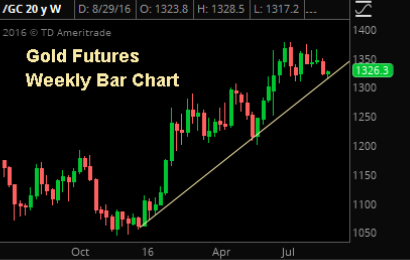
Gold futures are currently in a “consolidative pullback” from the post-Brexit highs in June, however the longer-term trend remains a bullish one.



Gold futures are currently in a “consolidative pullback” from the post-Brexit highs in June, however the longer-term trend remains a bullish one.
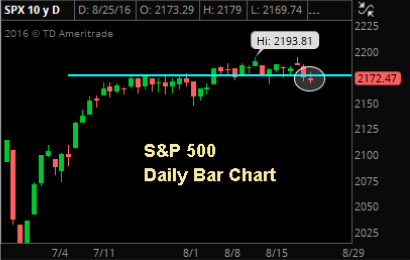
Although it was a choppy and seemingly uneventful session, the S&P 500 did quietly close at a 3-week-low yesterday. Today, Yellen could spur all sorts of different moves, but from a purely technical perspective, yesterday’s close was a bearish, near-term development
Yesterday’s dip in stocks was not because of an EpiPen, regardless of what the financial media said.
Yes, Hilary Clinton’s EpiPen comments did remind everyone of the healthcare induced pullback in 2015, but this time that’s largely a political distraction.
By far the most important thing that happened yesterday was that we learned 8 of 12 Regional Federal Reserve Bank Presidents requested a Discount Rate hike in July.
That’s potentially very important, because it means the chances of a rate hike in 2016 are higher than previously thought—and that is a threat to this market rally.
That’s the real reason stocks dropped yesterday, not some EpiPen political drama.
I included that analysis in the full, paid edition of The Sevens Report
this morning (which was delivered to subscribers at 7 a.m.), and I got some great feedback.
One subscriber, a wealth manager with ML, called and told me that he reads three things every morning: Gartman, The Sevens Report, and some of ML’s research.
He said Gartman had great information, but it was long and he really doesn’t need to know about pricing trends in cotton or the inner workings of Japanese politics.
The ML research was comprehensive, he said, but it was typical “Ivory Tower” stuff that was full of jargon and often tough to discern a clear, concrete takeaway.
He went on to say he subscribes to The Sevens Report
because every day it tells him, in plain English, what’s important in all asset classes: Stocks, Bonds, Commodities, Currencies, Bonds, and Economics.
No jargon, no obscure facts, just the information you need to know, in plain English, every day at 7 a.m.
And, he added that it didn’t hurt that the cost of The Sevens Report
was about 1/10th that of the Gartman Letter!
The truth is, this is a very difficult market, in part because there are unending distractions that take advisors and investors away from the key forces driving all asset classes right now: Global bond yields.
That’s why we consistently bring our subscribers (and you via these free excerpts) back to global bond yields, because they will decide whether stocks break out and extend the rally or break down and suffer a nasty pullback.
That’s why yesterday the most important piece of information was the revelation that at the July FOMC Meeting, for the first time in 2016, a majority of Regional Fed Bank Presidents called for a discount rate hike.
That’s a potential problem for stocks for two reasons:
Both of those numbers are too low, and both represent a potential risk to this stock market rally.
Understanding the outlook for US and global interest rates is the key to successfully navigating the markets for the rest of 2016, and we’ve included an excerpt of recent rate research as a courtesy.
Demand for a (Discount) Rate Hike Grows (Sevens Report Excerpt)
Easily the most important thing that’s happened so far this week is that a Fed document was released Tuesday that revealed for the first time in 2016, a majority of the Fed’s Regional Bank Presidents requested a reserve rate hike in July.
History tells us that implies that a majority of FOMC officials think the time for a Fed funds rate hike is sooner than later (like in the next month or two). For reference, the last time eight Regional Fed Bank Presidents requested a reserve rate hike was September and October of last year, and the Fed hiked in December.
But the important takeaway for any stock and bond holder is this:
The Fed may indeed be closer to a rate hike than the market expects.
And, that’s starting to be reflected in Fed Fund Futures as they have risen over the past week.
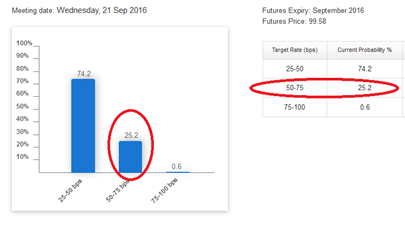
And, despite that, the S&P 500 is less than 1% off the recent highs.
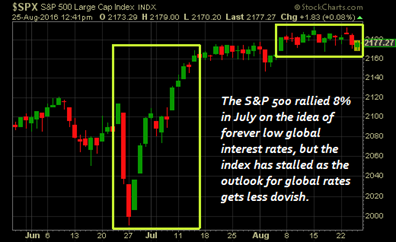
That should be a concern, because the idea of forever-low global rates and no 2016 Fed rate hikes spurred a 7% S&P 500 rally in July, and if that proves to be untrue, then there’s a risk of a pullback.
Bottom line, there is mounting evidence that global and US interest rates may not stay as low as the stock market has currently priced in, and that is a risk to the entire July/August rally. Again, we won’t know the outlook for rates until the end of September. But the bottom line is that markets are very, very complacent with regard to any future rate hikes, and there is growing evidence that a rate hike is in the works.
The Next Six Weeks Will Be Critical for this Rally
For now, this remains a market largely stuck in neutral at the moment and in need of resolution on several key upcoming events before it can break meaningfully past 2200 in the S&P 500, given current valuations.
Specifically, the overhang of global rate uncertainty needs to be resolved before stocks can resume the forever-low-rates rally and extend multiples and valuations beyond current levels.
And, that process will begin tomorrow with Yellen’s Jackson Hole speech.
Generally, it’s expected that Yellen will be (as usual) dovish in her comments tomorrow, and if so, that could provide a short term boost for stocks. But, that’s not going to cause a real breakout in the markets
because what happens to US interest rates is as much a function of global events as it is Fed policy.
The risk tomorrow is that Yellen offers a “hawkish” surprise for markets, and that surprise combines with recent hawkish Fed rhetoric to cause a low volume, potentially sharp decline in stocks.
In tomorrow’s full, subscriber-only edition of the Report, we’re going to detail:
Paid subscribers to The Sevens Report will have this information at 7 a.m. tomorrow, in plain English and it’ll take them only a few minutes to read it, so they will be prepared to quickly and confidently answer any client questions about the Fed, and propose tactical ideas for how to potentially profit from a “dovish” Fed or protect portfolios from a “hawkish” Fed.
We will give our advisor and investor subscribers the plain English talking points to help them turn any Fed or central bank based volatility into an opportunity to demonstrate their knowledge of markets and impress current clients and prospects.
And, we are going to provide that same level of analysis for the remaining 5 key events that are coming in September, events that will decide whether this rally extends into the fourth quarter
If all we do is help you navigate the month of September correctly and help you get properly positioned in client accounts for the fourth quarter, we will have more than covered our subscription costs.
If you do not have a morning report that is going to give you the plain English, practical analysis that will help you navigate the coming six weeks, then please consider a quarterly subscription to The Sevens Report.
There is no penalty to cancel, no long term commitment, and it costs less per month than one client lunch!
With thousands of advisor subscribers from virtually every firm on Wall Street and a 90% initial retention rate, we are very confident we offer the best value in the private research market.
I am continuing to extend a special offer to new subscribers of our full, daily report that we call our “2-week grace period.”
If you subscribe to The Sevens Report
today, and after the first two weeks you are not completely satisfied, we will refund your first quarterly payment, in full, no questions asked.
Click this link to begin your quarterly subscription today.
Value Add Research That Can Help You Grow Your Business in 2016
Our subscribers have told us how our focus on medium-term, tactical opportunities and risks has helped them outperform for clients and grow their businesses.
We continue to get strong feedback that our report is: Providing value, helping our clients outperform markets, and helping them build their books:
“Thanks for your continued insight; it has saved my clients over $2M USD this year… Keep up the great work!” – Top Producing FA from a National Brokerage Firm.
“Let me know if there is anything else that you need from us. Thanks again for everything. I really enjoy the Report – it is helping me grow my business and stay on top of things.” – Independent FA.
“Great service from a great company!!” – FA from a National Brokerage Firm.
“Great report. You’ve become invaluable to me, thanks for everything…! – FA from a Boutique Investment Management Firm.
Subscriptions start at just $65 per month, billed quarterly, and with the option to cancel any time prior to the beginning of the next quarter, there’s simply no reason why you shouldn’t subscribe to The Sevens Report right now.
Begin your subscription to The Sevens Report right now by clicking this link and being redirected to our secure order form.

Finally, everything in business is a trade-off between capital and returns.
So, if you commit to an annual subscription, you get one month free, a savings of $65. To sign up for an annual subscription simply click here.

Best,
Tom
Tom Essaye
Editor, The Sevens Report
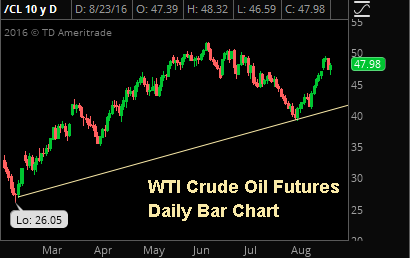
Despite the early week pullback in the energy market, WTI futures are continuing to trend higher right now thanks to speculation that global oil producers may “freeze” production next month in an effort to defend prices. Today, the weekly EIA Report released at 10:30 a.m. ET will be in focus.
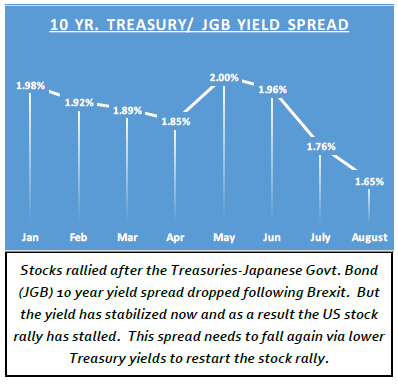
Stocks rallied after the Treasuries-Japanese Govt. Bond (JGB) 10 year yield spread dropped following Brexit. But the yield has stabilized now and as a result the US stock rally has stalled. This spread needs to fall again via lower Treasury yields to restart the stock rally.
It’s the calm before the storm.
That’s what this market feels like to me right now, because the fact is that the events of the next six weeks have the potential to either 1) Ignite an acceleration of the recent rally or 2) Cause a sharp pullback.
While I admit these markets are downright dull at the moment, it’s important for advisors and investors not to get too complacent, because through the end of September we will get three key central bank decisions that will determine whether bond yields keep grinding lower, or finally reverse higher.
That’s going to be critically important for how stocks and bonds perform in Q4, and the potential is there for either a continued melt up (at which point advisors are going to want to be very long) or a potentially violent pullback in both stocks and bonds (at which point advisors are going to want to be very defensive).
The next six weeks will be an especially critical time if you are an advisor or investor who has underperformed markets so far in 2016 (and there are a lot of very good advisors who have underperformed this difficult market) as these events will present an opportunity to close that performance gap… if you know what’s happening and how to be positioned.
We are going to be very focused on making sure our paid subscribers know, immediately, what the implications are for each of these key events, and which sectors will benefit from those events, whether it’s banks, consumer staples, utilities, tech or inverse ETFs.
Look, it’s been a very tough year to beat lazy indexing, but we recognize the chance to make up ground over the coming weeks and into Q4 and we’re going to be focused on helping our advisor subscribers do just that by making sure they have the need to know analysis of all asset classes and global regions, not just US economics or the Fed.
We’re approaching the one-year anniversary of the August 2015 collapse in stocks, and while markets are higher (finally), so is volatility, as international events exert greater influence over the Fed, the US economy, and the US stock market.
We understand that in this market clients’ assets are, to a point, at the mercy of the BOJ, ECB, Italian banks, Chinese policy makers, etc., and that’s why, every day, we make sure our paid subscribers know the key trends in:
It’s only by providing that 360-degree coverage, every day, that advisors and investors can truly have an understanding of the risk and opportunities for their portfolios in this environment.
Earlier this week we outlined the three key central bank decisions that are coming in the next few weeks, and we’ve included an excerpt of that research for you below:
Three Key Events to Watch (Sevens Report Excerpt)
With yesterday’s FOMC minutes and today’s ECB minutes, stocks have now entered a five-week central bank gamut that will ultimately decide whether this market can grind higher
into Q4, or see a potentially violent reversal
of this low-rates-forever rally.
I say that because over the next several weeks, we will hear from
1) Fed Chair Yellen,
2) The ECB (again) and
3) (most importantly) the Bank of Japan.
Key Date #1: September 26. The Bank of Japan’s “General Assessment.” You’re probably not hearing a lot about this given the Olympics and political focus of the media, but this is easily the most important event for markets over the next six weeks.
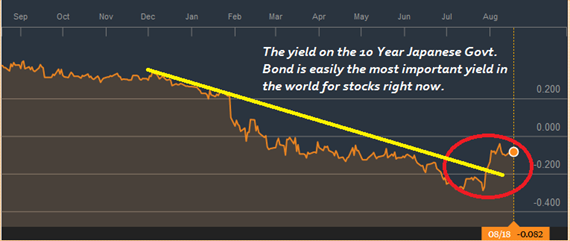
The reason this is the most important date over the next six weeks is this:
A few weeks ago the BOJ again disappointed markets and announced they would be doing a “Comprehensive Assessment” of policy on Sept. 21. “Comprehensive Assessment” in this instance is central bank code for, “We’re going to change our strategy.”
The reason the BOJ needs to change its strategy is because their QE program has become so big that it’s dominating the Japanese Government Bond market, raising the risk of some sort of market dislocation, and it’s still not stimulating inflation or growth. So, put in plain English, their QE program isn’t working anymore, and making it bigger will only increase the chances that they form another massive bubble.
So, the BOJ needs to come up with a new strategy, and that’s what the “Comprehensive Assessment” is all about.
People think one of two things will happen at this Comprehensive Assessment:
Option 1: The BOJ will change the duration of JGBs it’s buying for QE from the current 7-12 years to something longer dated (beyond 12 years).
Option 2: (This is the potential negative outcome): The BOJ could “abandon” QE and instead just commit to keeping longer-term interest rates low by making targeted purchases on the long end of the yield curve. It’s the second option that scares markets, because while it’s still stimulus, it’s basically a tacit admission that QE has limits and has failed.
Why This Matters to US Investors: If the BOJ takes option 2, it could cause a spike in Japanese bond yields and could be the catalyst for a massive unwind of the global money flows into US Treasuries. That, in turn, will undermine the entire low-rate-forever rally in US stocks, as the most aggressive central bank in the world (the BOJ) waves a white flag. And, in this scenario, conservatively the S&P 500 could trade back to the initial breakout down in the upper 2000s (a 5% – 7% correction).
Key Date #2: September 8
The Next ECB Meeting. This ECB meeting is important because it’s been assumed (and priced in) to markets that the ECB would be more accommodative post Brexit. But, that hasn’t happened yet. If inflation and growth estimates released at this meeting are stronger than expected, then expected ECB policy will be more hawkish than thought.
Why This Matters to US Investors: If the ECB estimates are good and the ECB hawkish, it could cause a spike in German bond yields and could be the another catalyst for a massive unwind of the global money flows into US Treasuries. That, in turn, will undermine the entire low-rate-forever rally in US stocks, as European investors unwind Treasury long positions. And, in this scenario, conservatively the S&P 500 could trade back to the initial breakout down in the upper 2000s
(a 5% – 7% correction).
Key Date #3: August 26. Yellen’s Jackson Hole Address. Yellen won’t be “hawkish” in the commentary but the extreme complacency in Fed expectations does lend itself to a surprise. Despite recent hawkish commentary, there is still less than a 50% chance the Fed hikes rates in December! So, if Yellen implies a December rate hike (December, not September) in her remarks in late August that will cause a serious readjustment to the market’s Fed expectations.
Why This Matters to US Investors: If Yellen points to a December rate hike, that, combined with what could potentially happen in German bunds and Japanese bonds a few weeks later will undermine the entire low-rate-forever rally, as US, European and Japanese investors unwind Treasury long positions. And, in this scenario, conservatively the S&P 500 could trade back to the initial breakout down in the upper 2000’s (a 5% – 7% correction).
Markets Nearing Tipping Point: How these events turn out will create a pretty sustainable glide path for stocks to start Q4.
On one hand, if all of these events turn out benign, that will be bullish for stocks into year end and a very reasonable target will be 2240 in the S&P 500, and perhaps 2340. And, certain specific sectors should handily outperform into year end, offering smart advisors the opportunity to outperform.
On the other hand, if Yellen isn’t dovish and the ECB and BOJ are “hawkish,” that will undermine the entire reason for this 8%, post-Brexit rally, as it will cause bond yields to rise and stocks to fall. Avoiding that potential pullback will give advisors the chance to close a performance gap and redeploy capital at more favorable levels.
So, bottom line, getting these events right will be a big key to outperforming in Q4 and finishing the year with strong numbers, regardless of the environment.
We are going to make sure that our paid subscribers know what each of these events means for the broad market and, more importantly, what tactical sectors we think can outperform the market into year end. We are very focused on helping subscribers be properly positioned for the fourth quarter.
Click this link to begin your quarterly subscription today and make sure you’ve got an analyst team working to help you outperform into year-end.
What We’re Doing Now
We continue to slowly and methodically add tactical bank exposure, as that will be a sector that will handily outperform if bond yields do rise. Now, is that our biggest holding? No, of course not, but it’s a tactical long that has outperformed the broad markets
and will continue to outperform if yields drift gradually higher or any of the above events contain a “hawkish” surprise.
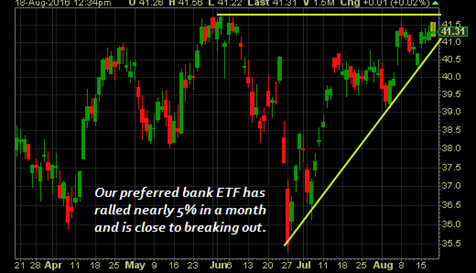
And, with bank stocks still generally down YTD and trading at historically low valuations, it’s not like we’re adding to some high valuation tech name or over-extended, “over-loved” sector.
From a risk/reward standpoint, if you’re looking to add a position or sector that still offers some relative value and the chance to significantly outperform if yields ever do rise, banks remain attractive from a risk/reward standpoint.
And, our preferred bank ETF does not have any European bank exposure, nor does it have any broad-based financial exposure to insurance companies or REITs – two sectors that are not trading at relatively cheap valuations.
Make sure you’ve got an analyst team that’s watching the macro horizon while at the same time focusing on sectors and tactical ideas that can help advisors and investors outperform.
I am continuing to extend a special offer to new subscribers of our full, daily report that we call our “2-week grace period.”
If you subscribe to The Sevens Report today, and after the first two weeks you are not completely satisfied, we will refund your first quarterly payment, in full, no questions asked.
Click this link to begin your quarterly subscription today.
Make More Money, Save Time, Have More Knowledge
Our job is to provide you the timely, need-to-know, critical information that will demonstrate to your clients:
1) That you are on top of the markets, and
2) That you are in control of their financial situation.
Actual subscribers to The Sevens Report have told me that discussing the information contained in the Report with prospective clients has helped them land accounts as big as $25 Million!
2015 was a volatile year, and things have gotten worse so far in 2016. Subscribe today and give yourself the market intelligence you need to help strengthen relationships with clients, and acquire new ones.
Subscriptions start at just $65 per month, billed quarterly, and with the option to cancel any time prior to the beginning of the next quarter, so there’s simply no reason why you shouldn’t subscribe to The Sevens Report
right now.
If you want to make your business more successful, you have to possess unshakeable confidence in your knowledge, and helping you acquire that knowledge is what The Sevens Report is all about. Begin your subscription to The
Sevens Report right now by simply clicking the button below:

Finally, everything in business is a trade-off between capital and returns.
So, if you commit to an annual subscription, you get one month free, a savings of $65. To sign up for an annual subscription simply click here.

Best,
Tom Essaye
Editor
The Sevens Report
Do you know what the TINA trade is?
I ask that, because I’m pretty sure talking about the TINA trade would have just gotten me new clients, if I was a financial advisor.
I just finished giving a presentation on the economy and markets to a group of business executives. While most of the presentation was spent talking about the lackluster fundamental backdrop for the markets, I told them that the reason the stock market was making new highs seemingly every day was because of the TINA trade.
TINA stands for There Is No Alternative, and it’s an acronym to explain why capital is funneling into stocks despite uninspiring economic activity and declining earnings growth.
The TINA Trade: There Is No Alternative to Stocks!
The discussion of the TINA trade generated, by far, the most response and excitement from the crowd.
After my speech, many prominent doctors, lawyers and business owners came up to me to discuss the TINA trade, and I couldn’t help but think that if I was a financial advisor, I would have just gotten a lot of really hot leads, because all of these men and women were asking me… “What do we do?”
I know it’s a dull market right now, but sophisticated investors I speak with know that something here isn’t right, and that markets are still risky. Because of that they want to know their advisor knows the markets and is watching their backs—and that he is not just some salesman pushing the firm’s structured products or sponsored ETFs as the market goes whistling past the graveyard.
That’s why the TINA trade discussion got so much response, and again, if I were an advisor I’m pretty confident I’d be getting some new clients out of that breakfast.
We produce The Sevens Report
so that advisors always have the talking points they need to impress prospects and show clients they are not just touting the company line—and it’s that independent analysis our advisors reference during meetings that helps turn prospects into clients.
That’s why thousands of financial advisors and investors read the full, paid version of our daily research report, because it tells them everything they need to know about Stocks, Bonds, Commodities, Currencies and Economic Data.
We provide the succinct analysis that allows advisors to
1) Save an hour
of research time each day
2) Increase their knowledge
about the markets
3) Have the talking points
to impress prospects and reassure current clients.
And we do this all for a monthly cost of less than one client lunch.
That’s why we say we offer the best value in the paid research space, and our over 90% initial retention rate confirms it.
Stepping back, do we think this rally is heralding a new bull market in stocks?
No, we don’t.
The risks to this market are generally unchanged from three weeks ago, and we’re continuing to monitor those risks for our subscribers.
But clearly, the near-term trend is higher, and you learn quickly in this business you have to invest in the market you’ve got, and not the one you think you should have!
So, the key question remains whether investors need to abandon those defensive equity positions and rotate into higher-growth/higher-beta sectors like tech/consumer discretionary and basic materials.
That’s a pretty important question from a performance standpoint, because defensive sectors have outperformed cyclical sectors in 2016 – and if we are going to see a massive rotation back in to cyclicals, then advisors need to know that to maintain outperformance.
We discussed the potential for that rotation in a recent edition of The Sevens Report
and have included an excerpt for you here below.
Tactical Sector Update: Great Rotation or Not?
Post Brexit, one of the topics we’ve been very focused on covering was the possible “Great Rotation” by investors out of defensive, higher-yielding sectors (staples, REITs, utilities) and into more cyclical sectors (consumer discretionary, banks, tech), because if that rotation does occur, it could have a profound impact on whether an advisor can outperform into year end.
To that point, while the S&P 500 is up nicely this year (a little under 7.5% after yesterday’s close), being over-allocated to defensive sectors throughout 2016 has been a recipe for outperformance. Case in point, our “Defensive” broad allocation suggestion (which is 2/3 defensive sectors, 1/3 cyclical sectors) has outperformed the S&P 500 by nearly 2% year to date and has been less volatile.
But given the breakout in stocks post Brexit, and the prevalence of the TINA trade in stocks (TINA=There Is No Alternative), that defensive outperformance could easily reverse.
Over the past month, there are hints of that starting, and recently we’ve seen a slight rotation out of safety and into cyclicals (including yesterday). Since July 12, the S&P 500 is up about 1.5%, and more cyclical sectors are up anywhere from 0.7% (consumer discretionary, XLY) to 5.27% (tech, XLK). Conversely, traditional safety sectors are all down slightly (staples off less than 1%, utilities down less than 1%).
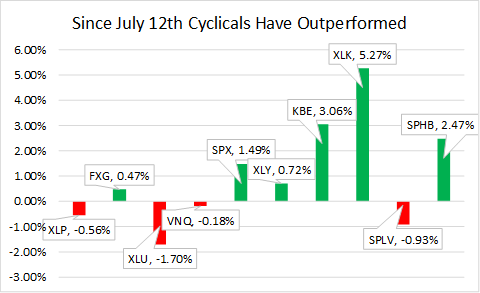
Looking more broadly, since July 12, SPHB (S&P 500 high beta ETF) is up 2.4% while SPLV (S&P 500 low beta ETF) is down 0.9% (although SPLV is still up 10.4% YTD while SPHB is up 7.5%, the gap is closing). So, with some evidence of this rotation, the question we are addressing is whether we should begin to sell some of our defensive sectors and re-allocate to more cyclicals sectors.
So far, the answer is “no,” and for three reasons:
1. Where would we go?
If you or your clients have owned staples and other defensive sectors for part or most of the year, it doesn’t make sense to sell them yet because no other sectors in the market offer a comparable yield and less volatility (remember, if you’ve owned them for a while the realized yield is higher than the current yield because you have a lower cost basis).
2. Economic growth isn’t breaking out.
Cyclicals generally outperform in a rising economic tide, but we’re stuck in stagnant water (and have been for years). Despite hopes, GDP is still looking to be on trend at an uninspiring 2%-ish growth for Q2 and Q3. That favors defensives.
3. The 10-year yield hasn’t broken out.
Think of the logic—the reason the stock market has rallied is because of the expectation of “forever-low” interest rates amidst slow/stagnant global growth. Well, beyond the short term, if rates are forever going lower, wouldn’t I want to hold my higher-yielding equities? It’s only when the 10-year Treasury yield breaks out to the upside that I would want to truly exit higher-yielding sectors and move into cyclicals.
Now, shorter-term underperformance is to be expected, and that’s why, several weeks ago we bought a regional bank ETF that we believed would help reduce any relative underperformance if we saw the start of a rotation out of safety and into cyclicals.
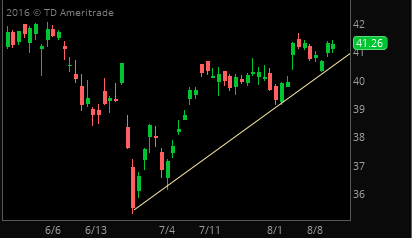
That decision has proved wise, because since then that ETF has rallied almost 5%, handily beating the S&P 500 and cushioning the relative underperformance of defensive sectors.
If you are heavy in defensive sectors, then I would advocate buying this regional bank ETF here because it will go up more than other sectors if rates start to rise.
Finally, we understand that getting this potential rotation right could be the difference between outperforming in 2016 and underperforming. So, we will continue to watch closely, and we will alert paid subscribers when, and if, we think it makes sense to exit defensives and move into cyclicals—including which specific ETFs we would allocate to with tactical funds to make sure you maintain outperformance.
These are the dog days of summer but this dull market isn’t going to last much longer, and volatility could make a big comeback starting in the next few weeks:
We’re committed to making sure subscribers to our full morning report have the independent analysis they need to navigate macro risks
while at the same time having the tactical idea generation that can help their clients outperform.
If your paid subscription research isn’t giving you talking points to discuss with clients, monitoring the macro horizon to keep you aware of risks, and providing tactical allocation suggestions and idea generation, then please consider a quarterly subscription to The Sevens Report.
If all we do is help you get one client, that will more than pay for the subscription!
I am continuing to extend a special offer to new subscribers of our full, daily report that we call our “2-week grace period.”
If you subscribe to The Sevens Report
today, and after the first two weeks you are not completely satisfied, we will refund your first quarterly payment, in full, no questions asked.
Click this link to begin your quarterly subscription today.
Value Add Research That Can Help You Grow Your Business Into Year-End
Our subscribers have told us how our focus on medium term, tactical opportunities and risks has helped them outperform for clients and grow their books of business.
We continue to get strong feedback that our report is: Providing value, Helping our clients outperform markets, and Helping them build their business:
“Thanks for your continued insight; it has saved my clients over $2M USD this year… Keep up the great work!” – Top Producing FA from a National Brokerage Firm.
“Let me know if there is anything else that you need from us. Thanks again for everything. I really enjoy the Report – it is helping me grow my business and stay on top of things.” – Independent FA.
“Great service from a great company!!” – FA from a National Brokerage Firm.
“Great report. You’ve become invaluable to me, thanks for everything…! – FA from a Boutique Investment Management Firm.
Subscriptions start at just $65 per month, billed quarterly, and with the option to cancel any time prior to the beginning of the next quarter, there’s simply no reason why you shouldn’t subscribe to The Sevens Report right now.
Begin your subscription to The Sevens Report right now by clicking this link and being redirected to our secure order form.

Finally, everything in business is a trade-off between capital and returns.
So, if you commit to an annual subscription, you get one month free, a savings of $65 dollars. To sign up for an annual subscription, simply click here.

Best,
Tom
Tom Essaye,
Editor
The Sevens Report
Yesterday, a subscriber called to tell me about a successful meeting he had with a client this week, in which the advisor explained:
The client asked him “How’d you Know That?”
because the advisor sends this client virtually all of compliance approved firm research materials, and they didn’t say anything about the Equity Risk Premium.
The advisor’s answer: “The Sevens Report.”
This advisor went on to tell the client that he uses
the daily publication as an independent research “check” on the firm-provided research to help formulate his overall investment strategy and make sure his clients are protected from macro risks.
Most importantly, the subscriber told me his client left the lunch happy and confident that his account was in capable hands.
So, what information did you have this week to impress clients?
The Sevens Report isn’t just another research tip sheet that’s designed to tell you whether stocks are going to go up or down. Rather, it’s a tool we have created for the purpose of helping advisors:
In fact, The Sevens Report helped thousands of your colleagues and competitors at wire house firms and smaller RIAs be more efficient and more effective in finding and closing new clients since we launched in 2012, and we did it again in 2016.
Affluent clients want communication on the markets that is not just a “boiler plate” strategy update from your broker dealer. They are expecting you to know what is happening in the markets and how it is affecting their portfolios, especially in this difficult environment.
We created The Sevens Report, so that advisors can make sure they have an independent analyst that communicates with them every day and quickly identifies for them the risks and opportunities for:
Most of our subscribers are not actively trading clients’ accounts. However, they can demonstrate to their clients that they weren’t blindsided by the recent volatility
thanks to The Sevens Report.
That’s the kind of analysis that leads to More Clients and ultimately More AUM.
Easily the most important thing that’s happened this week has been that the Bank of England’s QE program basically “failed” on Tuesday, and we’ve included an excerpt of that research for you below:
Implications of a Failed GILT Purchase Program
Most advisors don’t follow global bond markets, but the most important thing that happened this week was in the British bond market and it’s important for your clients because:
What Happened: On Tuesday, the Bank of England became the latest central bank to have egg on its face when, on the second day of its newly expanded QE program, the bank was not able to buy its daily quota of long dated bonds. The BOE sent bids for 1.17 billion pounds worth of 15 year and longer GILTS (British Government Bonds), but it only received offers for 1.118B of GILTS, falling short by over 52 million pounds worth of debt.
Because of how screwed up the global bond markets have become, holders of long term GILTS were literally unwilling to sell to the BOE because they know that 1) There’s nowhere else in the market to generate a decent yield, and 2) These GILTS are just going to keep going up. This is a prime example of where economic theory unfortunately meets market reality.
Why It Matters:
Reason One: Eroding Central Bank Confidence is a Longer-Term Problem for Stocks.
Japan has been ground zero for this eroding confidence as the Bank of Japan, over the first eight months of 2016 has largely admitted that, practically speaking, it is out of bullets to stimulate the economy. And that any further material easing: 1) Can’t be effectively executed because of the size of various markets, or 2) Will cause more harm than good
(like when negative interest rates sent global stocks plunging last week).
Bigger picture, for those investors with larger time horizons, I feel like even lower yields and more and more easing is becoming a virtual pressure cooker, and as yields grind lower the cooker is starting to shake and screws and nuts are starting to fly off as the pressure gets too great.
Perhaps that’s a bit over the top, but there are anecdotal signs that this entire system is starting to show signs of serious stress, and with global bonds, stocks and real estate all at all-time high prices, I honestly fear for the global economy if this thing blows up. I hope I am wrong.
Reason 2: The Yield Curve Might Invert, Signaling a Looming Recession.
We’ve talked for weeks now about the compression of the 10’s -2’s Treasury spread, and that if the yield curve inverts, that’s historically a sign of impending recession—or in this market, something worse.
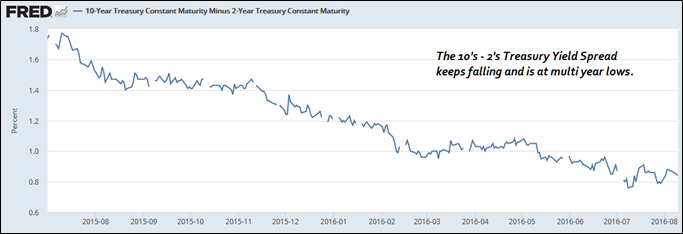
And, that fear has been elevated after the BOE this week.
That’s because while the BOE was unable to fill its quota of long-term debt, it easily bought more medium-term debt (GILTS that don’t yield as much).
That’s important for three reasons:
First, it’s created more downward pressure on 30 year Treasury yields. BOE QE makes the 30-year Treasury even more attractive because the yield of over 2% is much, much better than anything else out there right now. So, that will keep downward pressure on 30-year yields.
Second, it puts more downward pressure on 10-year Treasury yields. BOE QE will make the US 10 Year Treasuries even more attractive because the yield at 1.5% is much, much higher than anything comparable in the market, so that will keep pressure on the 10-year yield.
Third, it will not put pressure on 2-year Treasury yields. Finally, with economic data consistently coming in better than estimates (including last week’s jobs report), a Fed hike can’t be delayed any further than is currently expected.
So, the likely direction of the 2-year Treasury yield is flat to higher, unless economic data gets worse—and at that point we’ll be facing a recession
(which is obviously bad for stocks).
I realize that most financial advisors didn’t have “Global Sovereign Bond Markets” in their broker training program. But, this is what’s moving markets right now, so you need to be on top of it.
This research was already sent to our paid subscribers at 7 a.m. in the full, paid edition of The Sevens Report, and I’m confident some of them are using this analysis to impress clients and prospects.
Make sure you have a daily research document that gives you peace of mind in volatile markets.
We’ll directly tell you (in plain English) what’s truly important in markets and provide consistent tactical idea generation so you can outperform for your clients, regardless of the environment.
I am continuing to extend a special offer to new subscribers of our full, daily report that we call our “2-week grace period.”
If you subscribe to
The Sevens Report today, and after the first two weeks you are not completely satisfied, we will refund your first quarterly payment, in full, no questions asked.
Click this link to begin your quarterly subscription today.
Value Added Research That Can Help You Grow Your Business in 2016
Our subscribers have told us how our focus on medium-term, tactical opportunities and risks has helped them outperform for clients and grow their businesses.
We continue to get strong feedback that our report is: Providing value, helping our clients outperform markets, and helping them build their books:
“Thanks for your continued insight; it has saved my clients over $2M USD this year… Keep up the great work!” – Top Producing FA from a National Brokerage Firm.
“Let me know if there is anything else that you need from us. Thanks again for everything. I really enjoy the Report – it is helping me grow my business and stay on top of things.” – Independent FA.
“Great service from a great company!!” – FA from a National Brokerage Firm.
“Great report. You’ve become invaluable to me, thanks for everything…! – FA from a Boutique Investment Management Firm.
Subscriptions start at just $65 per month, billed quarterly, and with the option to cancel any time prior to the beginning of the next quarter, there’s simply no reason why you shouldn’t subscribe to The Sevens Report right now.
Begin your subscription to The Sevens Report right now by clicking this link and being redirected to our secure order form.

Finally, everything in business is a trade-off between capital and returns.
So, if you commit to an annual subscription, you get one month free, a savings of $65. To sign up for an annual subscription simply click here.

Best,
Tom
Tom Essaye
Editor, The Sevens Report
“It’s a good thing I’m retiring soon, because after almost 38 years in the business almost nothing makes sense in the markets anymore. So it’s a good thing I have you, who understands the way things work today.”
That’s what Reed, an advisor and subscriber, wrote to me yesterday.
If a guy with nearly four decades of experience in the business is confused by today’s markets, it’s a reasonable assumption that a lot of advisors feel overwhelmed and confused by a market that seems to be getting more random every day.
But, Reed’s comments reinforced in my mind that our research is helping advisors successfully navigate today’s environment, as thousands of the most successful advisors in the business who felt overwhelmed or confused by the markets over the past few years now use our daily morning report to cut through the noise and stay focused on what’s really driving stocks, bonds, commodities and currencies.
They’ve found that spending less than 10 minutes reading The Sevens Report
each morning gives them time to focus the rest of their day on growing AUM and building their businesses.
As I often do with testimonials, I hung Reed’s comments on my wall, because they remind me that advisors are counting on us to help them continue to grow their business by making them more efficient and more effective.
If you’re like most advisors I know, you simply do not have enough time to do the necessary research to understand what’s truly driving these wild markets, because you need to spend the majority of your time meeting with prospects, marketing, hand-holding current clients and dealing with an ever-growing list of compliance and regulatory requirements.
We provide the accurate, plain English, succinct research that allows advisors to dedicate more time to these revenue generating activities, because they know at 7 a.m. every day they will have a report emailed to them that explains what’s important across all asset classes:
And, we’ve been doing it for our paid subscribers all year long:
Now, there’s a new driver of markets, and it’s an obscure valuation formula called the Equity Risk Premium that large investors are using to justify this grind higher in stocks.
And until the market is fully valued (based on this formula) we continue to think the short-term path of least resistance for stocks is higher, despite underwhelming fundamentals.
We’ve included an excerpt of that research for you below as a courtesy:
What Is the Equity Risk Premium, and Why Is It So Important Right Now?
It’s a bit of “revenge of the nerds” in the markets right now, because one of the stealth factors behind this grind higher in stocks has been a largely academic valuation formula called the Equity Risk Premium.
This matters to you (and your clients) because it will show us:
1) Where (at least fundamentally) this market is overvalued and where we need to begin to reduce equity exposure, and
2) See why a rise in bond yields could kill this rally.
First, though, a primer on the Equity Risk Premium (this is review for those of you recalling your finance of Capital Asset Pricing Model classes). The Equity Risk Premium (ERP) is basically a fancy term for the risk/return setup in stocks (equities). Stocks are obviously historically riskier than bonds, so the ERP is the additional return (or reward) an investor expects when investing in stocks over Treasuries, and for taking on excess risk (higher risk/higher return).
But, depending on a multitude of factors, that expected return on stocks and expected return on Treasuries changes, so the ERP changes. In today’s market, thanks to relative macroeconomic calm, and based on the perception of a global central bank safety net, market consensus for the equity risk premium is about 4%.
Here’s how it’s calculated:
Given that number, we can generate a few conclusions:
Conclusion #1: 2340 in the S&P 500 is a potential top for this market. Assuming macro-economic calm, investors should keep buying the market until the ERP = 4.00. So, assuming bond yields stay low (and that is important) an ERP of 4% = 2340 in the S&P 500 or 7.5% higher from the current level.
If we get to that level (or approach it) I would likely begin to reduce equity market exposure, as beyond that stocks are simply very, very overvalued.

Conclusion #2: If Treasury yields rise to 2% or higher, this market will likely correct (potentially hard). To illustrate how important 10-year Treasury yields are to stocks, you have to understand one point: As Treasury yields rise, the ERP goes down.
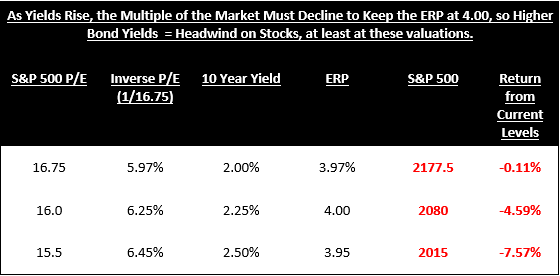
As the 10-year yield rises, multiples must come down to keep the ERP above the 4% floor. As a result, so too must the S&P 500. If the 10-year yield moves back to 2.5% (which is a long way away), then to keep the ERP at the 4% floor the S&P 500 needs to trade with a 15.5X multiple, which at $130 EPS is 2015, or 8% lower from here.
Conclusion #3: An 4% ERP is historically very low, and smacks of “exuberance.” I did some digging, and most people think a reasonable/historical ERP is between 5%-7%. In fact, I only found one instance where it dipped below 4%, and that was early 2008! (the data was off the NYU Stern School of Business website).
Given how active central banks are right now, we can probably dip that number below 5%. But if we get an anticipated macro headwind and we see the ERP move back into the mid 4%, that could result in significant downside for the S&P 500 of anywhere between 8% and 14%, depending on the level of the 10-year yield.
Bottom Line
I realize that following the Equity Risk Premium isn’t a priority for most of today’s advisors, but what is important is making sure that both prospects and clients feel confident you understand markets! And, our subscribers have found that reading our daily report (again, emailed every day at 7 a.m.) helps them stay on top of markets while saving them research time.
That creates more time for meetings and calls, which we all know leads to more AUM.
Finally, it’s well documented that affluent investors are weary of this stock market.
Yes, we all know it’s being inflated by the Fed, but many of us feel that this market now is just another bubble that will pop at some point. So, affluent clients want to know their advisor is constantly watching for signs that the bubble is going to pop, because avoiding another pullback in markets will be the key to outperforming over the next several years. Our subscribers know we are watching that for them, and the Equity Risk Premium is just the latest indicator we’re tracking for signs of trouble.
We’ll continue to watch the ERP and adjust it as yields move, and keep you abreast of any changes that are bullish or (more importantly) bearish. In order for this equation to balance, and keep the ERP at 4%, the P/E of the market must decline—which is negative for stocks.
Make sure you have a daily research document that gives you peace of mind in volatile markets.
We’ll directly tell you (in plain English) what’s truly important in markets and provide consistent tactical idea generation so you can outperform for your clients, regardless of the environment.
I am continuing to extend a special offer to new subscribers of our full, daily report that we call our “2-week grace period.”
If you subscribe to The Sevens Report today, and after the first two weeks you are not completely satisfied, we will refund your first quarterly payment, in full, no questions asked.
Click this link to begin your quarterly subscription today.
Value Add Research That Can Help You Grow Your Business in 2016
Our subscribers have told us how our focus on medium-term, tactical opportunities and risks has helped them outperform for clients and grow their businesses.
We continue to get strong feedback that our report is: Providing value, helping our clients outperform markets, and helping them build their books:
“Thanks for your continued insight; it has saved my clients over $2M USD this year… Keep up the great work!” – Top Producing FA from a National Brokerage Firm.
“Let me know if there is anything else that you need from us. Thanks again for everything. I really enjoy the Report – it is helping me grow my business and stay on top of things.” – Independent FA.
“Great service from a great company!!” – FA from a National Brokerage Firm.
“Great report. You’ve become invaluable to me, thanks for everything…! – FA from a Boutique Investment Management Firm.
Subscriptions start at just $65 per month, billed quarterly, and with the option to cancel any time prior to the beginning of the next quarter, there’s simply no reason why you shouldn’t subscribe to The Sevens Report right now.
Begin your subscription to The Sevens Report right now by clicking this link and being redirected to our secure order form.

Finally, everything in business is a trade-off between capital and returns.
So, if you commit to an annual subscription, you get one month free, a savings of $65. To sign up for an annual subscription simply click here.

Best,
Tom
Tom Essaye
Editor, The Sevens Report
When I think about what’s become of the Fed, it almost makes me sad.
I’m dating myself a bit by saying this, but when I started in this business the Fed was a revered (and sometimes feared) institution.
So, when I saw the market reaction to yesterday’s “hawkish” statement, it made me a little sad, because the market clearly no longer respects the Fed.
And, that makes me nervous.
I say that because while the Fed has successfully engineered massive rallies in both stocks and bonds (and, to a degree, real estate again), at some point things have to begin to return to normal, otherwise we’re going to get another bubble burst.
Yesterday’s price action was scary because it implied the Fed has potentially lost control of the markets, and if that is the case then we are going to see a bubble further inflate and then burst across all asset classes (stocks, bonds, real estate).
Given how fundamentally overvalued stocks and bonds are right now, it’s not unreasonable to think that we could see a 5%, 10% or even 15% decline in both
stocks and bonds (like last August, but worse) if the Fed does lose control and then tries to rein markets back in through a knee-jerk increase in rates.
Is that going to happen next week, or even next month?
No.
The trend in stocks is still higher, and 2200-2240 in the S&P 500 remains a very reasonable near-term target.
But, most of us aren’t investing for the next few weeks or months, we’re investing for quarters and years, and the bottom line is that yesterday’s reaction in stocks might be good in the short term, but beyond that—and unless something changes—we’ve got two unattractive alternatives:
No one knows how it’ll go, but the important thing is to be reading someone who recognizes these risks, and someone who is watching specific assets and leading indicators that will give us warning when this unsustainable situation comes to a head (and importantly, provides tactical guidance on how to protect client portfolios).
Over the coming weeks and months, we’re going to be doing that for our subscribers because our goal at The Sevens Report is to wake up each day and help our subscribers navigate these complex markets, and provide the best value in market analysis out there today.
I created this report because I know that most financial advisors and professionals are not glued to blinking screens from 9:00 – 4:00 each day.
They are discussing the financial goals of their clients and mapping a financial course to reach those goals. Most of their time is spent building and fostering relationships, not analyzing Fed commentary, studying the yield curve, or digging through an oil inventory report.
The most successful advisors use The Sevens Report
to stay ahead of the markets (stocks, bonds, currencies and commodities) and to make sure their clients are positioned to both outperform while also being protected from any financial “storm” that may blow up.
Specifically, we take complex macro-economic concepts (like FOMC Policy, Brexit, Jobs Report, Italian Bank Risk, etc.) and tell you:
1) What you need to know,
2) What will move markets, and
3) What will make those events positive or negative for stocks and other asset classes.
Every morning at 7 a.m. we deliver this information, so you can show your clients you’re on top of the markets with a plan to outperform, regardless of the environment.
Yesterday the Fed produced a “hawkish” statement that undoubtedly was designed to get markets to respect the possibility of a rate hike this year, but the effort failed, and while that likely will fuel incremental upside in stocks, it lays the foundation for a potentially violent pullback down the road if the Fed wants to regain the market’s respect.
As a courtesy, we have included both of those pieces of analysis for you today:
Why Was the Fed Hawkish but the Market Dovish?
In a somewhat shocking turn of events, the dollar declined following the Fed statement yesterday and Treasuries (including the Fed-sensitive 2 year) rose, which is the exact opposite of what should have happened based on the FOMC statement.

The reason for this opposite reaction is clear: the market does not believe the Fed anymore.
An old saying on Wall Street is, “Markets always tell the truth.” And the truth is that after a year of policy whipsaws, conflicting statements and consistent dovish excuses, the Fed has lost all hawkish credibility—and with good reason.
First, we’ve seen this act before. The Fed was hawkish last July, but balked at hiking in September. Then they were hawkish in December and said to expect three-to-four rate hikes. Then the entire month of May, various Fed speakers chastised the markets for being too dovish (yes, we’re talking to you Rosengren), only to have the FOMC produce a very dovish statement in June. So, the logical question is… “Why should we believe them now?”
Second, who cares about one 25 bps rate hike? Whether there is a rate hike in September or December, the market doesn’t believe the Fed will hike rates consistently beyond that one hike, regardless of what happens to economic growth or inflation. And frankly, why should markets expect it? It’s taken the Fed nearly a year to hike another 25 basis points, so why should anyone think that will change next year, especially after the Fed keeps talking “gradual rate increases.”
What will change it? It’s going to take Fed Chair Yellen basically saying she is in support of a rate hike sooner than later to re-establish credibility with the market, because at this point the market simply thinks that while there may be a growing number of hawks on the FOMC, Yellen is not one of them, and it’s her Fed.
Market Outlook: What’s Next
Safety vs. Cyclicals Update. The last two days have certainly caught my attention with regard to whether this rotation out of safety and into cyclicals has finally begun in earnest, but it’s still not enough for me to settle on the idea that it has.
There have been many false starts in this rotation over the past few years, and if the market is really skeptical about the Fed hiking rates near term, then defensive sectors are still attractive beyond the very short term.
So, we are not materially reducing our medium- and longer-term holdings of defensive sectors and won’t until we see a material breakout higher in the 10-year Treasury yield (paid subscribers know the levels we are watching).
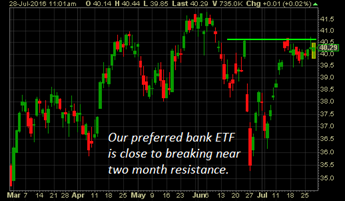
However, we are thankful we bought a specific bank ETF as a near-term hedge against safety sector underperformance. Since we bought our specific bank ETF two weeks ago, it’s risen 2%,
and we will likely add to it over the next few days if it can make a fresh closing higher above $40.57. This sub-sector of the banks remains one of the few areas of historical value in the markets.
Next Key Event to Watch:
The Jackson Hole Fed conference, which takes place in late August, has now become pretty important.
If Yellen is going to try and regain the market’s respect or prep investors for a potential rate hike in September or December, she will likely do it at her speech at that conference.
So, that’s a day to pencil in for a potential disruption to this rally, and we’ll be watching the Fed speak closely over the next month to discern any hints about what Yellen will say, because if she forecasts a rate hike, this market rally is going to reverse in a hurry.
Bottom line, the stakes in this market game of musical chairs keep rising, and the Fed is the one controlling the music, so it’s critical you’ve got an analyst working for you who is focused on helping you navigate the remainder of the year, regardless of what the Fed does with policy!
Our paid subscribers had this analysis at 7 a.m. this morning, so when their clients called today and asked, “What did they Fed mean for my portfolio?” they could answer quickly, directly, and confidently.
That’s how advisors use The Sevens Report
to strengthen relationships and close prospects.
If your broker or subscription research isn’t providing you this type of analysis on a daily basis and helping you build your business by saving you research time, increasing your knowledge about markets and giving investment ideas that can impress prospects and help client outperform, then please consider a quarterly subscription to The Sevens Report.
At just $65/month (billed quarterly) with no penalty to cancel, we are very confident we offer the best value in the subscription research space.
I am continuing to extend a special offer to new subscribers of our full, daily report that we call our “2-week grace period.”
If you subscribe to The Sevens Report
today, and after the first two weeks you are not completely satisfied, we will refund your first quarterly payment, in full, no questions asked.
Click this link to begin your quarterly subscription today.
Make More Money, Save Time, Have More Knowledge
Our job is to provide you the timely, need-to-know, critical information that will demonstrate to your clients:
1) That you are on top of the markets, and
2) That you are in control of their financial situation.
Actual subscribers to The Sevens Report have told me that discussing the information contained in the Report with prospective clients has helped them land accounts as big as $25 Million!
To be certain, 2015 was a
volatile year, and things have gotten worse so far in 2016. Subscribe today and give yourself the market intelligence you need to help strengthen relationships with your current clients, and acquire new ones.
Subscriptions start at just $65 per month, billed quarterly, and with the option to cancel any time prior to the beginning of the next quarter, so there’s simply no reason why you shouldn’t subscribe to The Sevens Report right now.
If you want to make your business more successful, you have to possess unshakeable confidence in your knowledge, and helping you acquire that knowledge is what The Sevens Report is all about. Begin your subscription to The
Sevens Report right now by simply clicking the button below:

Finally, everything in business is a trade-off between capital and returns.
So, if you commit to an annual subscription, you get one month free, a savings of $65 dollars. To sign up for an annual subscription, simply click here.

Best,
Tom
Tom Essaye,
Editor, The Sevens Report