Chart of the Day: Surge in the 10 Year Yield
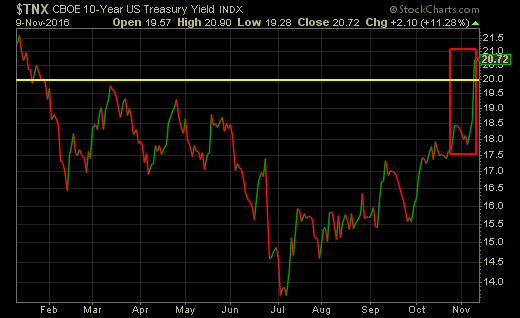
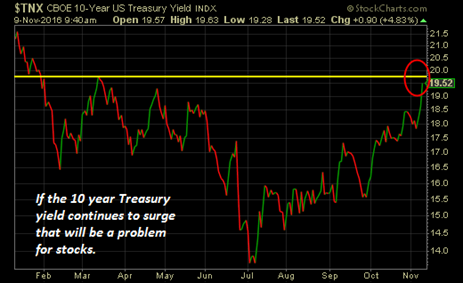
The 10 year yield surged back above 2% for the first time since late January yesterday. Stocks were able to withstand the rise given hopes for more growth, but the pace of the rise must slow down.



The 10 year yield surged back above 2% for the first time since late January yesterday. Stocks were able to withstand the rise given hopes for more growth, but the pace of the rise must slow down.
Stocks saw their biggest drop since Brexit early this morning while currency and bond markets made historic moves overnight, and I have no doubt that clients are calling you asking:
“What do we do?”
I basically didn’t sleep last night making sure we could help our subscribers answer that question when clients called today.
So, in today’s paid edition of The Sevens Report (which was delivered shortly after 7 a.m.), we explained:
1. Whether the Trump victory is a “Lehman Moment” that requires massive de-risking across asset classes (We do not think so at this point).
2. What key index and level we are watching to tell us when this might become a potential “Lehman moment” and require much more defensive positioning.
3. What we would consider buying TODAY amid the volatility.
4. What specific level we would consider buying this dip in stocks based on valuations (it’s lower than current levels).
I never like to see markets down like this, but I am happy that our “Election Preview” detailed, specifically, what would happen if we got a surprise Trump victory, and so far, much of our preview has been spot on.
So, despite the hysteria in the financial media today, our subscribers were not blindsided by that result and I’m sure that’s helping them today in conversations with their clients.
Going forward, everyone wants to know how this will affect markets and the amount of uncertainty regarding a Trump administration will be significant.
We will cut through that noise for our subscribers and deliver the information they need to successfully navigate this environment.
While the financial media (both TV and online) is going to be hysterical for the next few days about the impacts of this historic vote, there are three key issues we need to watch to tell us what to do from an allocation standpoint:
• Does the uncertainty of a Trump victory paralyze the markets for the rest of 2016?
• Will the Fed delay a rate hike due to stock market turmoil?
• Will the selloff in Treasuries accelerate and send the 10 year yield to and through 2%?
If the answers to all three of these questions are “No,” then the market impact of this will be temporary -and we will be watching each of these issues for our subscribers and will alert them to any changes.
That’s how we will help them cut through the noise and navigate this market.
Mornings like today are why I created The Sevens Report, so that our subscribers can turn market volatility into an opportunity to demonstrate their value to their clients, and in doing so increase AUM via more allocations and more referrals.
While some advisors are avoiding client calls or searching for something to tell nervous clients, our subscribers know what is driving the markets and are using this as an opportunity to show their clients they are in control of the situation.
The most important thing for financial advisors to do in this volatile
environment is to show clients that they:
• Know what is going on in markets,
• Are in control of client portfolios, and
• Know what to expect next.
Because if you don’t, you will lose those clients to someone who does.
Today will be a difficult day in the markets and we want to make sure people have a clear understanding of what’s actually driving markets and what the key catalysts are going forward. We’ve included an excerpt of our post-election research as a courtesy below. We hope it makes your day a bit easier.
What the Election Means for Markets: Sevens Key Takeaways.
The events of last night largely met our “Ugly” scenario, and as such we saw a “Brexit-style” reaction as markets traded sharply lower overnight, although notably they are well off those lows this morning.
From an analysis stand point I want to focus on immediate takeaways and trying to answer questions you may have (or questions you may get from your clients regarding this event):
Takeaway 1: The Trump victory is not a bearish game changer for markets, at least not yet. From a macro standpoint, we are seeing that “sell first/ask questions later” reaction from markets that we predicted. But, despite the reaction we do not view the Trump victory as a material, bearish gamechanger and we are not reducing medium/longer term allocations to stocks on the news or market reaction.
I say that for one main reason: Beyond the short term, with total control of government, Trump will be able to enact potential pro-growth policies and the new US government will be business friendly, which longer term is a positive.
Takeaway 2: Does the Trump win imperil a yearend rally in stocks? Yes. To put it lightly, a lot of policy uncertainty needs to be clarified over the coming months. So, from a practical standpoint, that uncertainty means a material year-end rally is unlikely. While some analysts are calling for a Brexit-style bounce following this initial selling, as the market digests Trumps pro-growth policies, we do not see that happening this year (i.e. the remainder of 2016) as there are simply too many unknowns about his policies and the makeup of his administration.
From a broad level, until the market knows more, stocks will have a very hard time rallying materially.
Takeaway 3: The Fed may not hike rates in December. Treasuries are down sharply this morning but the longer-term decline in bonds has potentially stalled for 2016, as we don’t know whether the Fed will hike rates in December given this political upset and market fallout. We are not adding to inverse bond positions although longer term the trends of inflation and growth should continue to push yields higher.
Takeaway 4: Gold is a clear winner, and will likely rally until there is more clarity on Trump’s policies, and that’s one of the clear winners of this outcome.
Takeaway 5: Make Sure You Have a Tactical Hedge in Case this Market Rolls Over. Restricted for Subscribers.
Takeaway 6: Sector Winners and Losers:
Restricted for subscribers.
Takeaway 7: Which Two Sector ETFs We Are Buying Today. Restricted for Subscribers.
Takeaway 8: What Makes This A Bearish Game Changer.
Restricted for Subscribers.
Having daily, accurate, up to date information on the key leading indicators for this market will be the only way to successfully navigate this environment, and that is what we are going to do for our paid subscribers.
If you are not confident that your brokerage supplied research or subscription research will help you successfully navigate his environment, then please consider a subscription to The Sevens Report. We will make sure our paid subscribers have the independent and timely analysis they need to turn the coming volatility into an opportunity to strengthen client relationships and grow their businesses!
Given the market volatility, we are extending a limited time, special offer to new subscribers of our full, daily report that we call our “2-week grace period.”
If you subscribe to The 7:00’s Report today, and after the first two weeks you are not completely satisfied, we will refund your first quarterly payment, in full, no questions asked.
Increased Market Volatility Will Be an Opportunity for the Informed Advisor and Investor
We aren’t market bears, but we said consistently that things were going to be volatile in 2016 and we were right!
As we enter this critical stretch into year end, the advisor who can confidently and directly tell their nervous clients what’s happening with the markets and why stocks are up or down, and what the outlook is beyond the near term (without having to call them back) will be able to retain more clients and close more prospects.
We view volatility as a prime opportunity to help our paying subscribers grow their books of business and outperform markets by making sure that every trading day they know:
1) What’s driving markets
2) What it means for all asset classes, and
3) What to do with client portfolios
We monitor just about every market on the globe, break down complex topics, tell you what you need to know, and give you ETFs and single stocks that can both outperform the market and protect client portfolios.
All for $65/month with no long term commitment.
I’m not pointing this out because I’m implying we get everything right.
But we have gotten the market right so far in 2016 and it has helped our subscribers outperform their competition and strengthen their relationships with their clients.
That’s our job. Each and every trading day.
And, we are good at it.
We watch all asset classes to generate clues and insight into the near-term direction of the markets, but our most important job is to remain vigilant to the next decline.
While we spend a lot of time trying to identify what’s really driving markets so our clients can be properly positioned, we also spend a lot of time identifying tactical, macro based, fundamental opportunities that can help our clients outperform.
If you want research that comes with no long term commitment, yet provides independent, value added, plain English analysis of complex macro topics, click the button below to begin your subscription today.

Finally, everything in business is a trade-off between capital and returns.
So, if you commit to an annual subscription, you get one month free, a savings of $65 dollars. To sign up for an annual subscription, simply click here.
Best,
Tom
Tom Essaye,
Editor of The Sevens Report
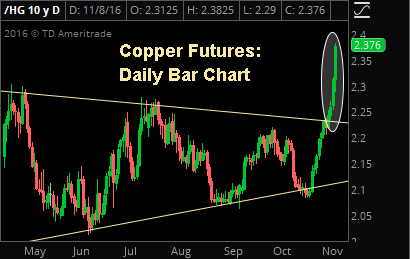
After threatening to break down just a few weeks ago, Copper futures have surged in recent sessions, breaking out through key resistance near $2.30 to trade to a 1-year high yesterday.
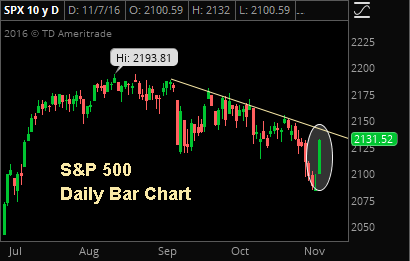
The S&P 500 rallied more than 2% yesterday, reclaiming all of last week’s losses as traders positioned ahead of the US Presidential election. But, the near-term trend remains a bearish one in the broad index.
It was a generally quiet day in the currency and bond markets as the various cross currents (election, M&A, economic data, etc.) all largely cancelled each other out. The Dollar Index closed little changed after spending most of the day modestly stronger.
The euro was modestly weak for most of trading Monday (down 0.30% at the low) thanks to a slightly soft October core HICP (their CPI). Year over year, core HICP rose just 0.7% vs. (E) 0.8%, and with inflation still sluggish the idea that the ECB will materially reduce its QE program remains an outlier. The risk to markets is that they underwhelm with their extension (i.e. taper and extend, as opposed to extending the current 80 billion monthly purchases).
It is just one indicator, and growth has appeared better in October, so it wasn’t a materially dovish influence and the euro rallied yesterday afternoon to finish with mild losses. Going forward, The Sevens Report continues to expect the euro to chop largely sideways near 1.10 vs. the dollar until we have more color on the ECB’s plans for its QE program.
Looking elsewhere in the currency markets it was quiet. The yen, Aussie and loonie were all little changed (the loonie held up well despite the plunge in oil, down just 0.20%).
It was equally quiet in bonds as Treasuries rallied small (the 10-year yield rose 1 basis point while the 30-year Treasury rose 0.33%). Part of that was buying following the soft EMU HICP (remember, deflation in Europe sends money into higher-yielding US Treasuries) and some of that rally was just general election angst given the October email surprise.
Going forward, the FOMC, BOE and jobs report are the next significant catalysts for the bond market, so I’d expect generally quiet trade into those events starting Wednesday.
Bottom line, if those events are hawkish and the 10-year yield moves up through 1.90% and towards 2% (remember the 10-year yield rose 11 basis points last week, so it could theoretically get close to 2%) that will be a headwind on stocks.
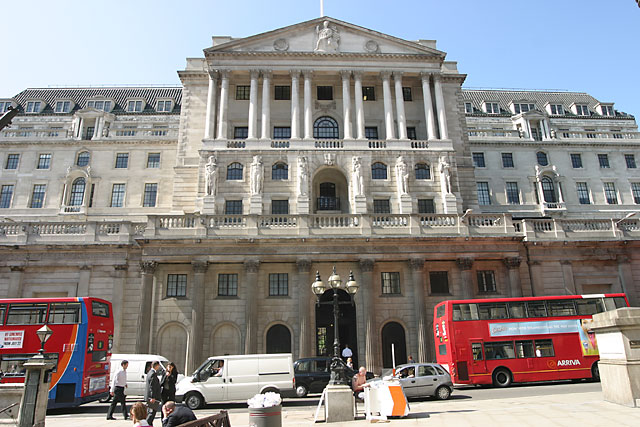
The Bank of England meeting is the most important Central Bank meeting this week.
Much of the media focus is on the Fed meeting this week, but actually the central bank meeting with the greatest potential market impact is the Bank of England meeting on Thursday.
The reason is well known. US Treasury yields continue to follow global yields (remember, Bund and GILT yields rose more than Treasury yields last week), and if BOE Governor Carney disappoints markets on Thursday we’ll see GILT yields move higher, and that will drag Treasury yields higher and become a headwind on stocks.
The risk into Thursday’s meeting is that Carney backs away from his promise for more stimulus this year because of the near-20%, post-Brexit collapse in the British pound, which is causing an uptick in inflation pressures across Britain.
Now, to be clear, he’s not expected to dial back his support for more stimulus, but it is possible, and that’s a risk to stocks as markets have priced in another move by the BOE (in December).
So, while the media likely won’t cover it nearly as much as a likely anti-climatic Fed or jobs report, this BOE announcement actually has the biggest potential to surprise markets this week. Stay tuned.
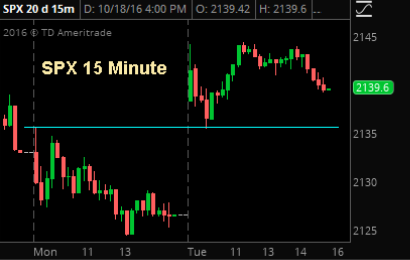
Stocks sold off several points in the opening hour of trade yesterday in what turned out to be a classic “gap fill” between yesterday’s open and Monday’s morning high.
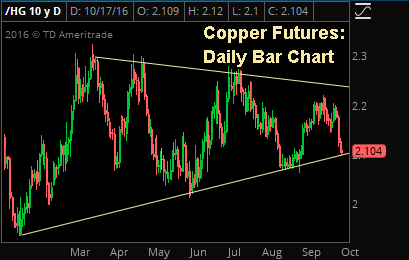
Copper tested and held a multi-month uptrend support line yesterday, but if that level near $2.10 is materially violated it could be forecasting a further slowdown in an already very sluggish global growth rate.
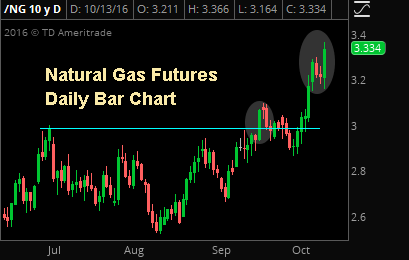
Since we recommended getting long natural gas on September 21st, futures have rallied more than 17% trough-to-peak and we believe there is still more room to run to the upside in both the near and longer terms.
Another episode with Tom Essaye and Adam Johnson on Market’s Bell discussing: Election Investing, Stock Market Sweet Spot & Bonds Italian Style.
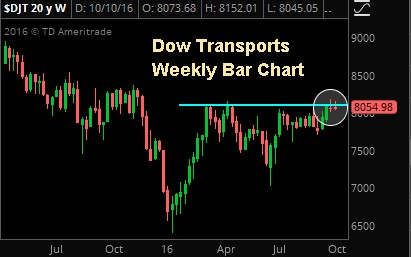
Dow Theory has been bearish since July of 2015 however, the Transports are threatening to confirm a bullish signal in the DJIA from earlier in the year which would shift the historically accurate indicator back in favor of the bulls.