Australian Dollar Continues Lower

Most currencies were driven by economic data yesterday. The Dollar Index drifted slightly higher off the decent June ISM manufacturing PMI (up +0.06%) while the euro was slightly weaker (down -0.12%) after mixed manufacturing PMIs (they generally met expectations but the euro has seen a big rally lately).

The Aussie was the best performer vs. the dollar, rising +0.8%, breaking decisively through resistance at $0.94 and hitting a new high for the year.  The strength in the Aussie was due to short-covering as the currency rallied through $0.94 (which had been the high for the year) thanks to the improvement in Chinese PMIs and the lack of any dovish comments from the RBA during their rate meeting yesterday.

Markets were looking for the RBA to make some mention of the recent strength in the Aussie and attempt to “talk it down” as they did last year, but that didn’t happen.  It’s especially surprising given the fact that some bulk commodity prices (specifically iron ore) have collapsed 30% since April while the Aussie has rallied, causing a “double whammy” on the mining sector that continues to threaten the economy.  But, the RBA refrained from any Aussie-related commentary and instead said they continue to expect a “period of stability” in interest rates (meaning no more cuts).

Given the divergence in the Aussie vs. key commodity prices (high vs. low), a stabilizing but not accelerating Chinese economy, and the RBA’s reluctance to ease further, the picture isn’t very optimistic for the Aussie economy. Fundamentally, things are still bearish for the Aussie.  But, clearly the trend is higher for now, and next resistance is $0.9518.  And, until the RBA says something about the elevated Aussie, then this counter-trend rally will continue.

The pound continued its grind higher, hitting another multi-year high after the Great Britain June PMI beat estimates (57.5) Tuesday, and the trend remains clearly higher. (As long as the Fed is dovish and the UK economy continues to surge, the pound will continue to rally vs. the dollar.  We’ve not seen the highs yet in this trade, I believe.)

The yen weakened a bit vs. the dollar yesterday (down -0.25%), but it bounced off the intraday lows and dollar/yen remains below the 200-day moving average – and it needs to get back above that support level today or tomorrow; otherwise the outlook for the yen will continue to get stronger.

Economic data lately out of Japan has been a bit tepid, and given the lack of specifics from Shinzo Abe’s “3rd Arrow,” it appears the market is starting to lose some confidence in the PM (that’s why the yen is rallying – it’s not because of economics per se).  The Bank of Japan remains in the corner of the yen bears, and I believe they will act if the economy begins to falter – but that could be at a much lower level for dollar/yen.

Again this has been a trade that has worked for over 18 months, so I’m hesitant to abandon it now, but the dollar/yen needs to get back above the 200-day sooner than later.

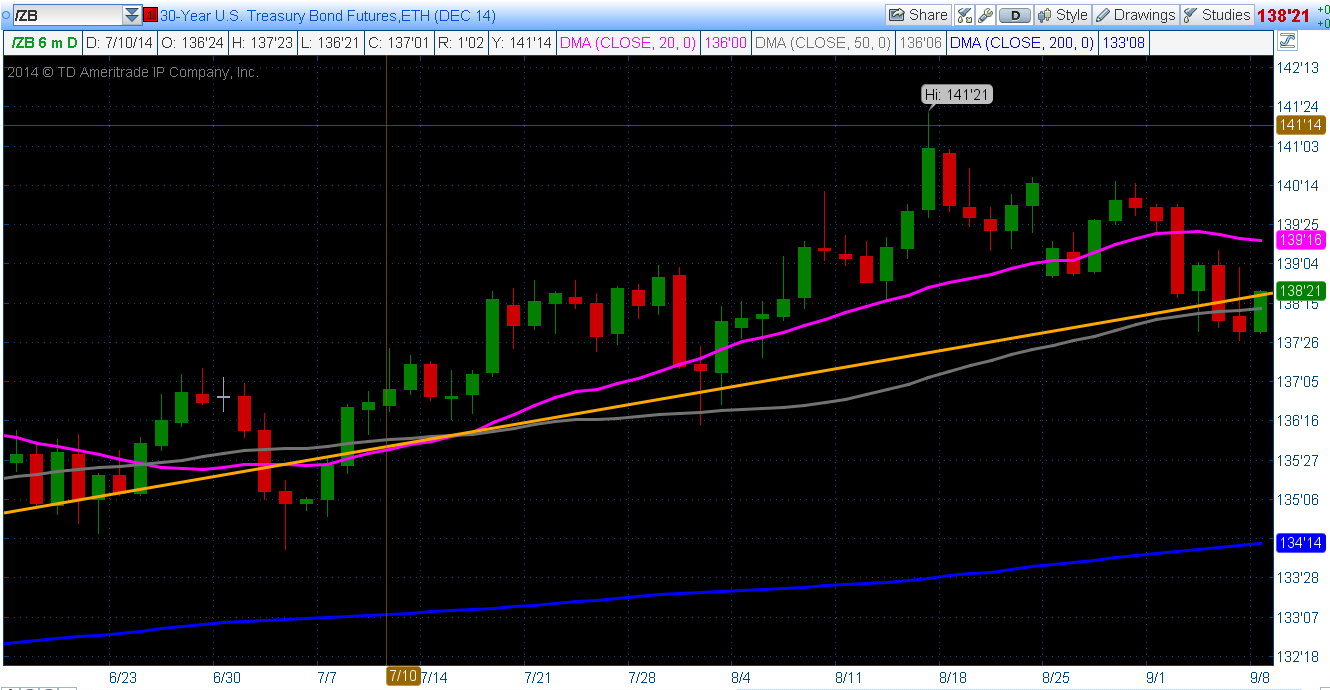
Bonds were sharply weaker yesterday as the 30-year fell -0.65%, trading lower off of the global PMIs. This largely implied the global economic recovery is progressing (there was also a cautious article on junk bonds and credit spreads in the WSJ, although that didn’t really tell us anything new).

Bonds were weaker all day yesterday (the selling began overnight Tuesday once the Chinese PMIs hit), and the declines accelerated after the strong auto sales and ISM manufacturing PMI.  The yield curve steepened yesterday as the “belly” of the curve declined only modestly (down -0.27%), helped by the Fed purchasing $2.9 billion worth of 7-year bonds.

Bonds gave back a lot of last week’s rally yesterday, but still remain firmly in a solid uptrend until the 30-year breaks 135’18-ish, the uptrend will continue.


Update on the Conflict in Iraq

Iraq Update

Iraq has deteriorated a bit this week and the inability of the Iraqi Parliament to choose a new PM weighed a bit on stocks late yesterday.  Before reading the particulars, keep in mind there are two negative scenarios in Iraq for the markets.  The first is that ISIS gets south of Baghdad and gains control of major oil export terminals in Basra in southern Iraq.  That would send oil materially higher.  The second is this Iraq conflict sparks a Sunni/Shiite civil was that spreads across the Middle East and pulls in Iran, Saudi Arabia, etc.  Obviously, that would send oil  higher.  Given the events of the last few days, the worry is for the later and the moment more so than the former, as ISIS remains well north of Baghdad.

Now, the reason things have deteriorated a bit this week are two fold.  First, ISIS (which is comprised of Sunni Muslims) attached a Shite shrine in Samarra earlier this week.  The last time that happened was ’06, and it sparked a nasty mini-civil war in Iraq.

Second (and more importantly) it was expected that the Iraqi parliament would pick a new Shiite Prime Minister to replace current PM Nouri al-Maliki, who is accused of largely ignoring Sunnis.  It was hoped that a new PM would be viewed as more inclusive, and ISIS would lose support among regular Iraqi Sunnis.

But, as Baghdad dithers, Iraq burns.  And, while militarily it seems a bit of a stalemate at the moment, any real solution will only come from a more inclusive government that saps ISIS’s ability to rally regular Sunnis.  Then the government can beat them back militarily.  But, the longer that doesn’t happen, the more support ISIS can gather among regular Sunnis, increasing the probability of a broader civil war.

Oil is down this morning so clearly the market isn’t worried about this yet.  But, the situation has gotten a bit and I wanted to make you aware.  A major positive in this scenario remains the appointment of a new Iraqi PM, while oil (specifically Brent Crude) remains the indicator to watch as to whether things are materially getting worse.


Your Weekly Economic Cheat Sheet – 6.30.2014

Last Week

There were three important economic takeaways last week:  First, housing appears to be finally bouncing from its winter dip.  Second, capital spending (businesses buying a new machine or some other high-cost investment) continues to not rebound like the rest of the economy has since the winter.  Third, inflation has clearly accelerated over the past three months, but economic growth doesn’t appear to be keeping pace with the recent acceleration in inflation.

Of the three, the final point is by far the most important. While it’s very early yet, if the economy can’t keep pace with accelerating inflation, then we risk stagflation, which is bad for most assets (bonds and stocks).  We aren’t anywhere close to stagflation, but after the data last week, it’s something we need to keep an eye on.

Looking at the actual data, the Personal Income and Outlays report was the most important release last week, and the main cause of the “stagflation” worries.  Core PCE, the Fed’s preferred measure of inflation, rose +0.2% in May and is now up +1.5% year-over-year (yoy), and that met expectations.  More importantly, though, Core PCE has gone from rising +1.1% yoy in February to +1.5% in May. If we annualize the last three months’ gains, we get an annual core PCE increase of +2.1%, basically at the Fed’s target.  This recent acceleration confirms what we’re seen recently in CPI.

At the same time, though, while the economy is continuing to recover, it’s not matching the gains in inflation over the past three months.  Case in point: May consumer spending slightly missed expectations, increasing +0.2% vs. (E) +0.4%, and real consumer spending (consumer spending less inflation) was actually negative in April and May.  So, the key here isn’t that the economic recovery has stalled—it has not.  But, over the last few months, the economy hasn’t grown as quickly as inflation has.

Capital spending, however, still isn’t seeing the rebound in activity that other sectors of the economy have enjoyed since April.  The May Durable Goods report headline declined, but the real number to watch (Non-Defense Capital Goods Excluding Aircraft) rose +0.7% and the three-month rolling average showed a +1.5% gain.  But, while it’s a positive number, it’s not strong growth.

With housing now showing clear signs of a rebound, capital spending (again, think investment by businesses in machines, etc.) is the one sector of the economy that still hasn’t gotten a bounce. This probably reflects continued caution by businesses on the future of the economy (i.e., things are getting better, but not enough to make large investments because people aren’t confident in revenue visibility).

Bottom line with last week: Nothing resulted in a material change in the outlook for the economy or Fed policy. But the recent acceleration in inflation/less than impressive consumer spending report (and extrapolating it out to potential stagflation) bears watching.

This Week

It is going to be a busy holiday-shortened week (the market closes at 1 p.m. EST Thursday and Friday is off).

Probably the most important number of the week has already been released, and it was the European flash HICP for June (their CPI).  The annual inflation rate ticked slightly higher to 0.8% vs. 0.7% in May (meeting expectations) so that’s slightly encouraging, but overall the deflation threat in Europe remains and this will keep the ECB fully “engaged” in the deflation fight.

Turning back to the future data, it’s “jobs week” this week, although be aware the May jobs report will be released Thursday at 8:30, at the same time as weekly claims.  Prior to that we get ADP on Wednesday.  The jobs report isn’t as critical as it has been in recent months, but it still is important.  In the context of our “stagflation” point earlier, markets will be watching for jobs growth in line with recent reports (so around 200K). If there is an increase in wages and hours worked, this will imply tightening in the labor market (which is both inflationary and positive for consumer spending).

Tomorrow we get global official June manufacturing PMIs, which should continue to confirm the consensus that: The pace of economic growth in China has stabilized, Europe’s economy continues to slowly recover, and the manufacturing sector of the U.S. economy is seeing the recovery accelerate.

The biggest risk of disappointment in this report is in Europe, as France’s flash PMI was pretty bad (47.8) while the overall EMU was stagnant.

Finally, as if all that wasn’t enough, Fed Chair Janet Yellen speaks Wednesday (we can expect similarly “Dovish” remarks like the last FOMC meeting) and there is an ECB meeting.  But, after their attempt to “shock and awe” the market last month, this meeting should be a non-event.


Sevens Report Analyst Tyler Richey Featured on the WSJ’s MarketWatch.com Discussing Crude Oil Prices

Oil holds above $106 on demand prospects

7:00’s Report Editor Tom Essaye Discusses Gold Miners on Fox Business 6.23.14

Tom Essaye discusses the outlook for the broad market and the potential for a continued rally in gold mining stocks on FBN’s Varney & Co. with Stuart Varney.

http://video.foxbusiness.com/v/3637800558001/time-to-buy-gold-miners/#sp=show-clips

Your Weekly Economic Cheat Sheet-6.23.2014

Economic data last week were universally better than expected and further implied that the pace of economic growth domestically is accelerating to the best levels since the crisis (referred to as “escape velocity,” or greater than 3% GDP growth).  Additionally, we got more signs that inflation is indeed bottoming, via the CPI.

Despite that, the Fed was “dovish” at the FOMC meeting, which helped push stocks to new all-time highs.  Interestingly, though, we saw some early signs that the market is starting to view the Fed as potentially very slightly “behind the curve” from an inflation standpoint. Meaning, the Fed is remaining incredibly “easy” despite clear signs growth is accelerating and inflation is bottoming. (That’s why bonds couldn’t rally despite the dovish Fed.)

So, the most important thing that happened economically last week was a very slight change in the market’s perception of the Fed.

Starting first with the Fed decision, it was in-line with most analysts’ expectations. However, there definitely was an expectation from some of the market that the Fed would at least hint that it’s starting to consider the normalization of policy. This hint would come via increases in Fed presidents’ projections for the expected Fed Funds rate over the coming years, and decreased unemployment rate forecasts.

That did not happen, however, as the average Fed Funds rate projection by Fed presidents for ’15 and ’16 was increased only slightly, to 1.2% for ’15 and 2.5% for ’16 – so, not enough of an increase over the March estimates to be considered “hawkish.”

Likewise, the expected unemployment rate was reduced only slightly to 6.0%-6.1% for ’14, and 5.4%-5.7% for ’15, but not enough to be considered “hawkish.”

So, the FOMC wasn’t “dovish” because of what the Fed did, but instead because of what it didn’t do.  Still skeptical of the economic recovery, the Fed seems content to ignore the uptick in growth and bottoming of inflation … and the market noticed.

Turning to the actual hard data, all three manufacturing reports further confirmed that the manufacturing sector is recovering:  May industrial production rose 0.6%, meeting estimates.  April’s declines were revised higher.  The first data points from June (Empire State manufacturing survey and Philly Fed manufacturing survey) rose to a 4-year high and 8-month high, respectively.  The New Orders components of each survey, which are leading indicators, surged higher as well.

So, the data continue to imply we’re seeing a strong rebound in the manufacturing sector after the winter dip and inventory depletion.

Finally, the most important piece of data last week was  the May CPI report, which increased +0.4% on the headline and +0.3% for “core” CPI, which is the largest monthly increase since ‘09.  To underscore the point that statistical measures of inflation are starting to move higher, looking at the last three months’ increases in CPI and annualizing them gets us to 2.8% yoy. So, while it can’t be taken as a true indication of inflation trends, it does show how we’ve seen an uptick in the rate of inflation recently.

This Week

Given the increased focus on inflation, the Personal Income and Outlays report this Friday will be the most-important data point this week.  That’s because the Fed’s preferred measure of inflation (Core PCE Price Index) will be released within that report. If we see a decent uptick in that price index, the idea that the Fed is “behind the curve” from an inflation standpoint will gain more traction (which will be positive for gold, and negative for bonds).

Beyond that, the global flash manufacturing PMIs for June hit earlier this morning and we get the U.S. reading later today. This and the Core PCE Price Index are the two most-important numbers to watch this week.

We also get some incremental insight into the economy, as May Durable Goods comes Wednesday, as does the final look at Q1 GDP (which is going to stay shockingly negative, but the market’s moved beyond it at this point).

Finally, we also get more insight into the state of the housing recovery via existing home sales (this morning) and new home sales (tomorrow).  Housing remains the one sector of the economy that hasn’t enjoyed a “bounce” off the winter dip. However, over the last month, the housing metrics have implied that may be changing.

Last week, new home sales was a headline miss but the details were “OK” as single-family permits rose nicely. If May existing and new home sales show continued signs of improvement, worries about the pace of the housing recovery will further recede. This will be a positive for the economy generally and the market.


Iraq and Rising Oil Prices

Headlines can be very powerful drivers of markets, and when the headlines involve the Middle East, war and oil supplies, you can bet the whole world gets a justified case of the jitters.

So, it should come as no surprise that the action in the commodities pits last week was a broad rally, as both gold and particularly oil prices moved sharply higher on news of the violence in Iraq. The commodity ETF DBC rallied 1.3% last week.

Given that Iraq was the main driver of commodity markets last week, it’s not surprising that oil was the best performer, as WTI and Brent crude both rallied over 4% on the news that terrorist group ISIL has seized most of the northern portion of the country (which has a lot of untapped oil reserves), and more importantly were moving south towards Baghdad (and towards the oil producing region in southern Iraq).

Oil prices were essentially flat in Monday trade, as over the weekend ISIL began to encounter resistance from Iraqi forces. Moreover, the international community now is working toward halting the group’s advance. Still, the recent action in oil via the United States Oil (USO) fund has showed a clear move higher. In fact, USO is up more than 4% since news of the ISIL violence flared up and grabbed global attention.

Yet it behooves us to see through the headlines here and keep this in mind: If ISIL gets south of Baghdad, this situation becomes materially worse and oil will rally. For now, however, the current state of affairs is largely priced into crude, which is at the highs for the year. Still, if you are looking to trade this situation (a risky but potentially profitable move), then I’d look to buy any dips in USO, or in related crude oil futures contracts.

Your Weekly Economic Cheat Sheet – 6.16.2014

Last Week

Last week ended up being a potentially very important week, but not because of the actual data, which slightly disappointed in the U.S. and came in generally in-line in China (further implying the pace of growth is stabilizing).

The most important event of the week came Friday morning, when Bank of England Governor Marc Carney surprised markets by hinting the BOE could raise rates this year, which is sooner than the market expectation (Q1 2015).  That surprise comment sent the pound nearly 1% higher vs. the dollar and the FTSE down more than 1%.

Carney’s comments matter especially in the context of the Fed meeting this Wednesday.  I’m going to flush this out more in the preview of the FOMC, but if there’s one thing the market seems too “complacent” on, it’s that global central banks are going to keep policy static for quarters to come.

Point being, the stock market has not priced in the Fed suddenly upping the time frame of rate increases or an acceleration of tapering.  If the broader market is as surprised as London was by Carney, and the prospects of a rate increase become more real, that will be a negative on the market.  It’s early yet and Carney just “hinted” at rate increases, but it underscores the point that markets are very complacent about the expectation for monetary policy in the UK and U.S., and that is a source of risk we need to monitor.

Turning now to the actual data, there were only two releases worth covering in the U.S.:  weekly claims and May retail sales, and both were slight misses.

Claims ticked higher to 317K, while retail sales increased in May by 0.3% vs. (E) 0.6%, while the “control” group, which is the best gauge of consumer spending, was flat in May (which reflects an uninspired consumer).  While slightly disappointing, though, the data didn’t change the outlook for the economy going forward (GDP estimates for Q2 remain around 3%).

Finally, China was in focus last week as CPI, PPI, Money Supply, Industrial Production and Retail Sales were released.  All the reports were basically in-line with expectations, which further confirms the pace of economic growth in China is stabilizing and implies the chances of a Chinese “hard landing” continue to get smaller (so, point being, China isn’t a threat to the global rally).

This Week

It gets a bit busier this week from an economics standpoint, with the highlight clearly being the FOMC meeting Wednesday.

First, it’s a meeting with staff projections and a Yellen press conference.  That’s important, because as we saw in March, there is the chance for a “hawkish” surprise in Fed officials’ expectations for the economy, and from Ms. Yellen herself (i.e., the “6 months” comment during the March press conference).  Additionally, given the Carney comments last week, markets will be nervous about anything that might be incrementally more “hawkish” than consensus expectations.

Again, the thing the market seems most-complacent with right now is the outlook for Fed policy, so that’s an area we need to continue to follow, as surprises usually come from things with the most complacency.

Away from the Fed, we get our first look at June economic data via the Empire State Manufacturing Index (this morning), and Philly Fed Index on Thursday.  While neither moves markets the way they used to (given the “flash” PMIs, which will be released a week from today), Empire State and Philly still are important in the context of a market that needs constant re-affirmation that the economic recovery is accelerating.

Also this week we get the first piece of May housing data via Housing Starts on Wednesday.  The April data implied we may finally be seeing a “bounce” in housing like we’ve seen in other sectors of the economy after the winter weakness, so data that further confirm this will be welcomed by the market.

Bottom line is this week will be Fed-dominated, especially in light of the Carney comments.  But, the rest of the week’s data also matter, because the market does need constant proof that the economic recovery in the U.S. is continuing to slowly gain momentum. Multiple pieces of evidence to the contrary will act as a headwind.


Sevens Report Analyst Tyler Richey Featured on the WSJ’s ‘Market Watch’ Discussing Gold

Gold Settles with a Gain as Data, News Flows Slow

Gold Holds Above $1250 for Third Straight Session


Sevens Report Analyst Tyler Richey featured on the WSJ’s Market Watch Discussing the Market Forces in Energy Futures

Link to article here.