Why You Need to Care More About the ECB Than You Probably Do.

Why You Need to Care More About the ECB Than You Probably Do.

I realize not everyone will have read this by the time the ECB makes its policy announcement (in 45 minutes) or when Draghi holds his press conference (in 90 minutes), but I want to include this analysis because simply put, Europe is really important right now.

Europe is by far the weakest major developed economy in the world, and it’s teetering on the brink of a triple-dip recession, if not worse.  And, seeing as a “global recovery” is one of my 4 pillars of the stock market rally, if the EU slips back into recession, that will be a headwind globally.

So, understanding what’s happening with the EU economy and what the ECB is doing is very important.  It is equally important as understanding what Fed policy was during the past three years here in the U.S. – because like the US economy with the Fed back then, the EU economy is now totally dependent on the ECB to provide stimulus.  This is all about the ECB.

Before going into what’s expected from the ECB today and the implications on policy, it’s important to make sure we correctly understand the setup …

First, the major threat to the EU is deflation.  That threat has resulted in European bonds surging to record levels, and a rise in the expectation that the ECB will eventually do QE—just as the BOE and Fed did when faced with a deflation threat in ‘11/’12.

Second, think of EU (especially German) interest rates as an inverse indicator of deflation.  So, the lower the yields go, the higher the market expectation the EU will actually find itself in deflation (and German yields are just off record lows).

Third, unlike the Fed when it did QE, the ECB’s goal isn’t to lower interest rates.  Interest rates in the EU are already too low.  For the ECB to start winning this economic fight, interest rates need to start rising. That will reflect increasing inflation expectations and an uptick in the demand for money (which means increased economic activity).

Fourth, if the ECB does not ease policy materially this morning (i.e. is hawkish), you will see EU interest rates go down, as the expectation of a deflationary crisis in the EU grows and investors rush for cover.  Conversely, if the EU shocks the world and actually announces QE, rates likely won’t decline by all that much in Europe, as that will ultimately be inflationary.  Those two reactions are the opposite of what should  happen normally, but again this is about deflation expectations, not about the level of interest rates.

With that in mind, let’s turn to ECB expectations:

Consensus:  No changes to policy. Draghi talks “dovish,” threatens QE, but basically plans to wait and see if the plans announced in June (TLTROs/ABS purchases) can help jumpstart the economy.  Market Reaction:  European bonds and the euro will rally (which is bad) and European stocks will likely fall.

“Slightly Dovish”:  Draghi announces some tweaks to the existing TLTRO program by reducing the fee to use it, increasing the size, releases more specific plans on the Asset Backed Lending program or makes further small cuts to interest rates.  Market Reaction:  The market wants QE; this won’t satisfy it.  Look for a mild decline in European bond yields and EU stocks.

“The Total Surprise”:  ECB announces QE. Market Reaction:  This would be a total shock – but if so, European (and U.S.) stocks would scream higher. EU bond yields would decline but only modestly – and may even rally. Treasury reaction would be tough to gauge, but I think we’d see a Treasury sell-off after an initial spike higher.

I know we don’t normally think of Europe as a key influence on stock prices – but it’s a different world nowadays. The bottom line is what’s happening with the EU economy (and specifically its influence on Treasuries) is critical to monitor – and we’ll continue to stay on top of it.

Tom Essaye Discusses Interest Rates on CNBC’s Closing Bell 8-1-2014

Tom Essaye discusses the outlook for interest rates and makes the case for regional banks despite the market sell off on CNBC’s Closing Bell.  Click the link below to view the video.

http://video.cnbc.com/gallery/?video=3000297300&play=1

Who’s Who in the Fed

WHO’S WHO IN THE FED

Sevens Report Chart of the Day by Analyst Tyler Richey

GC7.28.14

The technicals of the gold market are beginning to favor the bulls as futures have held both the 50 day Moving Average and now the 100 day Moving Average over the past week. And, the underlying fundamentals continue to favor the bulls as well with the threat of inflation looming and growing concerns that the Fed is “behind the curve” with regards to current policy.

Sevens Report Chart of the Day by Analyst Tyler Richey

HG7.24.14

Copper futures enjoying a nice rally this morning after Chinese Flash PMI’s topped estimates overnight.

Sevens Report 7.23.14

Equities

Market Recap

Stocks rallied yesterday on a combination of better than expected economic data and stagnant geopolitics. The S&P 500 added +0.5% on the day.

Stocks traded sharply higher out of the gate yesterday, hitting fresh all-time highs by midmorning before trading sideways for the remainder of the session and closing just off the highs.  Stocks rallied thanks to several encouraging economic reports: CPI was not too “hot” like many investors had feared, while housing data were better than expected.

Additionally, the lack of any material developments in either the Ukraine/Russia or Gaza/Israel situations reduced a bit of the recent geopolitical headwind that has been hindering equity markets (confirmed by the weakness in commodities yesterday, which have been supported by geopolitics in recent sessions).

There was a mini-dip in the market around 2:45 that coincided with a headline that the FAA was halting flights into Tel Aviv after reported rocket attacks near the airport, but the dip was temporary and stocks recovered shortly thereafter. Stocks hit fresh highs late morning, but investor conviction was absent, leaving the S&P to drift sideways into the close.

Trading Color

Encouragingly, cyclicals outperformed yesterday as the Russell 2000 traded +0.8% higher and the Nasdaq was +0.7% higher, both decently outperforming the S&P 500 (although while the SPX hit a new 52-week high yesterday, the Russell remains well off the highs).

The cyclical outperformance yesterday extended into sector trading as tech was the leader (up  +0.84% ahead of AAPL and MSFT earnings, which were mostly in-line).

Industrial miners and those sectors linked to the global recovery also continued to outperform, with PICK rallying +1.25% after hitting a new 52-week high yesterday.

Defensive sectors lagged again as consumer staples again traded poorly (mostly thanks to lackluster earnings). Meanwhile utilities, despite the fact that bond yields are basically at the lows of the year, continue to lag—which is not what you would expect in this environment.

Finally, regional banks continued to get beaten due to this rotation into the investment banks. But at this point, KRE is off more than 10% from the March highs and approaching multi-year support around $38 (this trendline dates back to Oct ‘11), and has to be worth a look on the long side if you’re a macro bull.

“Left Field”

Part of our  job is to make sure nothing comes out of “left field’ and blind sides us  – so we have a white board in the office called left field where we put potentially disruptive events that are low probability.

“Argentine default” has been up there for a while, and after yesterday’s non-decision by a New York court to allow Argentina to pay other bond holders before the hold outs from MNL Capital and others.

The likely outcome is there will be some sort of an agreement to extend the negotiations, but the official deadline for Argentina to pay other bond holders is a week from today July 30th, so we are getting down to crunch time.  Again, this will all probably work out, but we’re getting close, and this situation needs to be watched, because another Argentina default is currently not priced into risk assets.

Bottom Line

Yesterday was a nice rally but the S&P 500 failed to materially break through 1,985. This sort of reminds me of what we saw earlier in the year in the March-May period where 1,885 proved resistance and the market basically treaded water for two months.  I’m not saying that’s going to happen again this time, but it feels similar.

Earnings season rolls on, but I get the feeling it’s ready to be chalked up as “better than expected,” although it’ll be important to see continued revenue strength.  Today should be quiet as the next big data point is the flash PMIs out tomorrow.

Economics

CPI

  • CPI rose 0.3% m/m in June vs. (E) 0.3%.
  • Core CPI rose 0.01% vs. (E) 0.2%.

Takeaway

June CPI was in line, with both the monthly and year-over-year readings meeting expectations (importantly, core CPI maintained the 1.9% yoy increase seen in May, which will give the Fed some breathing room).

While clearly the pace of inflation remains elevated compared to a year ago, the recent acceleration from March-May seems to have moderated (as expected, because it was pretty unsustainable).  Nonetheless, this most recent CPI reading furthers the point that we are seeing inflation bottom, although we aren’t in a material acceleration phase.

But, there’s more to inflation than just price inflation. As I alluded to yesterday, there is evidence that wage inflation is starting to bottom along with price inflation – and that’s something for the Fed to watch closely.

More Signs of Growing Wage Pressures

While the world yesterday was focused on price inflation (which is what CPI measures), there have been some interesting developments lately with regard to wage inflation.  Stagnant wages remain one of the core reasons QE hasn’t resulted in higher general inflation. But there are some signs that wages may finally be rising, and along with them wage inflation.

In its quarterly survey, the National Association for Business Economics (NABE) reported that nearly 50% of companies reporting had increased wages during Q2 2014, which is up from 35% in Q1 and most importantly 19% in Q2 2013.

Taken in the context of the whole “Fed is behind the curve” opinion, if this trend continues and turns into legitimate wage inflation, then the outlook for inflation will take a material jump to the upside.  This matters because if that happens, then the Fed will be perceived as “way behind the curve” and they’ll have to react.

The Fed has been able to dismiss general price inflation (Yellen called it “noise”) because, so far, price inflation has been limited mostly to commodities—which is viewed as transitory.  But, wage inflation is another issue entirely, and it’s one that’s not so easily dismissed by the Fed.

Bottom line is despite the relentless rally in bonds, evidence is building that the Fed is going to have to adjust when it expects to begin to tighten. If these trends continue, that adjustment remains one of the biggest threats to this rally.  Again, we’re not there yet, but the case is slowly but surely building.

Commodities

Commodities traded mostly lower yesterday as the multiple geopolitical disturbances eased (or at least did not escalate) and economic data largely met or beat expectations. Natural gas was again the worst performer as prices remain in “free-fall,” while copper continued to trade well and was the sole outperformer on the day. DBC (the benchmark commodity index) fell -0.35%.

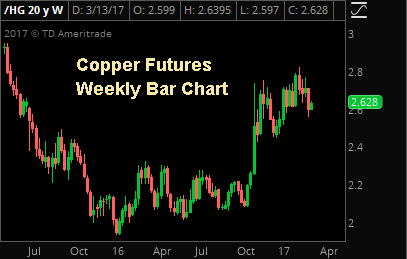
Beginning with the sole outperformer, copper was up well over +1% yesterday morning, but much of those gains were lost as short-term longs took profits and traders positioned ahead of Chinese economic data due out later tonight. Regardless, copper futures still encouragingly finished the day up +0.25%.

Going forward, we continue to like owning copper as one way to gain exposure to the ongoing global reflation trade. The charts, however, are relatively neutral on the low time frame as investors await the closely watched global flash PMI reports, namely the Chinese figure. But, an important support level to watch is the 200-day moving average at $3.18, as a close below it would shift the technicals in favor of the bears.

Elsewhere in metals, gold fell -0.55% yesterday thanks to the in-line CPI report as well as the better than expected housing data in Existing Home Sales. The CPI report was the real focus of the metals markets, though, as many investors continue to fear that the Fed may be “behind the curve” and a rate hike could come sooner than is currently priced into the market.

And, for that very reason, we remain cautiously bullish on gold as any mention of that possible “sooner than later” rate hike would likely cause a sharp rally as part of a greater “inflation trade” (which would include a sell-off in both the stock market and bonds, and a dollar rally).

Moving to the energy space, WTI crude oil futures fell -0.47% yesterday as energy traders positioned ahead of the weekly EIA inventory report due out this morning (10:30). Analysts are forecasting a draw of 2.5 million barrels in crude oil, a build of 900k in RBOB gasoline, and a build of 1.9 million in distillate supplies.

Looking at the technicals in WTI, yesterday sent mixed signals as futures failed to close above the $103 mark, which has proven to be stubborn resistance this week, but encouragingly held the 100-day moving average. Going forward, the story remains the same: As long as the economy continues to grow, specifically the labor market, so too will demand for crude oil and refined products. This means prices should remain comfortably above the $100 mark.

Natural gas continues to be under heavy selling pressure as the bears clearly maintain momentum for the time being. Futures fell another -2% yesterday and are down over -10% since this time last week. Sooner or later, natural gas is going to reverse, and likely sharply. But, until we get a disruption in production, or a spike in demand because of warmer weather, the path of least resistance remains lower.

Currencies & Bonds

The euro was the big mover in the currency markets yesterday as it fell to a new low for the year after violating major support at the 1.35 level.  There wasn’t any specific reason for the declines other than that technical break – and rather than having any specific catalyst, the euro has sold off this month on general realization that the paths of interest rate policy between the EU and the U.S. are diverging (EU easier, U.S. tighter).  Also pushing the euro lower yesterday was selling ahead of the flash manufacturing PMIs out tomorrow morning, as investors are assuming we’re going to get another soft number.

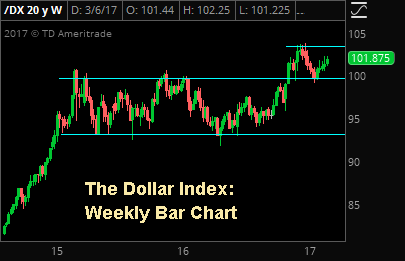
Despite other major currencies trading flat vs. the dollar (the pound, yen, Loonie and Aussie were all basically unchanged), the Dollar Index still managed to rally +0.28% almost entirely on euro weakness (the dollar largely ignored the in-line CPI and Existing Home Sales data).  Now, on the eve of the July flash PMIs, the Dollar Index sits at resistance at 81 while the euro is teetering on the lows.

At this point the euro is short-term oversold, and disappointing PMI is at least partially priced in. But even if there is a bounce, it appears that downward pressure on the euro is building, which would be a positive for the EU economy and EU stocks (remember, a weaker euro means the ECB policies are “working” and that will help stoke inflation and equity prices).  The weaker euro may be a potential signal to get back “in” to our euro longs, and this bears watching.

Turning to bonds, they went up again yesterday despite the in-line inflation data and stronger than expected Existing Home Sales report.  Initially, bonds declined on the CPI and EHS print, but there were buyers on the dip as clearly the trend remains higher.  Bonds now are sitting just off the highs ahead of the July flash PMIs tomorrow morning, and if recent past is prologue, then regardless of whether there’s a beat (which would be bond-bearish) or a miss (which would be bond-bullish), bonds will rally.

As I said yesterday, this market is totally detached from (apparent) economic reality at the moment, but clearly the trend remains higher for now, so more patience is required.

Have a good day,

Tom


Sevens Report Chart of the Day by Analyst Tyler Richey

SPX7.21.14

The S&P 500 is trading lower today, but remains above initial support at the 1963 level.

MoneyLife Interview: Tom Essaye Discussing the Outlook for the Economy.

Sevens Report Chart of the Day by Analyst Tyler Richey

HG7.18.14

Copper futures sold off hard in pre-market trading and are now below support at the 50 day moving average. If prices can recover the 50 day MA by the close however, it will be bullish for the near term.

Sevens Report 7.16.14

Equities

Market Recap

Markets declined Tuesday as cautious comments from Fed Chair Yellen offset strong economic data, although stocks managed to close well off the worst levels of the day.  The S&P 500 fell -0.2%.

Tuesday initially started pretty well as futures were higher after several major companies beat earnings (GS, JNJ, CMA, JBHT, JPM) and economic data (June retail sales, July Empire State manufacturing) beat estimates.  The Dow Industrials hit a new all-time high, and the S&P 500 inched closer to its recent high, but markets reversed on the Yellen appearance before Congress.

I’ll cover it more in depth below, but Yellen’s comments caused the small caps and “momentum” sectors (biotechs and Internet stocks) to come for sale hard (you’ll see why in a minute), and that dragged down the entire market.

But, as has generally been the case since last Thursday, there was no real conviction or follow-through to the selling Tuesday. The S&P 500 bottomed down -0.5% shortly after midday, and then began a slow rally back toward flat before selling off slightly into the close.

Bottom Line

The market has been consolidating since the highs of July 7, and that continued yesterday.

The price action in small caps and momentum names is disconcerting, but most of the selling that’s going on in those sectors is by fast-money funds and algos, not real money materially reducing exposure (like we saw in April).  Europe has also been weak and likewise needs to be watched, but the fundamentals behind the market remain broadly positive.

All that said, I don’t think this period of consolidation is over just yet, and it wouldn’t shock me if we have another “scare” to the downside on some sort of negative news over the coming days.

Earnings are helping to support markets (although it’s still early), but I’d continue to like to see the SX7P (European banking index) bottom before buying back into Europe, and for the NBI and QNET (biotechs and Internet indices) hold the lows of last week before allocating anything further into SPHB and more-cyclical sectors.

Again, this looks like a normal consolidation to me (rather than a correction), but I don’t think it’s over just yet.

Yellen’s Testimony Wasn’t ‘Hawkish,’ But It Did Cause Stocks to Decline.

The general consensus of Fed Chair Yellen’s statement and Q&A in front of the Senate yesterday was that she was incrementally “hawkish.” But that wasn’t really the case.

The main sentence that was being spun as “hawkish” was her commentary that “if the labor market continues to improve more quickly than anticipated by the Committee … then increases in the Federal Funds rate target would occur sooner and be more rapid than currently envisioned.”

Translation: If the jobs market improves and inflation accelerates, we’ll pull forward when we raise rates and how quickly we raise them.

That’s not a hawkish statement – it’s common sense.

The reason the market traded down yesterday was thanks to a totally separate piece of information – the Fed’s semi-annual report to Congress.  It contained the statement that “valuation metrics in some sectors do appear substantially stretched – particularly those for smaller firms in the social media and biotechnology industries. … Moreover, implied volatility for the overall S&P 500 index, as calculated from option prices, has declined in recent months to low levels last recorded in the mid-1990s and mid-2000s, reflecting improved market sentiment and, perhaps, the influence of ‘reach for yield’ behavior by some investors.”

So, the Fed singled out bio-tech and social media as overvalued, and that statement echoes recent comments Yellen has made about pockets of “froth” in the equity markets. Importantly, though, she described the valuation of the broader stock market as “not far above historical averages,” so this was more about addressing the overvaluation in “momentum” sectors more than it was declaring the stock market “irrationally exuberant.”

The Fed signaling out “momentum sectors” is a unexpected headwind (the fear is a repeat of April where a sharp decline in those sectors drags the entire market lower).

But, and that’s not exactly new messaging, and more importantly, the bottom line is that the outlook for the Fed did not change in yesterday’s testimony (and likely won’t change today, either).

Economics

Both economic releases yesterday beat estimates and painted an encouraging picture for consumer spending and economic activity in July.  But, neither resulted in an equity-market rally, as comments by Fed Chair Yellen overshadowed the hard data.

Retail Sales

  • June Retail Sales rose 0.2% vs. (E) 0.6%.

Takeaway

June retail sales disappointed on the headline yesterday morning, but that was a bit misleading. The details of the report were good and there were positive revisions to April (0.5% from 0.2%) and May (0.2% from 0.0%). The “control” number — which is retail sales ex-autos, building materials, and gasoline stations — rose +0.6% in June, the 4th month in a row.

Bottom line, the disappointing headline of yesterday’s retail sales report for June was misleading and the report was actually pretty good. And, while not reflecting robust consumer spending, the strong June “control” figure and positive revisions will help ease some of the general concern regarding consumer spending.  This report was a positive for the economy.

Empire State Manufacturing Survey

  • General Business Conditions Index rose to 25.60 vs. (E) 17.80 in July.

Takeaway

Manufacturing activity accelerated to a 4-year high in the greater New York area in July. Both the headline and details of the report were good, as new orders (the leading indicator within the report) were little-changed but remain strong at 18.77.

Empire State manufacturing hasn’t been a very good predictor of the broader national manufacturing PMIs in 2014. Regardless, it’s encouraging for the market to see growth in the manufacturing sector continuing in July, especially in the context of constant worries about the strength of the manufacturing recovery.

Focus will now turn to the Philly Fed manufacturing index Thursday. But the bottom line is this first data point from July implies the recovery in the manufacturing sector is accelerating further and that’s anecdotally encouraging for the economy as a whole.

Commodities

Commodities were almost universally lower yesterday, in part thanks to a stronger dollar (+0.3%). The sole exception was copper, which was only slightly higher on better than expected Chinese economic data. The benchmark commodity tracking index ETF, DBC, fell to a 5-month low before bouncing slightly into the close.

Precious metals got hit again yesterday. Gold fell -0.8% while silver gave up a more-modest -0.4%. Nearly all of the session losses in gold came in the first 15 minutes of Yellen’s testimony (when her statement was released and then feverishly dissected by the news-reading algorithms). Gold smashed through support in that $1300—$1310 range in heavy selling before finding support in the $1290 region.

Gold futures were able to hold the 50-day moving average at $1,292.40. But the reason it was defended was more a result  of shorts taking profits rather than new longs initiating positions. Bottom line, it appears that the broken uptrend line was more important over the near term than initially expected. Despite the 3 other supporting factors in the market (the bullish cross in the moving averages, the rising number of net longs, and the underlying inflation bid), the bears still have the momentum and we could see a further dip or at the very least some further consolidation here below $1,300.

Elsewhere in metals, copper was the only commodity to finish higher yesterday, adding a very modest +0.05% thanks to some better than expected economic data. A Chinese report showed that lending increased at a higher than expected rate last month, which helped reverse losses ahead of the release.

Going forward, prices remain somewhat extended as the recent rally from $3.00 was a sharp one; therefore we’d like to see a further pullback to around $3.20 before the risk/reward would be favorable to initiate long positions in copper. But, looking ahead, the improvement in the global economy will continue to be a tailwind on copper prices as a result of higher demand.

Crude oil futures resumed their downtrend Tuesday after seeing a bounce on Monday. WTI fell -1.01% yesterday but importantly held support at the 200-day moving average ($99.81). But, WTI still has some significant downside momentum and until we see a break of the sharp downtrend that has been in place since the mid-June highs, we will remain sidelined. Such a break would require a close above $101.25.

Fundamentally, today is inventory day for crude oil and the products, and a bullish report may facilitate a short-covering rally and a close above the aforementioned technical level. Expectations are:  -2.6M bbls in WTI Crude, 700k bbls increase in RBOB Gasoline, and + 2M in distillates.

Natural gas traders retested trend support at the $4.10 level yesterday as futures fell -1.3%. Like crude oil, natural gas also remains a “falling knife” here. Even though the risk/reward setup for initiating a long here is favorable, like in WTI crude there is significant downside momentum in the very short term, and we would like to see a close above the steep downtrend line (above $4.15 or so) before initiating a long position.

Currencies & Bonds

The dollar was nearly universally stronger yesterday courtesy of the good economic data (retail sales and Empire State manufacturing survey) and a “hawkish” take on Yellen’s testimony.  The Dollar Index rose +0.27%.

The only major currency that ended the day higher vs. the dollar was the British pound, as it rose +0.39% to (just off a new 6 year high) after Great Britain June CPI rose to 1.9% year-over-year, much higher than the 1.6% consensus.

The headline jump in inflation year over year was a bit eye-popping, but it’ll probably prove temporary.  That’s because the spike higher was caused by price increases for footwear and apparel.  But, the increase will likely be temporary because of seasonal adjustments. Normally, retailers in Great Britain heavily discount summer clothing in June, so the seasonality anticipates this discount.  This year, though, the retailers appear to have not as aggressively discounted in June, and will likely spread out discounts over the summer months.  So, that should result in some seasonality “payback” in the form of price declines in July/August.

Regardless, clearly inflation is trending higher in the UK, as is economic growth. This is just reinforcing the point that the Bank of England will be the first major central bank to raise interest rates, perhaps as early as this year.  The pound remains the single-most-attractive currency vs. the dollar right now.

Staying in Europe, the euro was almost the worst performer vs. the dollar yesterday, falling -0.38%, on a combination of factors:  dollar strength, a German ZEW Business Expectations Index miss, and “dovish” comments by ECB President Mario Draghi (he said a strong euro is a threat to growth and that asset purchases (QE) are well within the scope of the ECB).  None of the comments were new, but Draghi wanted to try to talk the euro down and appears to have been moderately successful (the euro is down again this morning and through support at 1.355).

Keep in mind, a weakening euro is what the “Europe bulls” want right now, so a declining euro is a needed tailwind for European shares, if it continues.

Looking at the commodity currencies, the Loonie was the worst performer vs. the dollar yesterday, falling -0.4% ahead of a manufacturing report earlier today.  The Loonie is now sitting on key support at $0.9260, and if that’s broken, look for the declines to accelerate. The Aussie was also slightly lower vs. the dollar after the Reserve Bank of Australia’s June meeting minutes were taken as slightly “dovish” in tone. (Nothing shocking was said; just general mention of concern about the economy.)  But, the Aussie remains in the middle of the trading range ($0.92-$0.94).

Turning to bonds, the 30-year traded in a big range yesterday. It initially traded down nearly -0.3% on the strong economic data and Yellen comments, but then rebounded and rallied nearly +0.3% later on in the testimony, before giving back those gains to finish basically unchanged.  Meanwhile the yield on the 10-year was also unchanged.

Treasuries remain buoyant but seem a touch confused at the moment, as the market tries to “game” the Fed’s potential normalization strategy within the context of foreign demand for Treasuries, an accelerating economy and bottoming inflation.  And, in the near term, money flows from the two aforementioned sources are trumping the fundamentals of the two latter sources.  Bottom line is that Treasuries remain above the uptrend of 2014. Until they decisively break that downtrend, then the short-term benefit of the doubt remains with the bulls, despite growing fundamentals that suggest Treasuries should be declining.

Have a good day,

Tom