Stock Market Today: An Early Earnings Update

Near the top of the influence list for the stock market today, and for the rest of the global financial markets today, as well as for the rest of the week, is the slew of big-time corporate earnings on tap. In fact, the market today will get earnings from Dow Jones Industrial

Average component Microsoft Corporation (NASDAQ:MSFT), as well as other tech giants such as Seagate Technology PLC (NASDAQ:STX) and Texas Instruments Incorporated (NASDAQ:TXN).

At the start of the market today, about 20% of the S&P 500 has reported earnings, and the results have been broadly mixed. Approximately 75% of those firms have beaten estimates, which is a pretty good percentage; however, the results haven’t been as good on the revenue front where the results have been much more in-line with estimates.

So, at least so far, we are not seeing the strong revenue numbers like we saw during Q3 earnings season late last year. I think the single biggest takeaway so far from this earnings season is that between the strong US dollar and the reduction in expected energy company earnings, the expected S&P 500 earnings number has come in somewhat materially from $130/share six months ago to under $125/share now, which does have an effect on valuations.

Using $122/share, at 2,070 the market trades at 17X current year earnings—not prohibitively expensive given 0% interest rates. However, given the macro environment it’s definitely on the high side. Point being, valuation is something we need to keep an eye on if results for the remainder of earnings season continue to disappoint, because valuation could become a mild headwind on the S&P 500 towards 2,100 (it’s one of the reasons I’m cautious about buying up here).

The markets today will start to get resolution in several of the macro overhangs that have weighed on stocks early in 2015, but at 2,070 a lot of “non-negative” resolution is already priced in, and I continue to have a hard time seeing a material positive near-term catalyst that will push stocks to 2,100 and beyond.

Last week’s ECB decision on QE was a positive, as the program will be powerful, and global central bank easing is a general tailwind on stocks. And, while likely a problem for another day, the Greek elections have provided at least some certainty over that hitherto unknown.

As for the remainder of the focus on the markets today, we have the Fed meeting on Wednesday. What we’ll look for here is whether the Fed is getting more “dovish” given the global slowdown and central bank easing. “When/How the Fed will raise rates” is a macro headwind on stocks, so this week will be a mover for the stock market today, and for the remainder of the week, month and quarter.

However, keep in mind, even if the Fed is dovish Wednesday, the market would much prefer a surging economy, rising inflation and higher rates, not continued low rates. Finally, the Russia/Ukraine situation is heating back up as outright fighting between Russian backed rebels and Ukrainian government forces started again over the weekend, and the West is already threatening more sanctions.

Bottom line: In our estimation there remain too many headwinds for a material move higher.

The news last week was bullish for the financial markets around the world, including the US, but I am not a buyer at these levels, and would wait to add to select sectors more towards 2,000 in the S&P 500.


Sevens Report 1.26.14

Sevens Report 1.26.15SWG

Stock Market Today: How to Buy the ECB QE

By far the biggest event in the stock market today, not only for the Dow Jones Industrial Average and the S&P 500, but also for the currency, bond and international financial markets today, was the European Central Bank’s (ECB) move to issue even more “QE” than even the most optimistic bulls had anticipated.

In fact, “Super” Mario Draghi lived up to his moniker, juicing financial markets today with a much-bigger-than-expected bond buying program that exceeded estimates both in terms of scope, and size. The result was a near 260-point spike in the Dow Jones Industrial Average, which lead other financial markets today markedly higher in sympathy.

Let’s take a look at the details of the ECB QE, and you’ll see why they caused such a kerfuffle in the markets today.

Size: 60 billion euros per month for 18 months vs. (E) 50 billion for 12 months.

Yes, some are saying the 60 billion per month is a touch misleading because it includes previously announced ABS and CDO purchases, but I think this is missing the bigger point. You see, the ECB QE is really all about the aggregate size of the balance sheet.

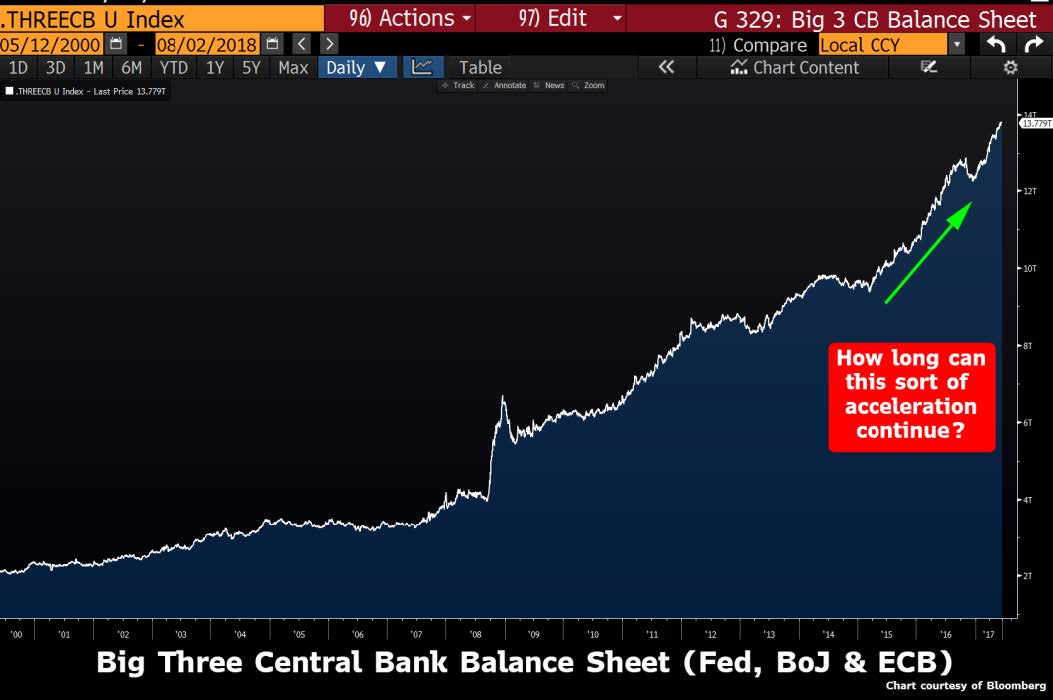
The new ECB balance sheet will be over 1.2 trillion euro by September 2015, with room for more. That is far larger than the previously stated 1 trillion euro target—and that, my friends, was the eminent source of the bullishness in the stock market today.

Risk Sharing: The sovereign bond purchases will be “Pari-Passu.”

The ECB said sovereign bond purchases would be pari-passu (meaning all bond purchasers can will be regarded equally, and thus repaid at the same time), which is important because it won’t result in an offset of private market debt purchases. Despite not including total risk sharing across the ECB, and as such putting default risk on the balance sheet of the national central banks, the bottom line is that the chance of default (which is really all that matters here) on much of the QE debt remains very low, and will not be an inhibitor to the success of the program.

Unanimity of the Decision: All Parties Thus Concur

Whether the Germans were on board with the ECB QE was a topic of concern for the markets today. While there was no actual vote (so we can’t see who was for it or against it), Draghi said in the press conference that there was unanimity in using QE as a legal monetary policy tool. This strongly implies the Germans, while likely reluctant, will not try to derail the program.

I believe the stock market today reflects the bullish response to the ECB QE, not just here at home but particularly with respect to European equities. In fact, if you are looking to buy the ECB QE then I think the best way to do so is with an exchange-traded fund (ETF) such as the Wisdom Tree Europe Hedged Equity ETF (HEDJ).

This fund already is significantly outperforming the S&P 500 year to date (7% vs. 1%), and I suspect this can continue over the coming weeks and months.

Interestingly, I was surprised yesterday while watching the analysis/reaction to the ECB QE announcement, as some of it seemed to focus on the economic implications of the details of QE.
We don’t actually know if QE helps an economy, even after six years of it here in the United States. However, we are interested in stock market returns, and we do know pretty well that QE makes nominal stock prices go up (see UK stocks, Japan stocks and US stocks).

My initial bullish thesis on Europe was based on the proposition of an expanded balance sheet, and seeing as the ECB is committed to an even larger and open-ended balance sheet expansion than most had previously anticipated, I view this as even more European equities bullish.

From an investment standpoint, I continue to like HEDJ as the single best way to play “Europe” broadly, as it also protects you from a decline in the currency. And despite the falling currency, I still like country-specific and sector-specific ETFs such as the iShares MSCI Italy Capped (EWI), Global X FTSE Portugal 20 ETF (PGAL), and the iShares MSCI Europe Financials (EUFN).

While these respective ETFs are not protected from the drop in the euro (and it will weigh on returns for US investors) I believe the potential upside in these ETFs is more than enough to warrant taking on the currency risk. To use a crude analogy, HEDJ is like the S&P 500, while the remaining ETFs are like cyclicals sectors—and thus they will be more volatile than HEDJ in both a rising and falling tide.

Bottom line: For anyone other than those with a very short-term outlook, I think you can begin to leg in to HEDJ or the other positions. And, if you already own them, I think adding to them gradually on a schedule over the next week or two will prove prescient.

Stock Market Today: Is Oil Following the Natural Gas Playbook?

One of the most notable oil “bullish” memes floating around the trading pits is all about declining rig counts in the United States, and how the falling number of drilling operations is a “game changer” for the oil markets that ultimately will lead to a bottom in energy prices.

That meme, however, is simply not true, and history backs this claim up.

First, while rig counts have indeed dropped from a recent high of 1,931 in September to 1,675 as of last week, this doesn’t necessarily mean lower oil supply in the pipeline. Though this may seem bullish on the surface, it actually isn’t, and that’s because total US production is still expected to rise between 5% and 10% next year. The reason is because the rigs that are being shut down are low-production/exploratory-type rigs that don’t contribute to a lot of production anyway.

Second, many analysts are focused on oil producers’ published “break-even” prices as they try to pinpoint a fundamental price floor (many of which we have already crashed through). But, there is speculation that a lot of those published numbers are misleading, and that as prices continue to fall producers will only try to pump more in an effort to stay profitable.

Put simply—the producers often lie about where their “break even” really is.

Supporting this idea is the recent history in the natural gas market, which saw production boom in the last several years cause prices to plummet, much like we have seen in the global crude oil market over the past six months.


Stock Market Today – A Very Important Week Ahead

Although nearly every week is replete with news, economic events and all manner of market-moving headlines, not all weeks are created equal.

This week is, in fact, the first really important macro-economic week of 2015, and while there aren’t a huge number of economic events, what we do have on tap is extremely important.

Obviously, the clear highlight this week is the European Central Bank (ECB) meeting on Thursday. We’ll be previewing the particulars of the meeting in the coming days, but given the Swiss National Bank (SNB) decision last week to de-peg the franc from the euro, it seems that expectations are high for something big from the ECB QE plan.

At this point, 500 billion euros remains a key level to watch. I suspect that anything below this level will be considering underwhelming.

Now, in addition to the ECB we also get the global January flash PMIs Wednesday night/Thursday morning. Given the concerns about global growth and global deflation, these metrics are very important, as the market needs a confidence boost about the pace of growth globally.

Specifically, China and Europe remain in focus, especially following the downbeat Chinese growth data Monday night and the ECB decision looming Thursday morning. And, for the first time in a few months, even the US data will be watched closely. On an absolute level it should be fine, but right now the key is just how much momentum the US manufacturing sector is losing.

If we see a sharp deceleration in US manufacturing data, it may weigh further on sentiment. Now, staying in the US, we also get the latest round of housing data via housing starts on Wednesday, and existing home sales on Friday. Keep in mind that housing has quietly lost a bit of positive momentum over the past two months, and some stabilization in that data will help provide a boost to market confidence.

For 2015, the global economy is estimated to expand by 3%, which is down from a projected 3.4% growth rate in June. In 2016, the World Bank thinks growth will come in at 3.3%, which is down from the prior estimate for 3.5% growth.

Bottom line: This week is key, because it is an opportunity for the ECB and economic data to help partially vanquish the growing concerns about the pace of global growth and disinflation. If the PMIs are decent (meaning China and Europe stay above 50), and the ECB does something powerful (i.e. QE greater than 500 billion), the outlook for the global economy could be a lot better as we head into Greek elections Sunday.

The World Bank Slashes Growth, and Traders Thrash Copper

The World Bank thinks global growth will be slower than originally estimated. On Tuesday, the lender issued its semiannual Global Economic Prospects report, and for global growth bulls the outlook wasn’t very encouraging.

For 2015, the global economy is estimated to expand by 3%, which is down from a projected 3.4% growth rate in June. In 2016, the World Bank thinks growth will come in at 3.3%, which is down from the prior estimate for 3.5% growth.

While most investors would be well served to take the World Bank’s estimates with the proverbial grain of salt, one thing we do know is that traders often take these data projections serious—at least in the short-term. We saw just that in Tuesday trade, as growth concerns weighed on commodities, most notably copper, which traded down nearly 5% in the session.

It is often said that copper has a Ph.D. in global economics, which just means that copper prices are a good indicator of the health of an economy. When the economy is trending lower, then usually we’ll see that reflected in copper prices—and that’s precisely what happened Tuesday, and what’s happened in copper via the iPath DJ-UBS Copper SubTR ETN (JJC). This copper exchange-traded note is down some 17.2% over the past three months, a move that betrays just how fearful traders have become about the prospects for global growth.

More broadly, the spot price of copper has been in a bearish downtrend now really since the spring 2011 highs, but most recently lower energy costs and weak demand specifically out of China, the world’s largest consumer of the industrial metal, have pushed prices down to near six-year lows.

copperchart

The collapse in “Dr. Copper,” has been somewhat lost in the oil declines, but clearly this is not a good sign for global growth.

Chinese demand for copper is expected to fall again this year, and that presents a very troubling backdrop for the future of copper prices going forward. The bottom line is clear; copper is falling victim to a combination of low production costs (oversupply) and soft demand expectations, which is resulting in a sharp slide to the downside that we think has room to continue going even lower.

So, if you are long this industrial commodity (and I hope you’re not) then now is the time to rethink the “Dr. Copper” bull trade.

If ECB begins QE …

Closing Bell Exchange: Oil, Jobs & Wages

Tom Essaye’s recent interview on “Closing Bell” at CNBC.

5 Macro Risks Keeping Stocks Down

Markets by their very nature are risky, but sometimes the macro risks are bigger and more dangerous than the bulls can handle. As we kickoff 2015, I see five big macro headwinds facing stocks—headwinds that are likely to limit upside at least in the near term.

In order of near-term importance, they are: 1) What will ECB QE look like? 2) Can oil stabilize? 3) Will we have another “Grexit” scare? 4) Is there really a global deflation threat or is it just oil? and 5) When will the Fed start to tighten and how will markets react?

Of the five, the first four are almost equal in importance with regards to what stocks do over the coming weeks. And, it’s important to note that European QE concerns now have trumped (or equaled) oil contagion worries as the near-term leading indicator for stocks. This was made evident Friday when articles in Bloomberg and Reuters were largely responsible for the drop in stocks (it wasn’t the jobs report).

Keep an eye on the WisdomTree Europe Hedged Equity ETF (HEDJ), a proxy for European stocks, as this fund’s direction will betray how the market assesses those concerns.

It’s key to realize, though, that beyond the very short term, none of the above should be materially negative influences on stocks.

The ECB may disappoint with initial QE, but the bottom line is the ECB knows it has to expand its balance sheet and provide more stimulus, which is bullish for European stocks over the coming months and quarters.

While we haven’t likely seen the low tick yet, oil appears to be trying to stabilize, as prices at these low levels will likely start to have an impact on marginal producers (so the pace of declines should slow), which is what is important from an “oil contagion” standpoint. The global “deflation” scare is mostly linked to oil prices so when they stabilize, so will inflation statistics. Third, the “Grexit” story is likely overdone (the chances of Greece leaving the EU remain very slim, and we know that from the bond markets).

Finally, the concern about the FOMC raising interest rates is a problem for the April time frame (as we approach the potential June “lift off” in the cost of capital).

The point here is that we are likely to see more near-term volatility until the events above get resolved, but I would view any material dip below 2000 in the S&P 500 as a buying opportunity in domestic cyclicals (banks, retailers and tech specifically) and continue to view European market weakness as offering fantastic longer term entry points.

Bottom line: The near term may be bumpy, but we see no reason to materially alter equity allocations.

Tom Essaye Featured in Forbes.com – Stocks Struggling To Break Free Of Oil’s Slide

By Steve Schaefer at Forbes.com

It’s oil’s market, stocks are just living in it.

That’s the most common takeaway from the first few trading days of 2015, as the months-long punishing of oil prices and energy stocks keeps broader market averages mired in negative territory.

If oil, junk bonds and the ruble are rolling over, expect equities to fall in concert, according to Tom Essaye, author of the Sevens Report. When that trio is pushing toward fresh lows, “the stock market will go down in sympathy.”

Tuesday the trend continued, with a short-lived morning rally in stocks evarporating as oil prices slumped further below the $50 mark. West Texas crude dropped more than 4% to below $48 a barrel, while Brent slumped 4.5% to $50.71. The S&P 500 fell 1%, with energy its worst-performing sector by a wide margin.

FactSet senior earnings analyst John Butters points out that analysts still seem optimistic on the sector — energy is tied with healthcare for the highest percentage of buy ratings in any sector (57%) and companies like SchlumbergerSLB -0.04%, Kinder Morgan KMI -0.6%, Phillips 66 PSX -1.25%, EOG Resources EOG +1.16%and Williams Companies boast buy rankings from more than 80% of Street analysts who cover them — even though earnings are expected to fall more than 19% in 2015.

Citigroup’s Tobias Levkovich points to the chart below, which shows that while 2015 earnings expectations have plunged in the energy sector, 2016 have been little changed.

energy chart

Perhaps that’s because analysts think the selloff is overdone and has created some undervalued opportunities. More likely it’s because the damage in the energy sector has come so rapidly the analysts haven’t even had a chance yet to turn their attention to future years.

At some level, bargain-seekers will think oil and energy stocks are worth buying, but Essaye warns that the true oil shakeout some are waiting for may be a bit further off than they think.

A global supply glut barreling up against weakening economic growth is a well-understood factor in oil’s slide, but another element Essaye points to is the potential breathing room oil companies have thanks to hedging strategies.

Companies that hedged their 2015 production at prices around $90 or more per barrel can likely stay afloat longer than outsiders like OPEC anticipated, given that those hedges are now “in the money in a big way,” according to Essaye. Net short positions held by producers have leaped from 15 million contracts in August to 77 million last week.

“Bottom line, shale producers are not yet feeling the “full on” pain from the roughly 50% selloff thanks to their hedging strategies,” Essaye says. “Sso we can expect production to remain high and fundamentals to remain very bearish.” He expects oil to head toward $45 a barrel in the near term.

In a recent letter to clients, Forest Value Fund’s Thomas Forester notes that the sliding prices in oil have been considerably worse than the broader declines in other industrial commodities, which might be explained away in part by the end of the Federal Reserve’s monthly asset purchases – which provided cheap money that sloshed into emerging economies like China’s – and the strengthening dollar.


http://www.forbes.com/sites/steveschaefer/2015/01/06/stocks-struggling-to-break-free-of-oils-slide/