Posts

Stock Market Update: 7/11/2016

stock-market-3

Stocks surged last week thanks almost entirely to the post-jobs-report Friday rally. The S&P 500 rose 1.28% on the week, and is up 4.21% year to date, and now is within a few points of its all-time high.

Despite the gains, the week started with some volatility as the S&P 500 dropped 1% Tuesday following a plunge in European financials stemming from worries about Italian banks and fund redemption halts at British commercial property funds. But, the market acted resilient and stocks rallied during the final hour of trading to close the day down modestly.

A good June ISM Non-Manufacturing PMI helped stocks rally Tuesday as markets ignored more weakness in European bank stocks (an important European bank index broke to multi-year lows), and the S&P 500 rallied and recouped almost all of the Tuesday declines. Thursday stocks basically drifted sideways ahead of the jobs report, as a drop in oil to one-month lows helped offset more positive economic data (good jobless claims) and a good earnings report from PEP.

Then, stocks exploded higher Friday as the blowout jobs report combined with a lack of selling in bonds and no rally in the dollar created a short squeeze higher that built on itself throughout the trading day amidst low volumes. Stocks moved steadily higher throughout the morning and afternoon, and traded to multi-month highs, closing just below the all-time high.

Trading Color

Cyclical sectors outperformed last week, but that was due almost entirely to Friday’s big rally, which came on low volumes and consisted of faster money managers chasing stocks higher via higher-beta cyclicals. Not to pooh-pooh the rally, but it didn’t come on strong volumes or with a lot of conviction.

From an internals standpoint, easily the biggest question facing advisors and investors over the next few weeks will be whether we see a large rotation out of defensive/yield-oriented sectors (utilities, staples, REITs) and into cyclicals (banks, materials, consumer discretionary). There certainly was some of that on Friday as cyclical sectors did outperform, but it was not nearly as big as it could have been given how “overbought” most people think utilities/staples and REITs currently are.

In fact, we were actually relatively impressed with the performance of consumer staples (XLP/FXG) on Friday, as given their recent outperformance we could have easily seen outright declines in both those sectors following that strong jobs report. To that point, there will be a lot written about a potential massive rotation out of defensive sectors and into growth over the coming weeks, but until we see a material break lower in the belly and long-end of the Treasury curve, the income provided by staples, utilities, REITs and other defensive sectors will remain critical to outperforming in a choppy market.

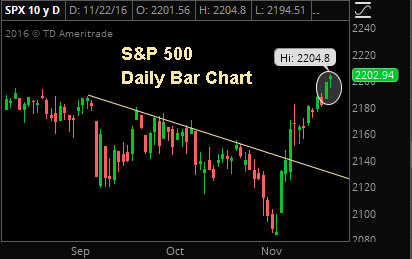
On the charts, the S&P 500 broke through several levels of resistance and nearly notched a new intra-day high—2134 is now the next near-term resistance level while support sits lower at 2100.

Bottom Line

Two and a half weeks ago the S&P 500 plunged temporarily below 2000 on Brexit fears, but in less than three weeks the market totally recouped those losses and traded to near-18-month highs. Yet despite all this whipsaw activity, the outlook for stocks has remained largely unchanged, and the bull and bear arguments remarkably static.

So, despite the rising chorus of optimism (which is largely based on very resilient price action) we remain generally cautious on stocks as fundamentals have not materially improved, and because of that we would not be chasing markets at these levels and would resist adding significant capital into stocks broadly, or re-adjusting allocations into higher-growth/cyclical sectors.

Looking at the bull’s argument, it has been bolstered by strong data so far in June, but with unknown Brexit effects looming, any well-reasoned bull is still solely relying on the $130 2017 S&P 500 EPS to justify allocating new capital to stocks. That’s the same argument we’ve had since April. And, in the meantime, the dollar is higher (which will weigh on earnings in the coming quarters) and oil looks heavy. To boot, if the bulls are right and we see a 17X $130 number, that’s only 2210 on the S&P 500, which is less than 4% from current levels. 2000 (which we hit less than three weeks ago) is now about 6% from current levels, so the risk/reward is not attractive.

Now, to be clear, I’m not advocating shorting stocks or selling everything. This tape is strong and that must be respected. But, from a “what do we do now” allocation standpoint, we are staying relatively unchanged in our proprietary accounts. We are not materially adding more cash to stocks, nor are we rotating out of defensive sectors and into cyclicals like materials or consumer discretionary.

Looking at other assets, the markets continue to send “Caution” signals. Treasury yields remain near all-time lows, the pound remains weak and Brexit is not “over” as an influence, the 10’s-2’s Treasury yield spread hit greater than 10-year lows last week while gold remains elevated and European (especially Italian) banks remain under pressure. Again, the odd man out in this cross asset analysis is US stocks, which are just off all time highs, so either the US stock market is “right” and everything else is wrong, or stocks are simply pricing in a very optimistic scenario right now. Regardless, despite the optimism we remain cautious.


5 Macro Risks Keeping Stocks Down

Markets by their very nature are risky, but sometimes the macro risks are bigger and more dangerous than the bulls can handle. As we kickoff 2015, I see five big macro headwinds facing stocks—headwinds that are likely to limit upside at least in the near term.

In order of near-term importance, they are: 1) What will ECB QE look like? 2) Can oil stabilize? 3) Will we have another “Grexit” scare? 4) Is there really a global deflation threat or is it just oil? and 5) When will the Fed start to tighten and how will markets react?

Of the five, the first four are almost equal in importance with regards to what stocks do over the coming weeks. And, it’s important to note that European QE concerns now have trumped (or equaled) oil contagion worries as the near-term leading indicator for stocks. This was made evident Friday when articles in Bloomberg and Reuters were largely responsible for the drop in stocks (it wasn’t the jobs report).

Keep an eye on the WisdomTree Europe Hedged Equity ETF (HEDJ), a proxy for European stocks, as this fund’s direction will betray how the market assesses those concerns.

It’s key to realize, though, that beyond the very short term, none of the above should be materially negative influences on stocks.

The ECB may disappoint with initial QE, but the bottom line is the ECB knows it has to expand its balance sheet and provide more stimulus, which is bullish for European stocks over the coming months and quarters.

While we haven’t likely seen the low tick yet, oil appears to be trying to stabilize, as prices at these low levels will likely start to have an impact on marginal producers (so the pace of declines should slow), which is what is important from an “oil contagion” standpoint. The global “deflation” scare is mostly linked to oil prices so when they stabilize, so will inflation statistics. Third, the “Grexit” story is likely overdone (the chances of Greece leaving the EU remain very slim, and we know that from the bond markets).

Finally, the concern about the FOMC raising interest rates is a problem for the April time frame (as we approach the potential June “lift off” in the cost of capital).

The point here is that we are likely to see more near-term volatility until the events above get resolved, but I would view any material dip below 2000 in the S&P 500 as a buying opportunity in domestic cyclicals (banks, retailers and tech specifically) and continue to view European market weakness as offering fantastic longer term entry points.

Bottom line: The near term may be bumpy, but we see no reason to materially alter equity allocations.

A snippet from February 25th

February 25, 2013

Equities

Market Recap

Stocks suffered their first weekly decline of 2013 last week as concerns about central bankers maintaining extraordinary accommodation and the pace of global economic growth weighted on stocks. The S&P declined .4% last week and is up 6.27% year to date.

Stocks traded flat for the start of last week on little new news, but Wednesday afternoon sold off hard after perceived “hawkish” Fed minutes provided the excuse for the correction everyone has been looking for.

The selling pressure continued through Thursday after economic data from Europe was surprisingly disappointing, and concerns rose that the Chinese might be forced to start tightening monetary policy to help cool and overheating property market.

Despite any real, positive, news Thursday, however, the S&P 500 held the 1500 level after briefly falling below it intra-day, and that support holding led to the bounce in the market Friday. But, there was no real “catalyst” for the bounce and it was little more than just an oversold rally into the weekend (and was not a big “buy the dip” response that might make you think the decline is over).

Sign up now for a FREE TRAIL

Don’t Forget About the DOW

Interestingly, the Dow was a big outperformer on the day (up .76%), and usually when that happens there is one stock that is up several percentage points that skews the average.  Interestingly, that was not the case on Monday, as the strength in the Dow was evenly spread across many of the index components (TRV, The Travelers, was the best performing stock in the index up just 1.79%).

The Dow is now up 5.76% for the year, about half of the S&P 500.  The reason for this underperformance has to do with the sectors that have rallied the most year to date (Tech and Financials) which are more heavily weighted in the S&P than in the Dow (plus the Dow doesn’t have AAPL).

But, the outperformance today should be noted.  If we are heading into a period of concern/weakness in the markets, the sturdy, somewhat stodgy, industrial companies in the Dow, with strong cash flows, good yields, and decidedly less economically sensitive businesses, will outperform.

If investors are concerned about the market trading like it’s 2011, then perhaps it’s helpful to look at what worked in 2011.  Keep in mind, in 2011 the Dow finished up 5.5%, while the S&P was flat, and the NASDAQ fell 1.8%.


The AAPL Effect

One of the things traders are constantly monitoring is internals of an index or market, for clues about the strength or weakness of that market beyond what the simple headline numbers say.

That is why investors and trader monitor which sectors are rising and falling, because it can give insight into the “health” of a market rally.

For instance, if you have a market rallying but defensive sectors like utilities or consumer staples are leading the rally, that’s not a good thing.  The reason is because those defensive sectors outperform when the economy isn’t growing or people aren’t confident about the direction of a market (they are both economically insensitive—people need electricity and basic consumer goods like razors regardless of whether the economy is growing or expanding) . . .

The above is an excerpt from the Sevens Report. To read the entire article and to receive daily commentary on all major markets and market moving economic and geo-political events, sign up today to request a free 2-week trial of the Sevens Report.