The Economy: A Look Back and What’s Ahead (3.24.14)

Last Week

The major question for the market remains: “Was the slowdown in economic activity in Dec/Jan largely the result of the awful weather?” Last week the February and March data further implied the answer is “Yes,” and that’s a good thing for the stock market.

The first two data points from March, the Empire State manufacturing survey and Philly Fed survey, both bounced back from weak February readings. They imply we’re seeing a modest bounce-back in manufacturing activity this month in those two regions (again implying the soft Jan/Feb readings were weather-related).

Turning to the FOMC, you know by now the Fed:  Dropped its “quantitative” forward guidance and abandoned the 6.5% unemployment and 2.5% inflation thresholds, and replaced them with opaque, “qualitative” forward guidance.  Additionally, there was  an “upward drift” in the “dots” as 10 of 16 Fed officials believed the Fed Funds rate would be at or above 1% by the end of 2015, compared to 7 in December.  Finally, Yellen’s “6 months” comment about when rates would start to increase after QE ended was also taken as “hawkish.”

But, all that aside, not a lot really changed with regard to the Fed.  Tapering is expect to continue at the pace of $10 billion each meeting, and perhaps the expected date of the first increase in interest rates moved slightly forward from July/August 2015 to May/June 2015, but it’s not like that is a monumental shift.

Finally, last week’s housing data continued to disappoint, as both housing starts and existing home sales missed estimates and remained sluggish. The housing recovery is ongoing, and the data last week again got a “pass” because of weather. But while other measures of the economy have stabilized in Feb/March, the housing recovery continues to lose steam.  It’s a not a problem yet and likely we’ll see stabilization in the coming months, but it remains something to watch.

This Week

The most important number to watch this week already passed, as we got the Chinese flash manufacturing PMIs last night (and the European numbers this morning).

But, the March U.S. flash manufacturing PMI comes at 10 this morning, and we’ll want to see improvement similar to what we saw in Empire State and Philly last week (so, it doesn’t have to recoup all of the Jan/Feb decline, but the market will want to see the number improve, again implying weather was the reason for the steep drop over the past two months).

Outside of the flash PMIs, most of the other economic reports will continue to shed light on whether the dip in economic activity was weather-based.  Durable goods, (Wednesday) will be second-most-watched number this week, and jobless claims (Thursday) will also receive some attention for the first time in months. The recent trend has been downward in claims and, if it continues, people will start to think we’re seeing incremental improvement in the labor market.

Final Q4 GDP and Personal Income and Outlays come Thurs/Fri, respectively, but they shouldn’t move the market much. Finally, we get more insight into housing via new home sales (Tues) and pending home sales (Thurs).  As mentioned, housing seems to be the one sector not showing a bounce-back in February. While that’s likely weather-related, it’ll be encouraging to see some decent data points, especially out of pending home sales.
 

The Economy: A Look Back and What’s Ahead (3.17.14)

Last Week

The domestic economic calendar was very sparse last week, as most of the market’s focus was on Chinese data.

Starting with the U.S., though, the two U.S. reports last week were retail sales and weekly jobless claims.  Both slightly beat estimates (retail sales rose 0.3% vs. 0.2% and weekly jobless claims were 315K vs. 330K), but neither report really changes anyone’s outlook for the economy or Fed policy.

The most “important” economic data last week came from China, as the country reported its trade balance, retail sales, fixed-asset investment and industrial production last Thursday. All of the report missed estimates, raising concerns that the Chinese economy is seeing growth further slow (multiple firms reduced their Chinese GDP forecasts to between 7.0% and 7.5%).

Read more

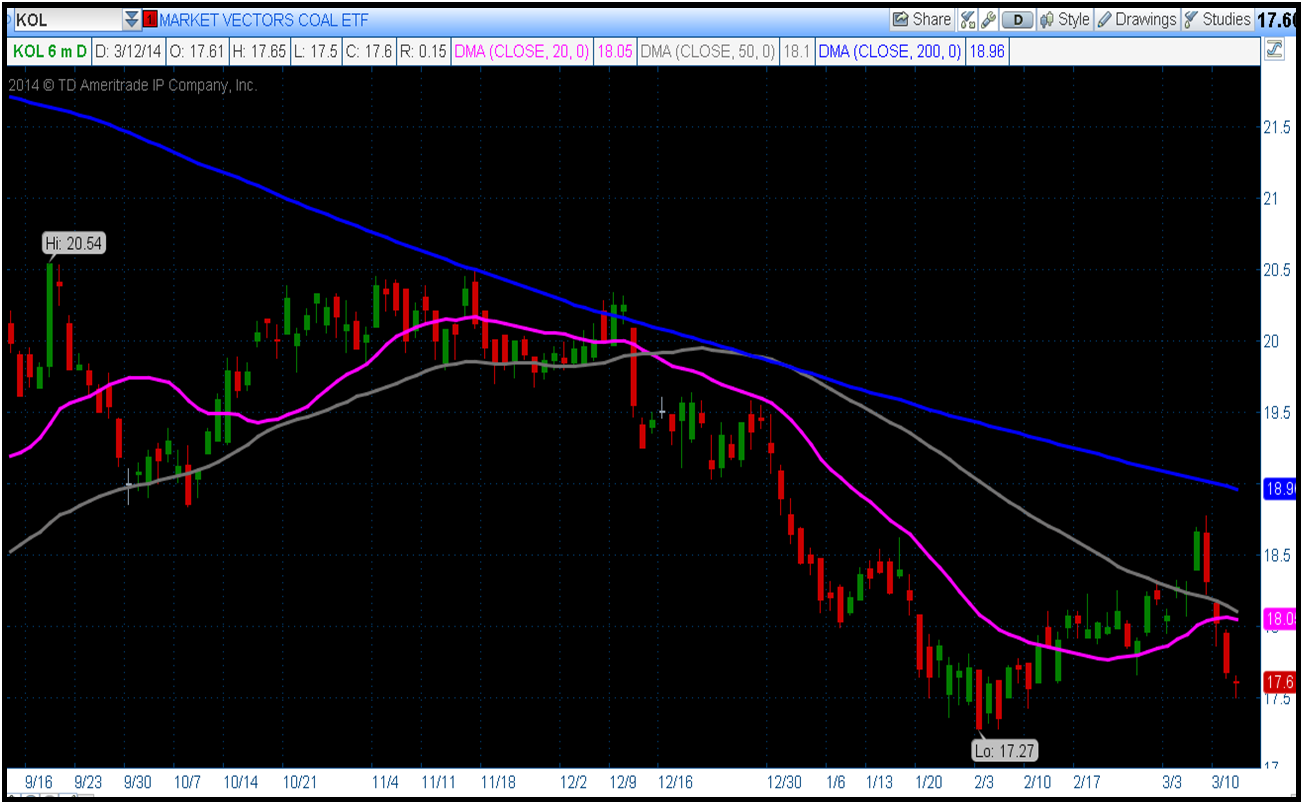
KOL (the coal stock ETF) Has Gotten Hammered on Peripheral China Concerns

SevensReport_KOL_Chart_3.13.14

KOL (the coal stock ETF) has gotten hammered on peripheral China concerns. But with natural gas prices so high, coal fundamentals are improving.


The Economy: A Look Back and What’s Ahead (3.10.14)

Last Week

Economic data last week broadly met or exceeded expectations, and 1) Solidified that the global economic recovery is ongoing, 2)Strongly implied the economic weakness in the U.S. in Dec/Jan is temporary, and 3)Ensured the Fed will continue to taper the QE program by another $10 billion at the March meeting a week from Wednesday.

From a practical investment standpoint, the last week’s data reinforces that the global economic backdrop remains a general tailwind on equities, although there certainly are risks to monitor.

Starting with the jobs number, we all know by now that it was a surprisingly strong report, at 175K jobs added in Feb. vs (E) of 150K and “whisper numbers” of around 130K-ish.  And, in addition to the positive February data, there were positive revisions of 37K jobs added in December and January (11K and 26K, respectively).

Looking a bit deeper into the number, while the headline was a strong beat, the details of the jobs number weren’t quite as good.  Specifically, critics are pointing to the fact that the average workweek fell from 34.3 to 34.2 hours, missing estimates and falling for the second-straight month.  That’s somewhat important because the average workweek is a leading indicator for employment. (As employers get busier, they work their current employees more before hiring additional staff, so an uptick in average workweek usually precedes increased hiring.)

I’ll let the economists debate the minutiae and validity of the report, but the bottom line from a market standpoint is this:  The jobs report was a positive because the weakness in hiring in December and January stopped and the “weather excuse” appears more valid, and, combined with other data, it shows the slowdown in the U.S. economy so far this year isn’t gaining momentum and appears, for now, to be temporary.

The other big reports out last week were the ISM manufacturing and non-manufacturing (services) PMIs.  And, the results were, on balance, positive.

ISM manufacturing rebounded from that big drop in January, bouncing to 53.2 vs (E) 51.9.  ISM non-manufacturing, though, dropped to 51.9 vs. (E) 53.5, and the employment sub-index fell to 47.5, the first sub-50 reading for that number in over two years, although that sub-index was obviously overshadowed by the government report.

Internationally, data was also supportive.  China remains the No. 1 “macroeconomic” risk to the global recovery, but last week the data largely met expectations and, while the Chinese economy is slowing, so far it appears to be slowing about as everyone expected (which is “OK” as that won’t de-rail the global recovery).

Indeed, much to the despair of the China bears, China remains a crisis that hasn’t materialized.  Manufacturing and composite PMIs met expectations and importantly stayed above the 50 level.  And, although there was a disappointing trade balance report out Friday night (exports plunged), a lot of that was because exports were “pulled forward” by the Chinese New Year, so that soft data point will get a “pass” of sorts.

Europe was actually the area with the best data last week, as manufacturing and composite PMIs beat, as did EU retail sales.  This in part led the ECB to make no changes to policy, and to strongly imply that the ECB was “on hold” for the foreseeable future (which is very positive for European bonds, and I continue to think PIIGS’ bonds remain some of the most-attractive options in the bond markets today.)

Bottom line is that, while you can argue that the economic data last week had its gives and takes (there are legitimate points for the bears to remain bearish), it did help positively resolve the question of “is the global and domestic recovery faltering?”) with a pretty definitive “no.”

Bottom line from last week is this:  Economic data remains broadly supportive of stock prices, and if this rally is going to break in the near future, it won’t be because of economic growth concerns.

This Week

After an exhausting week of data last week, we all get a rest this week.  The calendar is very light domestically, with retail sales and jobless claims (both Thursday) the only reports to watch.

Internationally it’s almost equally quiet, although we do get some Chinese data Thursday morning (industrial production and retail sales).  Given the ongoing concern about China, the data will be watched, but even if it “misses” I don’t think it’ll materially change people’s outlook on China. (The expectation remains for between 7.0% and 7.5% GDP growth.)


Sevens Report Analyst Tyler Richey Featured on WSJ Market Watch Discussing Crude Oil and Gold Prices

Gold futures lose 1% but gain for the week

Oil reclaims $102 as payrolls rise more than expected

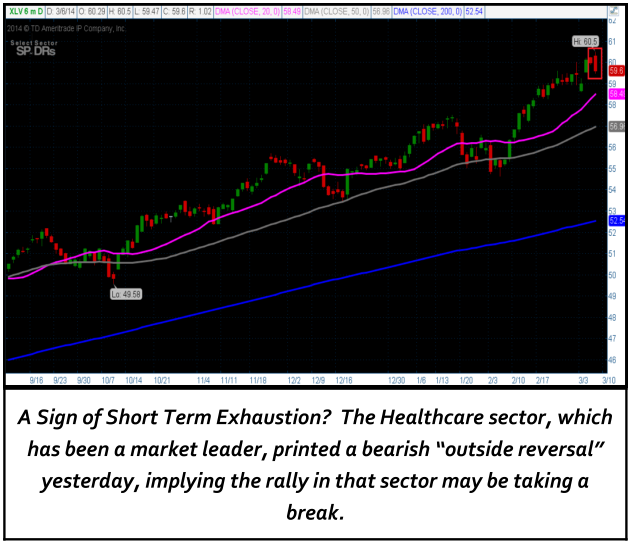
Bearish Reversal in the Healthcare Sector

Healthcare 3.7.14

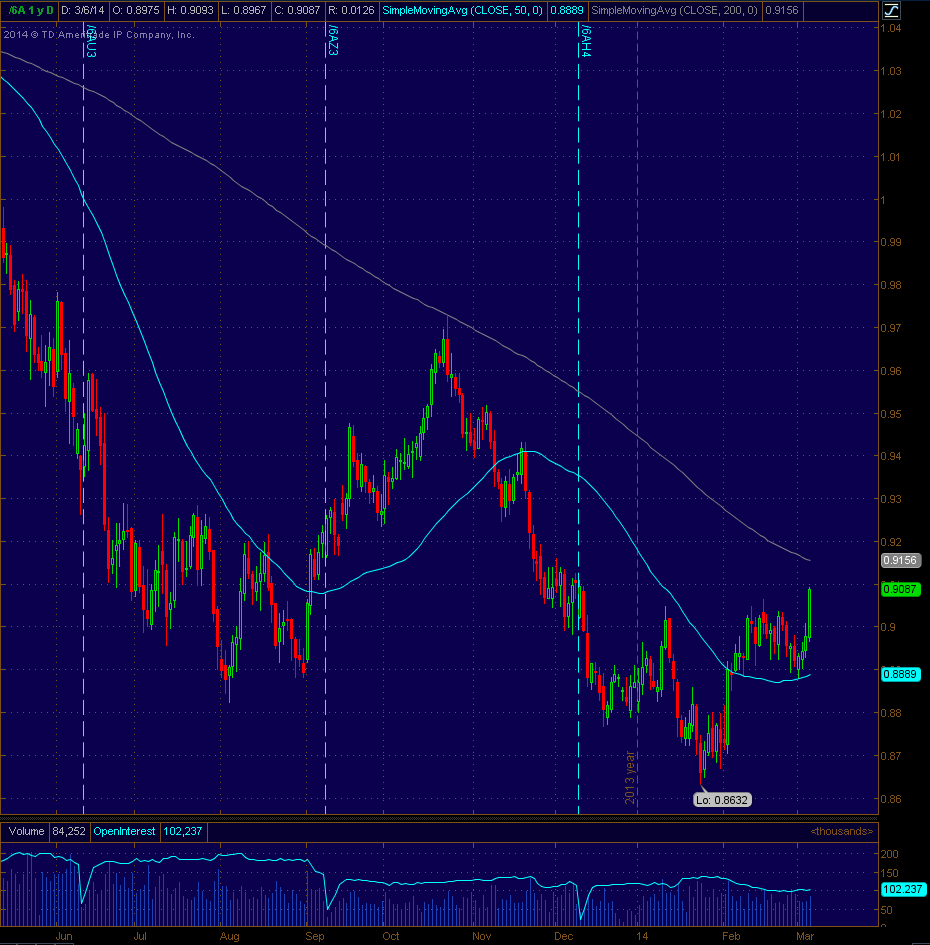
Short Opportunity in the Aussie Dollar

Aussie

The Aussie rallied as a result of the GDP report printing a touch better than expected at 0.8% vs. (E) 0.6% m/m and 2.8% vs. (E) 2.3% y/y. And, that rally is continuing this morning thanks to strong Australian export and retail sales data.  Aussie has now traded through the .90 level versus the dollar, which I believe is a great entry point to open, or add to, short Aussie positions. Quite simply, I don’t think the Reserve Bank of Australia will allow appreciation in Aussie materially past the $0.90 mark. You can either short outright Aussie dollar futures or shorts FXA, or buy the ProShares UltraShort AUD ETF (CROC); however it is “trade by appointment” at an average of between 10K and 20K shares traded a day.


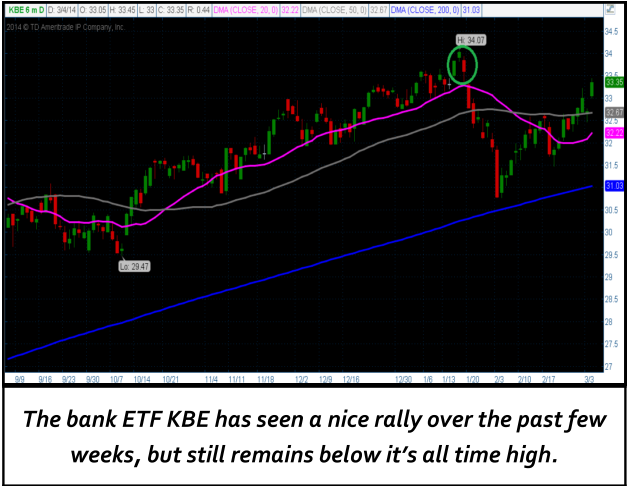
Bank Stocks Remain a Great Value at Current Levels

KBE

I would continue to look to under-performers that have bottomed out and can play catch-up if the U.S. and global economy continues to gradually grow:  banks via KBE, retailers via RTH, industrials (the Dow remains well off the highs) via DIA, and global miners via PICK.

Sevens Report Analyst Tyler Richey Featured on Market Watch Discussing Crude Oil Prices

Oil Prices Retreat from 5 Month High

The Economy: A Look Back and What’s Ahead (3.3.14)

Last Week

Economic data was better-than-expected last week and helped further break the previously relentless string of “misses” versus expectations.  And, although economic data was somewhat overshadowed last week by events in the Ukraine and as investors looked ahead to the critical week of data looming, there were some important anecdotal releases that imply the drop-off in economic data we saw in December/January is leveling off. That helped stocks rally to new all-time highs.

New home sales data were shockingly good, rising to 468K saar, a multi-year high (and the highest level since the economic recovery started).  But, while the number was much better-than-expected, it was driven higher by big sales gains in the Northeast and South. Seeing as they were the hardest-hit regions weather-wise in January, it doesn’t exactly reinforce the “weather” explanation for all the other disappointing data.

Regardless, the market liked the report and homebuilders caught a bounce because of very low new home inventories and strong pricing going forward.  Looking beyond this one positive report, though, most of the January housing data showed the recovery is continuing to lose positive momentum. It’ll be very important for the longer-term health of the market and the economy to see the housing data stabilize once the weather “noise” is out of the reports.

Durable goods was the other notable release from last week, as the key “New Orders of Non-Defense Capital Goods ex-Aircraft” rose 1.8%, after the December number was revised lower from –0.6% to –1.7%.  The market also welcomed this number, as it implies we’re not seeing the very steep drop-off in capital expenditures from businesses that the January durable goods repot implied.

Finally, the most-effectual piece of data from an investment standpoint last week came from Europe.  The February flash HICP (their CPI) saw “core” HICP rise 1.0% year-over-year in February, higher than the 0.8% that was expected.  That’s important because it almost certainly removes any chance that the ECB will take further accommodative action at this week’s meeting (or beyond that, for the foreseeable future).  And, that is a continued positive for the euro and high-yielding European bonds, which remain my favorite destination for any fixed income capital that can stomach some degree of risk.

Turning to the Fed, Janet Yellen gave the Senate portion of her “Humphrey-Hawkins” testimony Thursday, after the initial date was postponed by weather.  The testimony was expected to be a non-event, as everyone assumed she would largely repeat what she said at the House testimony two weeks earlier, and it met those expectations.

Yellen again reiterated that the Fed’s strong preference is to continue tapering QE, although it’s not on a “pre-set course.”  And, weather has played a role in the recent disappointing data, but to what extent isn’t clear.  Bottom line is the outlook for Fed policy remains the same:  It will take seriously weak data this week to get the Fed to delay further tapering of QE at the March meeting.

This Week

Economically this is the most important week of the year, plain and simple.  And, it’s important because we are going to get a lot more insight into the two critical “macro” questions the market is currently facing:  Was the dip in U.S. economic activity the past two months mostly due to weather?  And, is the Chinese economy stable, or is it contracting further?  Where the market goes in the coming weeks will depend on both answers.

Starting with the global manufacturing PMIs, we’ve already gotten the Chinese PMI (it beat expectations and importantly stayed above the 50 level) and the European data, while the U.S. report comes at 10 AM this morning.  Global composite PMIs (both service sector and manufacturing) are released Tuesday night in China and Wednesday morning in the EU and U.S.

In addition to getting the latest insight into the state of the global economy, it’s also jobs week here in the U.S.  ADP comes Wednesday, jobless claims and Challenger layoff survey is Thursday, and then the all-important government jobs report is Friday morning (early estimate is for 150K).

This jobs report, and to a slightly lesser degree the PMIs later this morning, are the doves’ last chance for the data to alter the outlook for Fed policy.  If the jobs numbers remain low (say another sub-100K print with the December/January numbers unrevised), then the outlook for a further tapering of QE in March will be called into question, although I personally think the data will have to be pretty bad to “taper the taper.”  But, if there’s a chance for it to happen, it’s going to be this week.

There is also a Bank of England and ECB meeting Thursday morning, although given events of last week (the EU HICP) neither bank is expected to alter policy. Both meetings should be relative non-events.

Bottom line is we will have a lot better insight into the state of the U.S. and global economy at the end of this week, and how those economies “look” will dictate which direction equity markets trade over the coming weeks, regardless of what happens in the Ukraine.