S&P Chart: Strikes New All-Time High
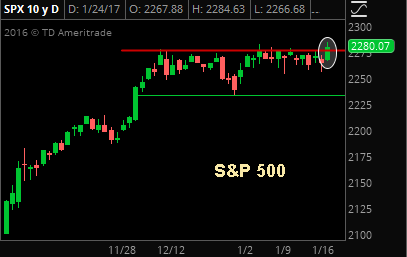
S&P Chart: “A new high” is the oldest confirmation signal of a bull market in technical analysis and the S&P reached a new all-time high yesterday leaving the path of least resistance higher still from here.



S&P Chart: “A new high” is the oldest confirmation signal of a bull market in technical analysis and the S&P reached a new all-time high yesterday leaving the path of least resistance higher still from here.
10 Year Treasury: The greenback ended a volatile week little changed as the Dollar Index dropped more than 1% last Tuesday after now-President Trump called it “too strong.” Then a hawkish tone from Yellen on Wednesday, and dovish comments from ECB President Draghi Thursday, helped reverse that initial decline. The Dollar Index ended the week down 0.30%.
The headline volatility around the dollar last week is likely a preview of what’s to come over the next year (it’s going to be a good one for currency brokers) because while the trend in the Dollar Index remains clearly higher, there will be bouts of sharp declines due to politics, economic data, etc. However, at its core, the rising dollar is an economic and interest-rate phenomenon, not a political one.
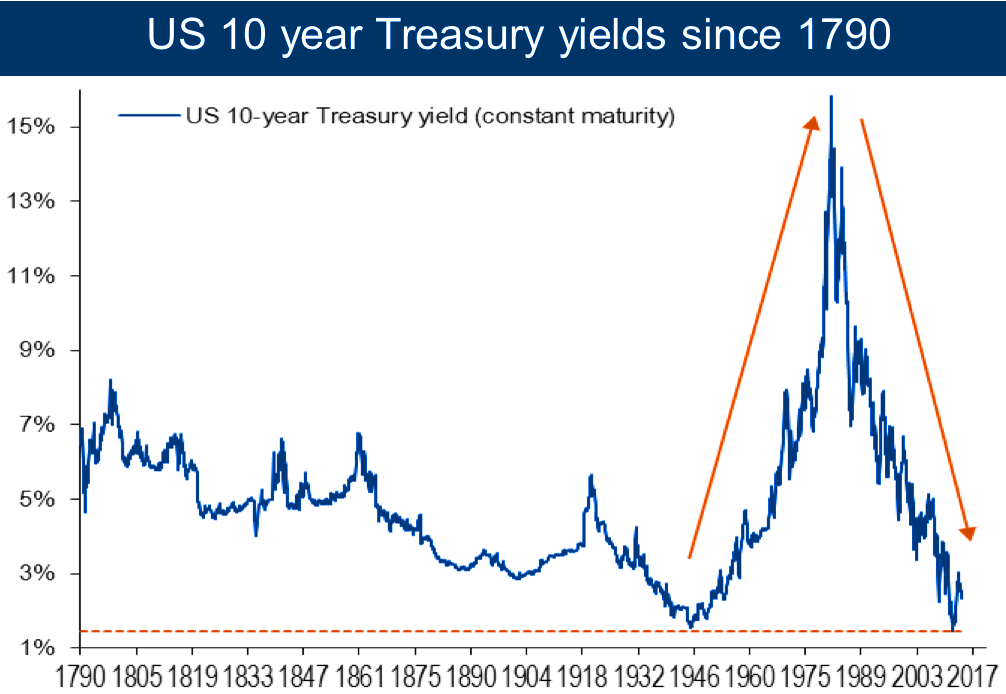
Turing to bonds, yields were sharply higher last week on a combination of firm inflation data (CPI, Prices Paid indices, Beige Book commentary) and Yellen’s hawkish tone from Wednesday. The 10-year Treasury yield rose 7 basis point while the 30-year yield rose 6 basis point, the first weekly rise since early December.
Going forward, depending on economic data, it looks like this counter-trend rally in a greater bond decline is coming to an end, and we are watching 2.60% in the 10-year yield specifically. If that level is broken, then we could see a potentially sharp acceleration in Treasury yields, and stocks will definitely start to notice if/when the 10 year approaches 3%. Economic data needs to continue to accelerate for stocks to weather that type of a rise in yields.
This Week
The key number to watch this week is the flash manufacturing PMI out tomorrow. As stated, that number needs to remain firm for general market psyche, because we’re likely to encounter at least temporary disappointment on the fiscal stimulus front in the next few weeks (as is typical in Washington).
Beyond the flash global PMIs, Durable Goods and Q1 GDP are the two next most important numbers. Durable goods will offer the latest insight into business spending, which needs to continue to accelerate. GDP won’t mean much from a market standpoint but the media will cover it, and anything north of 3% will be taken as a positive (although a number that high is unlikely). For all the optimism over future growth, right now the economy is still stuck in 2%ish annual growth mode, just like we’ve been for the last several years.
Finally, Existing Home Sales comes Tuesday, and as we mentioned last week, it’s critical to the economy that the housing recovery doesn’t get derailed by higher rates. Last week’s Housing Starts data was mixed, so focus will remain on the December data, as that was the first full month of consistently higher rates.
Bottom line, the key here is acceleration in the data. Better economic growth and hope of fiscal stimulus has powered stocks higher, but the latter will likely get delayed due to regular Washington shenanigans. To counter that, growth needs to continue to accelerate.
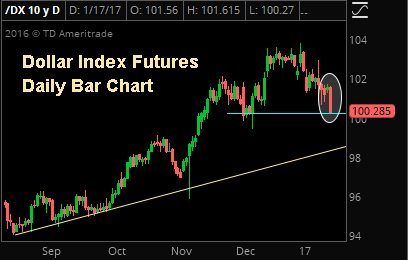
The dollar index fell into a key support level yesterday as the market remained in “Trump-Off” mode. If support just above 100 is violated, dollar index futures could quickly fall back to the uptrend line pictured above, near 98.00
Donald Trump and British PM Teresa May were the two major influences on the currency markets yesterday, as Trump’s comments to the WSJ over the weekend about the dollar being too strong, combined with May’s Brexit address being slightly less hardline than feared, caused a big drop in the greenback. Meanwhile, the pound surged nearly 3% (it’s best day since ’08). The Dollar Index closed down 0.75%.
Starting with the biggest mover on the day, the pound hit fresh multi-decade lows over the weekend on fears of PM May taking a hard line in her Brexit address (the pound briefly broke through 1.20 late Sunday). But in her comments yesterday, May said that while she will seek a clean break from the EU, any final deal will be put to a vote before Parliament.
It was the last point that ignited the pound rally, because while the news of the vote isn’t exactly positive (it will still be a “hard Brexit”) it does introduce some sort of moderating force and influence into the negotiations. And, since it was unexpected, it caused one massive short-covering rally.
Going forward, do we think today’s news marks the low in the pound?
No, not unless US economy rolls over. That’s because Brexit will be a consistent headwind on the pound for quarters and years (May said she will begin a two-year negotiation with the EU in late March). Unless you are a nimble traders, we certainly would not want to be long the pound, as we don’t think this is the start of any material rally (again, absent any rollover in the US data).
Turning to the US, Trump’s comments about the dollar being too strong over the weekend and “killing” US manufacturing hit the currency. As a result of those comments, all other major currencies were universally stronger vs. the buck. The euro and yen rose 0.80% each while the Aussie rose 1% and the loonie rose 0.60%. Nothing particularly positive occurred with those currencies, they were simply reacting to dollar weakness.
Going forward, at this point I don’t see Trump’s comments as necessarily dollar negative, and for one simple reason. If he accomplishes his goals of tax cuts, infrastructure spending and deregulation, the Fed will hike interest rates much more aggressively than is currency expected, as inflation will accelerate—and that will be demonstrably dollar positive despite what Trump says.
Near term, clearly the momentum is downward, and the dollar is testing support at 100.24. A close below that level likely opens up a run at, and through, par, with truly firm support resting in the high 90s.
Turning to Treasuries, they also traded Trump Off yesterday, in part due to the uncertainty of Trump’s comments (generally though, he didn’t say anything Treasury positive), and the 30 year rose 0.60% while the 10 year rose 0.35%. The 10 year hit a fractional two-month intraday high while yields on both bonds hovered near two-month lows.
Much like the dollar, we don’t see the recent Trump Off rally in bonds as longer-term violation of the new downtrend. Again, that’s based on the simple fact that if growth accelerates, so will inflation, and the Fed will have to hike rates faster than is expected—and that will power bond yields higher.
Near term, clearly we are seeing consolidation. If today’s CPI is light, and the Philly Fed is light later this week, and if Yellen is dovish in her comments, then we could see the 10-year yield test 2.30%. Longer term, unless we see a big reversal in economic growth, this counter-trend rally in bonds remains an opportunity to get more defensive via shorter duration bonds, inflation-linked bonds (VTIP) or inverse bond ETFs.
 Stock Market Update excerpt from the Sevens Report: Foreign markets were open yesterday, and generally traded lower on consolidation, but overall the weekend was quiet and nothing negative occurred.
Stocks finished last week little changed, as a Friday rally helped recoup losses from earlier in the week. Some of the shine was taken off the “Trump Trade” following a disappointing press conference. The S&P 500 slid 0.10%.
The important price action last week didn’t come until Wednesday, when Trump’s first press conference as president-elect failed to deliver any specifics on timing for tax cuts, infrastructure spending or deregulation. Following the press conference on Wednesday, stocks immediately dropped and turned modestly negative, although buyers stepped in and the markets recovered in the afternoon to close slightly higher.
Then, stocks dropped nearly 1% in early Thursday trade, again on Trump disappointment. But support at 2250 held, and stocks were able to recover most of the day’s losses to finish down slightly (-0.28%).
On Friday, markets rallied thanks to generally “ok” economic data, and following the two resilient performances following the Wednesday/Thursday sell-off. Stocks were higher most of the day, although they gave back some of their gains Friday afternoon to finish slightly higher.
Stock Market Update: Trading Color
Tech and healthcare remain the two surprise star performers of 2017. Tech was driven higher by internet stocks (which have become the recipient of capital inflows again as investors search for value in an extended market) as (ETFs Restricted to Subscribers) our preferred internet ETF, rose more than 1%. Semiconductors also traded well despite a profit warning from TSM.
Healthcare, meanwhile, weathered a surprising negative comment by Trump and still rose last week. Healthcare remains one of our preferred contrarian allocations for 2017 based on too-negative sentiment, valuation and overdone political risk.
Looking at broad trends, the Trump trade sectors took a breather last week as banks rose slightly while energy declined on the fall in oil, and industrials underperformed. However, despite the slight decline in stocks, defensive sectors lagged as utilities and consumer staples finished modestly weaker. We expect that consolidation of the Trump trade to continue until there are hints of policy specifics.
Bigger picture, there was no clear rotation out of defensives and into cyclicals, and sector trading has been more catalyst driven in 2017. From an activity standpoint, volumes have returned to pre-holiday levels and we expect that to continue.
Stock Market Update: Bottom Line
Some shine came off the Trumpenomics rally last week due to his lack of specifics on tax cuts, deregulation and infrastructure spending at his press conference. But as we said in the Report last week, and as the resilient price action confirmed, the market will continue to give Trump/Republicans the benefit of the doubt through most of Q1. As a result, policy disappointment alone will likely not cause a near-term pullback in stocks. However, it is important to realize that the single-biggest medium/longer-term threat to the markets is political disappointment (which could cause a steep pullback in Q2/Q3).
Focusing on the near term, there are two specific reasons that the market is giving the new administration/government leeway. First, economic data was getting better pre-election, and if the data continues to improve, that means that one of the two reasons behind the Q4 rally will remain in place. Second, the market knows Washington is slow, even with one party in power. So, it’ll take something besides lack of policy clarity to cause a near-term pullback in stocks, (some risks to watch there are slowing economic data, more than three Fed rate hikes in 2017, or Chinese trade tensions).
On the flip side, if stocks are to break materially higher, we will have to get specifics on corporate tax cuts in the coming weeks. The other two pro-growth initiatives championed by Republicans (deregulation and infrastructure spending) aren’t as critical as corporate tax cuts, and that remains the key to helping the S&P 500 break materially above 2300.
From a tactical standpoint, we would continue to hold broad allocations to stocks. If you’re putting new money to work, we would focus on the value sector of the market (ETFs Restricted to Subscribers) over cyclicals or defensives.
Tactically, Europe (ETFs Restricted to Subscribers) and healthcare (ETFs Restricted to Subscribers) are two attractive contrarian opportunities, in our opinion, while banks (ETFs Restricted to Subscribers) remain attractive longer term but seem to be consolidating. We therefore wouldn’t initiate a position here (we’re holding our position and waiting for a further pullback to add to it). Bottom line, lack of policy specifics won’t reverse the rally, but some specifics have to emerge soon if this rally can continue.
This Week
Earnings come into focus this week, as it’s the first week of major company reports from virtually every sector. Unless the results are terrible or fantastic, they shouldn’t move markets too much, as potential fiscal stimulus remains the key focus right now.
From a macro standpoint, there is consistent economic data throughout the week, but CPI on Wednesday is the key number. Then we have Yellen making two speeches (Wednesday and Thursday), and comments on policy could pop up given the topic of both speeches.
Finally, as if I needed to remind anyone, Inauguration Day is Friday, and though it likely won’t have any direct market impact, it is a positive in so much as we will move forward (hopefully) towards some policy clarity.
Our paid subscribers know we will give them the succinct analysis they need to communicate effectively with their clients and strengthen their relationships.
Did you enjoy the “stock market update” excerpt?
Why not make an investment in yourself and your business? We are confident it will produce returns many times greater than the $65 per month subscription cost.
As a courtesy, I am extending a limited time, special offer to new subscribers of our full, daily report that we call our “2 week grace period.”
If you subscribe to The Sevens Report today, and after the first two weeks you are not completely satisfied, we will refund your first quarterly payment, in full, no questions asked.
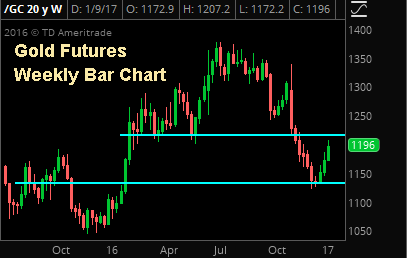
Turning to gold, we saw an unwind in the Trump Trade that has dominated the markets since the election yesterday morning. Reason being, the markets did not gain the clarity they were hoping to from Trump’s press conference Wednesday, so basically investors were left disappointed.
Stocks pulled back, the dollar declined and bonds rallied, all of which supported the early gains in gold. Looking ahead, if the dollar continues to grind lower and the bond bounce continues, gold will be able to extend recent gains. But until futures can establish themselves above the $1235 congestion area, this still needs to be considered a rebound in an otherwise downward trending market.
t.
Wednesday was volatile as Trump’s press conference induced a mid-day sell off, but stocks recovered after lunch to finish with moderate gains. The S&P 500 rose 0.28%.
The markets are now experiencing “Trumponomics.” The Sevens Report, a daily macro-economic report for financial advisors, just released it’s “Stock Market Update: Investors Guide to Trumponomics.”
Stock Market Update
 Stocks were basically flat throughout the morning yesterday in what was very quiet trading. Trump really dominated the narrative all day yesterday as the Russian “dossier” story weighed on sentiment slightly pre-open on Wednesday, and that was made worse by the fact that there was no economic data or corporate news to distract from the Trump story.
So, stocks opened basically flat and chopped sideways ahead of the Trump press conference at 11 a.m..
As we said earlier this week, this event had the potential to move markets and, at least temporarily, it did not disappoint.
The press conference was full of figurative fireworks but the fact that there was absolutely no mention of fiscal stimulus or tax cuts hit stocks (as we cautioned it might in our preview on Wednesday). First, Trump’s left field comment about reducing the cost of drug prices sent biotechs into mini free-fall, and that took healthcare lower which weighed on the whole market. Then, after a brief rebound, stocks rolled over again after Trump failed to imply a timeline for tax cuts of fiscal stimulus.
But, the market is giving Trump and the Republicans the benefit of the doubt and his omissions weren’t damming yesterday (yet). So, stocks rebounded after lunch and rallied throughout the final two hours of trading to close basically at the higher of the day. Oil, which accelerate higher during the afternoon, also helped stocks rally, as oil remains an important short term influence over stocks.
Stock Market Update: Trading Color
 Trump dominated sector trading as well yesterday as this comments about “bidding” for drug prices hit biotech stocks (NBI dropped nearly 3%) and healthcare more broadly (XLV fell 1%). XLV the only SPDR we track to finish negative yesterday.
But, it wasn’t just the biotech comments as the quasi disappointing press conference did cause some defensive outperformance as utilities rose 1%. Besides energy (XLE), which was up on the oil rally, utilities were the best performing SPDR in the markets yesterday.
Continuing that cautious theme, cyclical sectors also rose (again every SPDR except healthcare was higher yesterday) but banks, tech and industrials were up just .5%., so clearly there was no real, cyclical outperformance.
So, Trump’s comments (or lack thereof regarding tax cuts of stimulus) took some wind out of the cyclical led “Trump Trade” sails yesterday.
Bottom Line
Yesterday’s price action after the press conference gave us some important insight into how we can expect stocks to trade over the next few weeks:
The fact that there was no mention of tax cuts, infrastructure spending or de-regulation by Trump weighed on stocks temporarily Wednesday, and bigger picture that lack of specifics does threatens to undermine the post Election rally.
But, while stocks are lower this morning mostly because of that disappointment, yesterday’s press conference likely won’t cause a material unwind of the “Trump Trade” because the market is still willing to give Trump/Republicans the benefit of the doubt on a lack of policy specifics. So, this morning’s dip aside, don’t expect lack of policy clarity alone to cause a pullback near term (it’ll take something additional like Chinese currency volatility, bad economic data, etc.).
But, beyond the short term (and I mean the next 2-4 weeks) the biggest risk to stocks is the gap between market expectations of tax cuts and pro-growth policies, and the potential political reality. And, yesterday’s press conference did nothing to reduce that risk.
As I said in the Trump Press Conference Preview, if the market does not get some evidence that corporate tax cuts are progressing and forthcoming by the middle of Q1, that will begin to weigh on stocks.
In the mean time, the benefit of the doubt remains with the bulls but the S&P 500 is still at a valuation ceiling at 18X forward earnings, and it’s going to take evidence of looming pro-growth policies to help stocks punch materially through recent highs.
Thoughts on Healthcare
Trump’s surprise comments on bidding for drug prices caught markets by surprise and hit healthcare and biotech stocks yesterday, but at this point that general rhetoric isn’t enough to make me abandon my long position.
That may change once we get some actual policy specifics but for now that comments seemed more like populist rhetoric than anything actually concrete, and I imagine the complicated Obamacare repeal will likely dominate any healthcare related policy in the first half of 2017. Put another way, they will have enough to worry about ensuring that coverage continues for Obamacare recipients, never mind changing national drug pricing structures to the detriment of biotech firms.
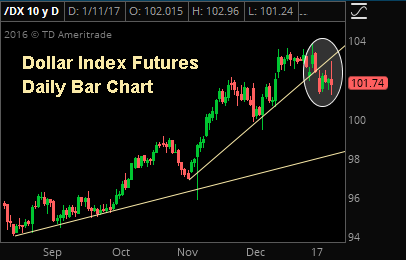
The dollar index traded down to a one-month low yesterday as the markets grew cautious after Trump failed to divulge details of his administrations’ plans after inauguration, most notably corporate tax reform.
Stock Market Update excerpt from the Sevens Report: Stocks gave back most of Friday’s gains on Monday thanks mostly to digestion of last week’s rally ahead of some important catalysts later this week (Trump’s speech Wednesday specifically). A sharp drop in oil also weighed on the averages. The S&P 500 fell 0.35%.
Stocks started Monday mostly flat following a quiet weekend. There were actually macro positives yesterday, primary of which was the Chinese currency reserve data. But economic numbers from Germany were also strong Monday morning.
Then a drop in oil offset those positives, and as a result stocks opened lower and fell basically to the lows of the day within the first 30 minutes of trade, again thanks almost entirely to oil.
From those lows, stocks basically traded sideways for the remainder of the session. There were potential catalysts including Fed speakers and the Consumer Credit number at 3:00 p.m. yesterday, but none of it provided any material surprises, and nothing changed the general outlook for markets. Stocks chopped sideways in the afternoon before closing near the lows of the day.
Stock Market Update: Trading Color
 Healthcare and super cap internet stocks were again the positive story yesterday, and five trading days into 2017 they are the clear surprise winners so far.
Healthcare was the lone positive SPDR yesterday, rising 0.42% again mainly on biotech strength. Meanwhile, super cap internet stocks (think FANG—FB/AMZN/NFLX/GOOG) rallied again yesterday and FDN, our preferred super cap internet ETF, rose 0.25%.
Away from healthcare and internet names, selling was broad yesterday as eight of the nine SPDRs we track declined. Energy was an obvious laggard due to the drop in oil, as XLE fell 1.45%. Oddly, utilities also fell sharply (down 1.3%) despite the decline in bond yields.
Financials, industrials and consumer staples all relatively lagged the S&P 500, but didn’t fall by more than 1% while tech was again another relative outperformer, with XLK down fractionally.
Single stock news was virtually non-existent yesterday, and trading from an activity and volume standpoint was very quiet. General digestion remains the best way to describe yesterday’s price action.
Did you enjoy the stock market update excerpt?
To start 2017, I am continuing to extend a special offer to new subscribers of our full, daily report that we call our “2 week grace period.”
If you subscribe to The Sevens Report today, and after the first two weeks you are not completely satisfied, we will refund your first quarterly payment, in full, no questions asked.
Stock Market Update from The Sevens Report: Stocks declined for the first time in 2017, but the losses were small, as disappointing retailer earnings offset more decent economic data ahead of the first big catalyst of the year… the December jobs report. The S&P 500 declined 0.08%.
Stocks were flat at the start of Thursday trade, as very poor results from KSS and M offset more decent global economic data. US data yesterday was mixed, but generally “fine,” as jobless claims dropped sharply (ADP missed estimates, but not terribly so) and ISM Non-Manufacturing PMI slightly beat estimates. In total, none of the data points altered the narrative around the economy or Fed expectations, and stocks opened flat and chopped sideways with small gains until the oil inventory number.
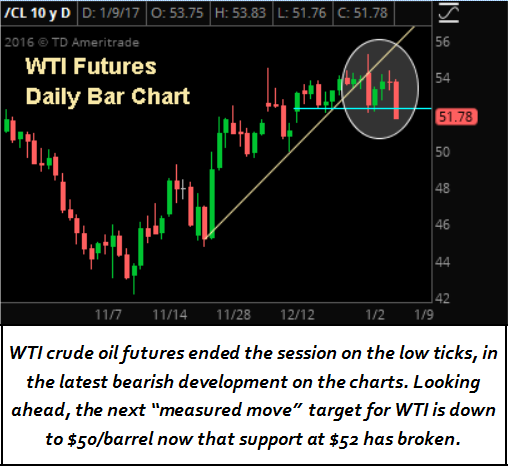
 The weekly oil inventory report was taken initially as bearish, and that caused a pullback in stocks as the drops in oil at 10:30 and 11:00 led the break lower in the major averages, as oil remains a shorter-term influence over the stock market. But both oil and stocks bottomed for the day right around 11:30, and both began rallies that lasted until oil’s close at 2:30. With no other notable news (and an important jobs report this morning) stocks chopped sideways before closing slightly lower.
Stock Market Update: Trading Color
From a sector standpoint it was quiet outside of financials and retailers (more on those in a second). No SPDR we track moved more than 0.50% yesterday, and trading was mixed excluding financials. Three of the SPDRs we track traded higher (led by healthcare (XLV +0.45%) while five SPDRs were lower (led by industrials, XLI -0.30%). There was no notable news that caused the moves in these sectors, and most of it was just general positioning.
The same cannot be said for financials and retailers, as banks dropped 1.7% and financials fell 1.2% on the drop in bond yields, as the 30-year Treasury yield hit a one-month low.
Retail, meanwhile, got hammered courtesy of KSS and M, which plunged 19% and 14%, respectively. That dragged down XRT, the retail ETF (-2.4%). Notably, though, the broad consumer discretionary SPDR, XLY, declined only 0.11%, and that reinforces what I said earlier Wednesday that the KSS and M prints are a retail business model problem (i.e. too much brick and mortar, not enough online) not a consumer spending problem (and that’s a positive for the economy broadly). The traditional retail sector continues to face stiff structural headwinds, and I’m not interested in buying dips.
Finally, looking at tech, semiconductors continued to fall but they held support at 900 in the SOX. A break of that makes me short-term nervous on stocks. Meanwhile, our old friends the FANGs (FB/AMZN/NFLX/GOOGL) all traded well and FDN rose 1.1%. While not as powerful as they were in 2015, owning super-cap internet stocks continues to make sense for longer-term investors, as those companies continue to be on the edge of innovation in tech.
Looking ahead to today, the risk here is for a soft jobs report due to ADP and if the report but unless the S&P 500 breaks support at 2239 the short term trend remains higher.
Why Chinese Yuan Volatility Matters to You
One of the more important, but underfollowed, stories in the financial media this week has been the surge higher in the Chinese yuan. That move caused the dollar drop yesterday, and it’s an uncomfortable reminder of yuan-inspired stock volatility in January 2016.
Understanding yuan trading dynamics is about as exciting as reading stereo instructions (and in some cases just as complicated), so I’m not going to bore you with the details. But, it is important you understand 1) What’s happening with the yuan, 2) Why it’s a risk to stocks and 3) How to hedge against a yuan-inspired decline in stocks.
What Happened: Since the election, the yuan weakened relentlessly vs. the dollar. And as we started 2017, it was in danger of breaking the psychologically important $7.00 level. A break of that level is a problem for two reasons. First, it would provide fodder for China hardliners in the Trump administration to get tough on trade, because the currency would be so weak. Second, it would put stress on China’s ability to control the yuan, as a break of the level would invite more selling of the yuan.
So, to support the yuan, Chinese authorities intervened in the markets starting on Wednesday, and continued on Thursday, and the results were significant—the yuan surged nearly 2% in two days, the biggest two-day move since 2010.
Why It Matters: There have been two periods in the last two years where we’ve seen this level of yuan volatility: Aug/Sept ’15 and Jan ’16. Both periods saw deep, sharp and scary stock market pullbacks, because the yuan gyrations caused a loss of confidence in the Chinese economy/authorities. Fearing a Chinese “hard landing,” global investors sold first and asked questions later.
Today, the causes of yuan volatility are different, and I don’t think we’re on the precipice of a yuan-inspired pullback in stocks just yet. But, the chances are rising.
The reason why is the yuan declines aren’t over. That’s because the decline in the yuan is a product of 1) Fears of trade disputes with a Trump administration hurting the Chinese economy and 2) A relentlessly rallying dollar, which will force the yuan lower and risk a recession in China.
Everyone knows both these longer-term trends (higher dollar/weaker yuan), which is why Chinese citizens are trying to exchange yuan for dollars or other currencies. And it’s why the Chinese government has imposed capital controls preventing citizens and companies from doing just that!
Near term, Chinese authorities can support the yuan and continue to defend the $7.00 level by selling foreign currencies from their massive forex reserves (when you sell a currency against the yuan, the yuan goes up). But that can’t last forever, and if their forex reserves drop below $3 trillion, markets will start to get nervous about China’s ability to keep the yuan stable. This is particularly important, as over the weekend China will release its currency reserves for December. That number better be above $3 trillion, or Monday could be a down open.
How We Position for It: Again, I’m not saying this yuan volatility will cause a pullback, but the chances of a one-time, large yuan devaluation are rising, and that could cause global macro volatility in Q1. From a positioning standpoint, the best way to hedge against a China-inspired pullback in stocks is EUM, the inverse emerging market ETF. That ETF protected portfolios in Sept/Aug ’15 and Jan ’16, and I’m confident it will do so again if China/yuan volatility causes a pullback in stocks.
Bottom line: The yuan volatility is not a problem for stocks yet, but I do want everyone to understand the context in case we do see a big, one time devaluation of the yuan in Q1 2017, as that might cause a knee-jerk, “risk off” trade of lower stocks/lower commodities/lower dollar/higher Treasuries.
Going forward, the two key numbers to watch are $7.00 yuan/dollar (a break above that level is bad) and $3 trillion Chinese Foreign Cash Reserves (a break below that number would be bad). If either occur, chances of another China-inspired pullback in stocks will rise.
Did you enjoy the “Stock Market Update” excerpt from The Sevens Report, please sign up for our updates or subscribe and get a two week money back guarantee.
Stock Market Update excerpt from The Sevens Report. Stocks surged to start the new year as a resumption of the Q4 “Trump/Reflation” trade, along with strong economic data sent stocks moderately higher to start the year. The S&P 500 rose 0.85%.
Stocks were higher from the outset Tuesday in part because they needed to play catch up to foreign markets, which rose on Monday while the US was closed. But, even without the foreign tailwind, US stocks would have been higher Tuesday as there was a clear resumption of what outperformed in Q4. Cyclical stocks, the dollar and oil were higher while bonds were lower. That “reflation” trade accelerated following the open after strong December ISM Manufacturing data.
 Markets lost a bit of momentum midday as politics interjected into yesterday’s trade (a theme we should all get used to in 2017). Trump’s tweet about GM (he mentioned border taxes) helped stoke some worries about trade issues for 2017 (although the announcement that Ford was keeping a plant in the US was met positively). The Stock Market drifted lower on general digestion, and hit the lows for the day up just 7 points in the S&P 500. However, stocks bounced off intraday support at 2245 and rallied during the final 30 minutes to finish with solid gains.
Trading Color
Volumes and activity still muted yesterday, and while certain sectors did mimic Q4 performance (cyclicals did outperform), it wasn’t overall compelling outperformance. The major indices all finished with similar gains (there was no Russell 2000 or Nasdaq outperformance).
From a sector standpoint, there was cyclical outperformance as financials (XLF) and energy (XLE) both rallied more than 1% while utilities dipped 0.25%. However, it wasn’t a true out-of-safety, into-cyclicals rotation, as consumer staples had a decent day, up 0.40%, and REITs rose 1.33%. Finally, healthcare traded well to start the year, with XLV up 1.3%. The sector remains one of my contrarian ideas for 2016 due to negative sentiment and overblown political fears.
Did you enjoy the “Stock Market Update” excerpt from The Sevens Report? Please sign up for free market updates or subscribe and get a two week money back guarantee.