Why Stocks Rallied on Thursday

What’s in Today’s Report:

  • Why Stocks Rallied on Thursday
  • Policy Spread Update (Rate Cuts Imminent?)

Futures are slightly lower on digestion of Thursday’s rally and as markets await bank earnings this morning.

Fed balance sheet news overnight was mixed, as total usage of the Discount Window and BTFP dropped to $139 bln from $149 bln, but that’s still very elevated and it underscores there’s still stress in the regional banks.

Focus today will be on economic data and earnings, and the key here remains stability in both sets of reports (so no major disappointments).  Important economic reports today include, in order of importance, Retail Sales (E: -0.4%), Industrial Production (E: 0.3%) and Consumer Sentiment (E: 62.7).

Earnings season starts today and key reports we’re watching include: JPM ($3.41), C ($1.66), WFC ($1.15), PNC ($3.60), BLK ($7.73), UNH ($6.24).

Finally, there’s one Fed speaker, Waller at 8:45 a.m. ET but he shouldn’t move markets (the Fed message is very consistent right now).

Tom Essaye on USA TODAY – His Take on Market and Economy Surge

“The stock market is relentless in asking the question, ‘What’s next?’ ” says Tom Essaye, founder of the “Sevens Report,” a financial newsletter. “The idea of ‘peak everything’ is a legitimate one. There is a fear that … while things are great right now, it’s as good as it gets.”

Access the full USA TODAY article here.

Why “Credit Impulse” Matters to You, June 21, 2017

Credit Impulse Explained: There are many analysts and investors who believe that the entire ’09-’17 stock rally is nothing more than the result of a historic, globally coordinated credit creation event from the world’s major central banks. Put in layman’s terms, every major central bank in the world has done QE at some stage over the past eight years, and pumped the world full on cash. So, all they’ve done is create massive asset inflation in bonds, stocks and real estate.

Help your clients outperform markets with The Sevens Report—start your free two-week trial today.

Credit ImpulseQE is Quantitative easing. It is a “monetary policy in which a central bank creates new electronic money in order to buy government bonds or other financial assets to stimulate the economy (i.e., to increase private-sector spending and return inflation to its target).”

First, the theory goes, it was China’s central bank (the PBOC) and the Fed unleashing the initial wave of QE following the financial crisis in ’08/’09. Both central banks kept their foot on the accelerators over the next several years (remember QE1, QE2, Operation Twist, and then QE Infinity). In 2013, the Bank of Japan joined the Fed, PBOC and Bank of England at the QE party, only they came to really party, and upped the ante by creating a huge QE program.

Then, as the US and Chinese economies showed signs of life (finally) in 2015, the Fed and PBOC paused their QE/credit creation programs. And, whether causally or coincidentally, 2015 turned out to be one of the more volatile years in the markets in the last decade… and US stocks largely traded sideways until early 2016.

But by that point, the ECB had joined the QE party, and the PBOC restarted its credit creation machine following the economic scare of 2H 2015. So, even while the Fed has stopped QE, on a global basis the total amount of QE and credit in the system resumed a steep acceleration, as now the PBOC, BOJ and ECB were doing QE.

Again, coincidentally or causally, stocks broke out in February 2016, and they literally haven’t taken a break in 19 months (excluding two one-night scares with Brexit and the US election).

So, again, while there is no hard proof that this global expansion of credit has powered US (and now global) stocks higher, there certainly is at least a casual relationship if we look at history.

The reason I am pointing this out is simple: There are growing signs that the near-decade-long global credit creation/QE cycle appears to be nearing the end. First, there are the central bank actions. The Fed is hiking rates, and likely taking steps to reduce its balance sheet, draining liquidity from the system.

Second, the ECB appears to be on the verge of tapering its QE program, and while that will still result in a net credit increase for the next year, the pace of credit creation will slow. Finally, and perhaps most importantly, China continues to aggressively reduce credit in its economy, and I’ll again remind everyone the last time they did that, we got the volatility in 2H ’15.

This is where the “Credit Impulse” comes in.

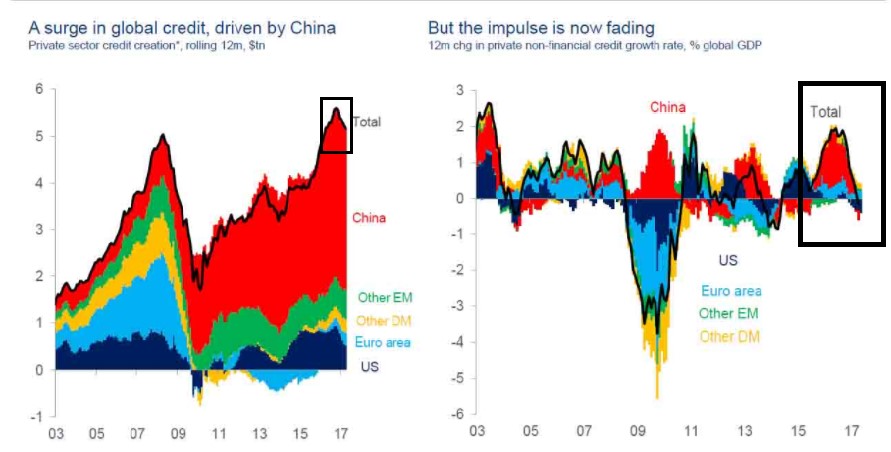
Credit Impulse is a term used by various research firms that measures the “Rate of Change of Change” of global credit creation/QE. Put simply, while the global amount of credit may still be rising, the pace of the increase has not only slowed… it’s turned negative. Similar to taking your foot off the gas while you’re still going forward. It’s just a matter of time until you stop.

Getting more granular, UBS has been out front on this issue, and back in February noted that Credit Impulse turned negative. In a much-anticipated report out last week, the firm said that the decline over the past three-to-four months has accelerated, with Credit Impulse dropping to -0.6% annualized over the past three months.

Now, Credit Impulse is a composite of various measures of credit, including loans, loan demand and other metrics, so this is not a hard-and-fast number. And the fact that it has turned negative doesn’t mean we’re looking at an impending collapse in stocks.

But if we look at the entire picture, negative Credit Impulse; a more-hawkish-than-expected Fed that’s apparently committed to reducing its balance sheet, a Chinese central bank that is apparently committed to reducing credit in that economy, and an ECB that will begin tapering QE in 2018… the fact is we appear to be nearing the end of the post-financial-crisis credit expansion, and with economic growth where it is, I cannot see how that will be positive for stocks longer term.

Bottom line, I’m not turning into ZeroHedge (although they are all over this), but the fact is that I sense a lot of complacence regarding the end of this global credit creation cycle.

People seem to think that because the Fed ended QE and hiked rates, and then nothing “bad” happened, that this means things will be ok. The only problem is they fail to consider that at the exact time the Fed stopped QE, the BOJ, ECB and PBOC all ramped up their QE programs. That means global liquidity continued to expand, and stocks and Treasuries have been the massive beneficiary.

So, there’s what keeps me up at night, i.e., what happens in 12 months if the only central bank still doing QE is the BOJ? Maybe nothing, but I can’t be sure, especially considering current economic growth.

We will continue to watch the tectonic movements in the global economy for signs of stress, because while we enjoy quiet markets and low volatility now, we appear to be on the cusp of an unknown period where the global punch bowl slowly gets removed from the party. And, I’m bound and determined to make sure we don’t get stuck with the proverbial bill. Food for thought.

If you feel like at any moment this market could turn around – and in a hurry—subscribe to The Sevens Report!

What the Election Means to Markets (Updated)

Election Day is just two weeks from this Tuesday, so you’re probably getting the question:

“What does the election mean for the markets?”

Specifically, we want to address, in plain English, what a Clinton or Trump win would mean for:

  • The major asset classes: Stocks, Treasuries, Gold, Oil, the US Dollar and
  • Which stock sectors will be winners or losers

We’re producing this research now because if you’re like advisors who subscribe to The Sevens Report, you’re already getting asked questions about the election, and we want to make sure our paid subscribers have a clear, confident answer if a client or prospect asks about the potential market consequences of a Clinton or Trump victory.   

We’re addressing this for two specific reasons.

  • I haven’t found a good, comprehensive, Plain-English analysis of the election that focuses on the specific implications for all asset classes (not just stocks) and that singles out which stocks or sectors will rise or fall depending on the outcome.
  • The election is obviously a popular topic, and advisors will be talking about it with current clients and prospects. We want to make sure our paid subscribers have the talking points they need to turn those conversations into more assets and more clients
    – because the opportunity will be there for the informed advisor!

That’s why we made sure our election analysis covered all asset classes (not just stocks), because who wins will affect bond prices, oil prices, gold prices and the US dollar.

The election will also produce opportunities in specific stock sectors to outperform into year end, and we want our subscribers well versed in those potential opportunities, so when a prospect or clients asks – they have a specific answer!

As we enter what we believe will be a volatile fourth quarter, we will be dedicated to making sure our subscribers know what’s really driving markets, because we firmly believe volatility is an opportunity to strengthen your relationships with current clients and impress
prospects who are currently with other firms.

We all know that successful advisors grow their books by connecting with high net worth clients, and to build trust with those clients you can’t just repeat company “perma-bull” strategies.

That is why we created The Sevens Report, so that advisors can make sure they have an independent analyst that communicates with them daily, by 7 a.m., and quickly identifies the risks and opportunities for:

  • Stocks
  • Bonds
  • Currencies
  • Commodities, and
  • Interprets what economic data means for the market

The Sevens Report is the daily market cheat sheet our paid subscribers use to keep up on markets, seize opportunities, avoid risks and get more assets.

With a monthly subscription cost less than a single client lunch, we are confident that we offer
the best value in the independent research space.

As a courtesy, we’ve included an excerpt from a recent edition of The Sevens Report that provides a roadmap for the markets given a Trump or Clinton victory.

What the Election Means for Markets

Three Market Winners (Regardless of Who Is Elected)

Infrastructure Stocks: Both candidates will likely expand infrastructure spending. Some names to watch (there isn’t a pure play infrastructure ETF): Restricted for subscribers. IGF is a global infrastructure ETF, but the US makes up less than 1/3 of the ETF, so it’s not a pure play (although still not a bad idea as increased government spending is likely across the globe).

Defense Stocks: Both candidates will likely increase defense spending, at least initially as the push to eradicate ISIS. Obviously given their stated policies it’s more positive for defense names if Trump gets elected, but either way this is a sector that should have a tailwind regardless of the outcome. Our preferred Defense ETF is:  Restricted for subscribers.

Gold: Regardless of who wins the outlook from a political and macro standpoint isn’t exactly rosy, so gold will likely catch a mild bid in either case even if it’s nothing more than as a protest vote by investors (neither candidate is exactly wanted by the markets).

Clinton Victory

Macro View:
The market “prefers” a Clinton win solely because it’s more of the same. So, a Clinton victory should be viewed more as “not bad” for stocks rather than “good” (in the short term) compared to the uncertainty of a Trump victory.

Market Reaction: Stocks: A mild relief rally (relief there were no surprises) but nothing particularly bullish. Bonds: Also a mild relief rally. Oil/Gold: Oil little changed, gold likely modestly higher. US dollar: Little changed.

Winners: Hospitals (Thesis: No Obamacare repeal or replacement, ETF: Restricted for subscribers), gun manufacturers (Thesis: Potential restriction on certain firearm sales. No ETF, best stock,
Restricted for subscribers
). Alternative energy (Thesis: Continuation of investment in alternative energy programs. ETFs:
Restricted for subscribers
.

Losers: Biotech/Pharma (fears of regulation/price ceilings), energy & coal (Thesis: Increased environmental regulation reducing coal and fossil fuel production, ETFs:  Restricted for subscribers. Private prison stocks (Thesis: Clinton said she wants them basically out of business at the debate.  Stocks:
Restricted for subscribers
). Notable: Natural gas may be the exception here and worth a look on a dip as natural gas is the favorite fossil fuel of the alternative energy crowd.

Trump Victory

Macro View: The level of uncertainty regarding his policies will be very high, and that will elicit a “sell first, ask questions later” immediate reaction from stocks. But given the period between Election Day and Inauguration is usually a quiet one for the President Elect, I don’t think a Trump victory will, by itself, cause a material selloff into year end.

Market Reaction:
Stocks: Likely a mild-to-modest selloff, but not a bearish game changer. Bonds:  Treasuries lower near term but not a bearish game changer. Dollar: Lower as markets price in potentially contentious trade deals. Gold/Oil:  Both up (potentially materially) on uncertainty (the former more so than the latter).

Winners: Coal (Thesis: Reduced regulation on coal production and sales. ETF: Restricted for subscribers), energy (Thesis: Relaxed regulatory environment. ETF: Restricted for subscribers), pharma/biotech (Thesis: No risk of price controls or ceilings. ETF:
Restricted for subscribers
), banks (Thesis: Potentially higher rates, rollback of certain Dodd-Frank regulations. ETF: Restricted for subscribers).

Losers: Hospitals (Thesis: Potential healthcare law changes. ETF: Restricted for subscribers). Alternative energy (Thesis: less funding for programs. ETFs:  Restricted for subscribers).

The Worst Election Outcome for Stocks

Given the large shift in the polling towards Clinton over the past few weeks, there are two new threats to the market from the election that I want to cover.

First, the Democrats sweep and win the presidency, Senate and House.

Second, and more likely, the Democrats win the presidency, Senate and shrink the Republican majority in the House.

Now, to be very clear, calling this a threat to markets has nothing to do with politics. These events aren’t a threat to markets because of the Democrats. Instead it’s because the market generally prefers a divided government that can’t really do anything. One party in full control is the opposite of that desire.

So, turning back to the first scenario where the Democrats sweep, that could be at least a temporary market negative because the government wouldn’t be divided and would likely be very active over the next two years.

The second scenario, where the Democrats win the presidency and Senate would still leave us with a divided government.

But, it would also vastly increase the chances of multiple budget/government shutdown dramas over the next two years. I say that because the Republicans would only be able to use the withdrawal of funding to influence policy (similar to what we saw in ’08 to ’12). And, to that point, current government funding is due to expire December 9th, so if this is the outcome of the election, that date will all of a sudden become more important.

Bottom line, Elections can move markets.

In 2012 the S&P 500 dropped 7%
ahead of and after the election, and if we get a negative surprise this year, a similar decline could easily turn the S&P 500 negative year to date.

If you don’t have a morning report that tells you, in plain English, what the election means for all asset classes, and doesn’t specifically identify sectors and stocks that will rally or decline based on the outcome, then please consider a quarterly subscription to The Sevens Report.

There is no penalty to cancel your subscription, no long-term commitment, and it costs less per month than one client lunch!

If all we do is help you avoid any election related pullback in stocks, or give you a tactical idea that can outperform into year end, it will be well worth the quarterly subscription cost!

With thousands of advisor subscribers from virtually every firm on Wall Street and a 90% initial retention rate, we are very confident we offer the best value in the private research market.

I am continuing to extend a special offer to new subscribers of our full, daily report that we call our “2-week grace period.”

If you subscribe to The Sevens Report today, and after the first two weeks you are not completely satisfied, we will refund your first quarterly payment, in full, no questions asked.

Click this link to begin your quarterly subscription today and learn the 10 ETFs and 6 stocks we think will outperform or underperform depending on the election results.

Value Add Research That Can Help You Finish 2016 Strong!

Our subscribers have told us how our focus on medium-term, tactical opportunities and risks has helped them outperform for clients and grow their businesses.

We continue to get strong feedback that our report is: Providing value, helping our clients outperform markets, and helping them build their books:

“Thanks for your continued insight; it has saved my clients over $2M USD this year… Keep up the great work!” – Top Producing FA from a National Brokerage Firm.

“Let me know if there is anything else that you need from us. Thanks again for everything. I really enjoy the Report – it is helping me grow my business and stay on top of things.”
– Independent FA.

“Great service from a great company!!” – FA from a National Brokerage Firm.

“Great report. You’ve become invaluable to me, thanks for everything…! – FA from a Boutique Investment Management Firm.

Subscriptions start at just $65 per month, billed quarterly, and with the option to cancel any time prior to the beginning of the next quarter, there’s simply no reason why you shouldn’t subscribe to The Sevens Report right now.

Begin your subscription to The Sevens Report right now by clicking this link and being redirected to our secure order form.

Finally, everything in business is a trade-off between capital and returns.

So, if you commit to an annual subscription, you get one month free, a savings of $65. To sign up for an annual subscription simply click here.

Best,
Tom

Tom Essaye
Editor, The Sevens Report

Buy, Sell or Hold? (What’s Next for the Markets)

People on Wall Street have a great sense of humor.

I remember thinking that years ago when I started my career at Merrill Lynch, and despite the fact that we’ve witnessed a lot of changes in this business over the years (most of them not good, in my opinion) I’m happy to say there are still a lot of funny people in this industry.

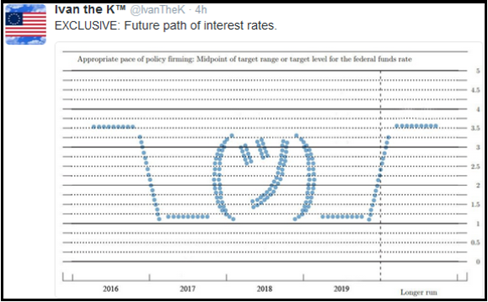
One of them is this guy “IvantheK” who I think is a trader (you never can tell on Twitter).

After the Fed meeting last week, he tweeted this image:

That’s a pretty accurate description of most people’s opinion of Fed policy!

Unfortunately, a dysfunctional Fed isn’t an excuse for advisors (or analysts) to underperform, and blaming a confused Fed for not having a good year won’t keep a client.

So, to keep growing both our businesses (yours and mine), we’ve got to get this market “right’ regardless of how difficult it is.

Given that, I’m happy that we again cut through the noise last week and gave our subscribers the need-to-know information about the Fed and BOJ.

Last week, we said the risk going into these central bank decisions wasn’t that they’d cause a pullback.

Instead, it was that they’d inadvertently put a “cap” on future stock gains.

And, we think that fear was realized because neither central bank was dovish enough to make us think global bond yields will drop towards post-Brexit lows.

And, without that tailwind, our fear is that the S&P 500 is now “stuck” at 2200.

Without the US 10-year Treasury yield heading towards 1%, there isn’t any justification to buy the S&P 500 above 17X earnings (I say the S&P 500 is stuck at 2200 because 17 * $130 (the 2016 S&P 500 EPS) = 2210).

So, in last Thursday’s Report, we said that while the post-FOMC rally was enjoyable, it was just a “relief” rally (relief that the BOJ and Fed weren’t outright “hawkish”) and not indicative of a new bull market.

And, over the past two trading days, the market has validated that analysis as the S&P 500 has retraced the entire post-FOMC rally.

Over the last week, we gave paid subscribers:

  • Central bank previews that they used for talking points when discussing interest rates and the Fed with clients and prospects.
  • Analysis they could send to clients immediately following the central bank decisions that showed they understood markets and were in control of portfolios.
  • Marketing material they can use with clients and prospects that shows their analysis of those decisions was right!

And all it took was a 7 minute read each trading day at 7 a.m.!

That’s how we turn our daily macro report into a tool advisors use to grow AUM.

Now that the key events of September are (mostly) behind us, focus is shifting towards the fourth quarter, and while the general consensus on Wall Street is that it could be a quiet few months, there are still several key events looming between now and December 31
that will decide whether the S&P 500 finishes 2016 positive or negative, and we’ve offered an excerpt of that list as a courtesy.

What’s Next for Markets: 5 Key Questions

Nearly six weeks ago in mid-August, when almost every analyst on Wall Street was trying to cram in a little extra vacation time, we told our paid subscribers (and you via these free excerpts) that the period of low volatility was about to end, because starting with the Fed’s Jackson Hole Conference (in late August) we were entering a critical stretch of key events that would largely decide whether stocks resume the July rally or not.

Since then stock volatility has risen sharply and the upward momentum in stocks has been broken.

Now, we’re saying it again:

The rest of the year will likely not be smooth sailing, and there is a lot of potential for volatility.
And with the S&P 500 up just over 4% year to date, there’s not a lot of room for error from a performance standpoint.

We have identified five key questions that, depending on their outcome, will ultimately decide whether the S&P 500 ends 2016 positive or negative:

Question 1: Will the ECB Extend QE? It’s widely assumed the ECB will extend its current QE program in December, but that’s not a given, and if they disappoint markets, we could see a sharp pullback at the worst time – three weeks until year end.

Question 2: Will the BOJ Taper QE This Year? The Bank of Japan basically admitted it’s “out of bullets” last week, so now it’s just a matter of time until they actually reduce their QE program (it’s not working and risks doing more harm than good). If/when the BOJ does taper QE, that will hit stocks.

Question 3: Does the Italian Referendum Pass? This is easily the most important issue for markets you likely haven’t heard about. This vote isn’t the Italian version of Brexit, but it isn’t very far from it, either. Later this year Italy will vote on a series of constitutional reforms, and if the vote fails, that will set up a “Brexit” type vote in 2017.

Question 4: Does the US Election Cause a Surprise? Even after last night’s debate this election will be closer than anyone thought possible, and it has the potential to cause a surprise and rattle markets.

Question 5: Does OPEC Cut Production: Falling oil is still a weight on stocks, so if OPEC does not cut or cap production at tomorrow’s meeting, the last date to do so in 2016 will be in late November. Plunging oil caused a drop in stocks last December, and the potential is there for a repeat.

In tomorrow’s paid subscriber edition of The Sevens Report, we will tell our subscribers the “Need to Know” on each of these looming events including:

  • Key Dates to Watch
  • What Will Make Each Event Bullish or Bearish
  • What Assets and Sectors Could Benefit or Get Hurt?

It is our hope that subscribers print this section of the report out and tape it to their desks, as it literally will be a road map to help advisors and investors navigate the remainder of the year.

Finally, our paid subscribers know we will monitor these looming events, but more importantly we’ll be watching for macro surprises that aren’t on the calendar – including:

  • European bank concerns (DB is in trouble)
  • US economic slowdown (notice economic data has been soft lately?)
  • Unexpected Chinese economic slowdown

That’s how we are going to help subscribers successfully navigate a volatile fourth quarter, so they can continue to focus on growing their business and strengthening client relationships.

The fourth quarter helps you lay the foundation for more allocations in the New Year, and we’re determined to help advisors “win” in Q4!

What Does This Mean for Markets (Stocks, Bonds, Commodities, Currencies)?

The S&P 500 being capped at 2200 does leave the markets vulnerable to macro shocks.

In fact, this market environment is starting to look at a lot like last year.

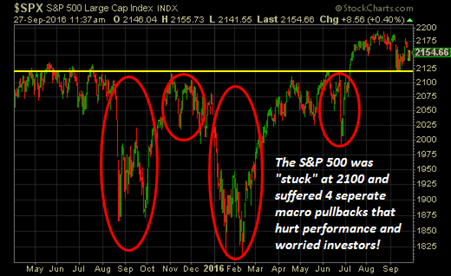
From May 2015 to July 2016 the S&P 500 was “capped” at (basically) 2100, and because it was capped, it was susceptible to sharp macro-economic inspired pullbacks:

  • August 2015: The S&P 500 dropped 10.5%
    in a month peak to trough on worries about the Chinese economy.
  • December 2015: The S&P 500 dropped 4.3%
    in two weeks on plunging oil and junk bond concerns.
  • January 2016: The S&P 500 plunged 13%
    in a month on falling oil, negative interest rates and a volatile Chinese yuan.

Obviously the market has recovered from these dips, but if an advisor had been able to tactically reduce exposure during just part of these declines, the cumulative effect on performance would be huge, and that means happy clients and more assets!

That is what we are very focused on doing for our paid subscribers over the next three months.

We are going to make sure they:

  1. Have someone carefully watching the macro horizon to alert them to any potential risks (more on that below) and
  2. Provide tactical idea generation that can help protect portfolios in a falling market, or outperform in a stable-to-rising tape.

If you don’t have a morning report that is going to give you the plain-spoken, practical analysis that will help you navigate the fourth quarter and help you get positioned properly to outperform into year end, then please consider a quarterly subscription to The Sevens Report.

There is no penalty to cancel, no long-term commitment, and it costs less per month than one client lunch!

With thousands of advisor subscribers from virtually every firm on Wall Street and a 90% initial retention rate, we are very confident we offer the best value in the private research market.

I am continuing to extend a special offer to new subscribers of our full, daily report that we call our “2-week grace period.”

If you subscribe to The Sevens Report today, and after the first two weeks you are not completely satisfied, we will refund your first quarterly payment, in full, no questions asked.

Click this link to begin your quarterly subscription today.

Increased Market Volatility Will Be an Opportunity for the Informed Advisor and Investor
We aren’t market bears, but we said consistently that things were going to be volatile in 2016, and we were right!

And, as we approach the biggest event for markets since Brexit (the BOJ meeting next Wednesday) the advisor who is able to confidently and directly tell their nervous clients what’s happening with the markets and why stocks are up or down, and what the outlook is beyond the near term (without having to call them back), will be able to retain more clients and close more prospects.

We view volatility as a prime opportunity to help our paid subscribers grow their books and outperform markets
by making sure that every trading day they know:

1) What’s driving markets

2) What it means for all asset classes, and

3) What to do with client portfolios

We monitor just about every market on the globe, break down complex topics, tell you what you need to know, and give you ETFs and single stocks that can both outperform the market and protect client portfolios.

All for $65/month with no long term commitment.

I’m not pointing this out because I’m implying we get everything right.

But we have gotten the market right so far in 2016, and it has helped our subscribers outperform their competition and strengthen their relationships with their clients – because we all know the recent volatility has resulted in some nervous client calls.

Our subscribers were able to confidently tell their clients 1) Why the market was selling off, 2) That they had a plan to hedge if things got materially worse and 3) That they were on top of the situation.

That’s our job, each and every trading day, and we are good at it.

We watch all asset classes to generate clues and insight into the near-term direction of the markets, but our most important job is to remain vigilant to the next decline.

While we spend a lot of time trying to identify what’s really driving markets so our clients can be properly positioned, we also spend a lot of time identifying tactical, macro-based, fundamental opportunities that can help our clients outperform.

If you want research that comes with no long-term commitment, yet provides independent, value-added, plain-English analysis of complex macro topics, click the button below to begin your subscription today.

Finally, everything in business is a trade-off between capital and returns.

So, if you commit to an annual subscription, you get one month free, a savings of $65. To sign up for an annual subscription simply click here.

Best,

Tom Essaye
Editor, The Sevens Report

Is the Bond Bull Market Over? (Central Bank Preview)

SL: Is the Bond Bull Market Over? (Central Bank Preview)

In the next 24 hours we’re going to get the answer to two very important questions:

  1. Is the Bond Bull Market Over?
  2. Have We Seen the Highs in Stocks for 2016?

And, it’s the Bank of Japan that likely will decide the answers to those questions, which will decide whether we see a potentially sharp decline in both stocks and bonds.

I’m not one for patting myself on the back, but I don’t know of many other research firms that were pounding the table back in August (when the market was quiet) saying:

  1. The July rally in stocks was in trouble because global bond yields were moving higher (they did, and the S&P 500 is down 2% from the August highs), and
  2. That the Bank of Japan and ECB were more important to US stocks than the Fed (the ECB caused a pullback two weeks ago and the Bank of Japan may do so tomorrow).

So, now I’m reiterating that tomorrow is a potentially very important day for clients’ stock and bond holdings, because even if we don’t see a lot of volatility immediately following the meetings, the Bank of Japan decision may mean the continuation of this rally in global bond yields, and the decline in stocks.

And, that could have significant consequences on clients returns as we enter the fourth quarter.

We are committed to making sure our paid subscribers know, before their competition, whether the Bank of Japan will cause global bond yields to move higher or lower, because that will be the key to getting clients properly positioned to outperform in Q4.

We’ve already delivered our Plain-English BOJ Preview to paid subscribers and they already know:

  1. What The Market Expects from the BOJ
  2. What will Make the Meeting “Dovish” and the likely market response
  3. What will Make the Meeting “Hawkish” and the likely market response

So, tomorrow, while other advisors and investors are searching WSJ.com, MarketWatch or CNBC to try and determine whether the meetings were bullish or bearish for stocks and bonds, our subscribers will already know.

But, more importantly, our subscribers know that at 7 a.m. Thursday morning we will deliver clear, Plain-English analysis of what the meetings mean for all asset classes (Stocks, Bonds, Commodities, Currencies) in the short and long term, and what tactical ETFs or general allocations we think will outperform in Q4 and beyond (and if that means raising cash, we’ll say it!).

Our paid subscribers won’t have to wait for a delayed, compliance-approved recap from their brokerage firm that just explains what the BOJ or Fed did, and ignores how to either protect gains or profit from the decisions.

We are going to tell our subscribers (at 7 a.m., and in plain English): 1) What Happened, 2) What it Means for Client Holdings (Stocks, Bonds, OI, Gold, the Dollar) and 3) How We Think We Can Make Money from It.

And, because this is such an important time for markets, we will be hosting a special webinar this Thursday at 1 P.M. EDT titled: “Breakout or Breakdown? 4th Quarter Market Preview.”

We will discuss the outlook for both stocks and bonds (and how we think investors should be positioned) heading into the 4th quarter.

There are a lot of moving pieces to tomorrow’s BOJ meeting and there aren’t a lot of clear, easy-to-read previews out there, so I’ve included an excerpt of our BOJ Preview as a courtesy:


BOJ Preview: What’s Expected

The fear going into tomorrow’s meeting will be that the BOJ will tacitly admit that it is indeed out of bullets, and is no longer able to provide meaningful stimulus to the Japanese economy. And while Japan is a unique case, this matters to all developed stock markets for two reasons.

  • First, and most directly, if the BOJ raises a symbolic white flag tomorrow, Japanese Government Bond yields will keep rising, which will make US Treasury yields rise, and that will keep a headwind on stocks.

  • Second, global stock markets have been supported (or propped up, depending on your definition) by the idea of ever more accommodative central banks. If the most aggressive central bank just declared itself impotent to spur further growth or inflation, what does that say about the ability of other central banks to support stocks prices/the economy if we see a slowdown? I often say at its heart, the market is little more than a confidence indicator, and a BOJ that disappoints markets again will strike a big blow to market confidence.

Bottom line, for global stock and bond markets that have been driven higher by the expectation of forever-low rates and ever-increasing central bank stimulus, having the most active player tacitly admit defeat is not good.

Now that we have the context, let’s look at what’s expected (there are a lot of moving pieces here, so bear with me):

  • QE: The first thing I will look at when I get up Wednesday will be to see if the BOJ increased the amount of QE. What’s Expected: No change to QE. If there is no change to QE, this BOJ decision will be at best neutral for stocks.
    • Dovish If (and Likely Market Reaction): Restricted for Subscribers
    • Hawkish If (and Likely Market Reaction): Restricted for Subscribers


  • Interest Rates:
    What’s Expected: Deposit Rate Cut from -.1% to -.3%.


    • Dovish If (and Likely Market Reaction): Restricted for Subscribers
    • Hawkish If (and Likely Market Reaction): Restricted for Subscribers

Wildcard to Watch: If the BOJ increases the inflation target from 2% to 3% (or close to 3%) that will be a surprise dovish move, and be taken as an unexpected positive (positive for stocks, negative for global bond yields).


Have a Plan In Place If Yields Keep Rising (and Stocks Keep Falling)

If you’re like me, and most advisors and investors, the biggest risk for tomorrow’s meetings is that global bond yields keep rising and stocks keep falling, creating an extension of the past 10 days where both stocks and bond holdings are falling together.

Given that risk, we spent last week providing subscribers with our “Higher Rate Playbook” they can refer to if we see that negative outcome, because in that scenario protecting profits and finding sectors that can outperform will be critically important! Paid subscribers already have this tactical playbook they can refer to, because we all know thinking clearly gets much more difficult when markets are falling!  

Play #1: Get Short the Long End of the Yield Curve, and/or Reduce the Overall Duration in any Bond Ladders

If we see a sustained decline in bonds/rally in yields, the belly and long end of the yield curve will get hit much harder than the short end of the yield curve.

There are two reasons for this:

First, the long end (say beyond 10 years) is over inflated because of foreign money, and as such has a lot further to fall before we get to compelling values.

Second, the short end of the curve (really 2 years or less) trades off Fed expectations, and the Fed simply isn’t going to raise rates quickly regardless of what happens in the markets (and especially if we see a selloff in stocks). So, the Fed will anchor the short end of the yield curve while the longer end rises, meaning the declines in short-term bonds will be less than in longer-term bonds.

ETFs to Get “Short” the Long Bond (there are many ETFs to do this but this is a list of the most liquid and targeted): Restricted for Subscribers

What to Buy in the Bond Markets: Restricted for Subscribers.
We don’t think everything in the bond market is toxic and we continue to have a top pick in the fixed income market for incremental capital that is less than five-year duration and the best alternative in a bond market that may be broadly declining.


Play #2: Focus on Good (but not Great) Credit Quality in Corporates

First, I think there may be opportunities for additional yield in the tier right below the top end of investment grade.
Point being, I would take the extra yield in that space between AAAs and junk, because barring a broad economic slowdown, corporate balance sheets are as strong as they’ve been in years.

Second, if I had a large allocation to junk bonds, I would rotate into higher-quality corporates because junk will get hit, and hit hard, in a declining bond market (think of junk bonds as the “subprime” of the bond market). Yes, junk pays a good yield, but in a rising rate environment it’s not worth the incremental risk.

How to Get Short Junk Bonds: Restricted for Subscribers.

How to Put on a Long Investment Grade/Short Junk Spread:
Restricted for Subscribers.


Play 3: Shift Exposure in US Stocks Out of “Yield Proxy Sectors.” (Know the difference between high-yielding sectors and truly defensive sectors).

If bonds and stocks keep falling, sector selection is going to become very important, and knowing the difference between truly “defensive” sectors vs. sectors that pay big dividends will matter for performance.

We provided the specific defensive sectors we like to paid subscribers in a report last week.

Play 4: Get a General Hedge Against “Risk Off.”

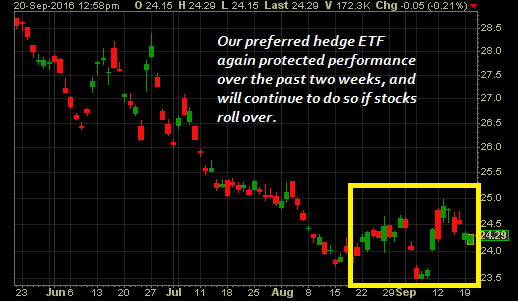
For over a year now we’ve used a specific inverse ETF as a broad hedge against a “risk-off” move in stocks, as this ETF has direct, specific exposure to some of the weakest sectors of the market, and as such can cushion any broad declines in the markets (like we saw in August/December 2015 and in January/February 2016).

We provided this specific ETF to subscribers once again in a report last week.

To be clear, I’m not advocating taking any of these steps right now, as it’s simply not clear that the bond market has indeed turned. So, we have to be wary of (another) head fake in this multi-year bull market.

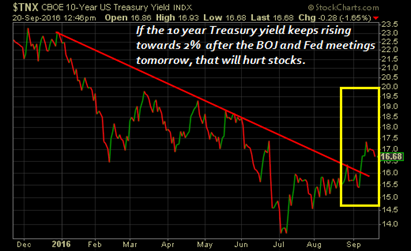
But, if the bond market does turn and 10-year Treasury yield moves towards 2%, it is important that advisors have a plan before the declines start, because things could get ugly quickly.

If you don’t have a morning report that is going to give you the plain-spoken, practical analysis that will help you navigate the BOJ and Fed decisions tomorrow, and help you get positioned properly to outperform into year end, then please consider a quarterly subscription to The Sevens Report.

There is no penalty to cancel, no long-term commitment, and it costs less per month than one client lunch!

With thousands of advisor subscribers from virtually every firm on Wall Street and a 90% initial retention rate, we are very confident we offer the best value in the private research market.

I am continuing to extend a special offer to new subscribers of our full, daily report that we call our “2-week grace period.”

If you subscribe to The Sevens Report today, and after the first two weeks you are not completely satisfied, we will refund your first quarterly payment, in full, no questions asked.

Click this link to begin your quarterly subscription today.

Value Add Research That Can Help You Finish 2016 Strong!

Our subscribers have told us how our focus on medium-term, tactical opportunities and risks has helped them outperform for clients and grow their businesses.

We continue to get strong feedback that our report is: Providing value, helping our clients outperform markets, and helping them build their books:

“Thanks for your continued insight; it has saved my clients over $2M USD this year… Keep up the great work!” – Top Producing FA from a National Brokerage Firm.

“Let me know if there is anything else that you need from us. Thanks again for everything. I really enjoy the Report – it is helping me grow my business and stay on top of things.”
– Independent FA.

“Great service from a great company!!” – FA from a National Brokerage Firm.

“Great report. You’ve become invaluable to me, thanks for everything…! – FA from a Boutique Investment Management Firm.

Subscriptions start at just $65 per month, billed quarterly, and with the option to cancel any time prior to the beginning of the next quarter, there’s simply no reason why you shouldn’t subscribe to The Sevens Report right now.

Begin your subscription to The Sevens Report right now by clicking this link and being redirected to our secure order form.



Finally, everything in business is a trade-off between capital and returns.

So, if you commit to an annual subscription, you get one month free, a savings of $65. To sign up for an annual subscription simply click here.


Best,
Tom

Tom Essaye
Editor, The Sevens Report


Bond Bubble

Something potentially very important just happened with the 10-year Treasury yield.

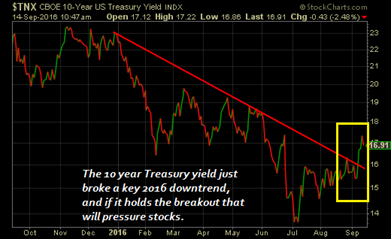
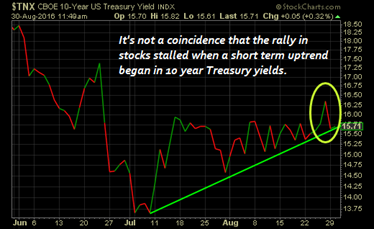
It broke a downtrend in place since the start of 2016, and if it can hold this breakout through the Bank of Japan and Fed meeting next week, it will be a strong signal that the bond bull market may be ending, and interest rates may be (finally) moving higher.


I’m under no illusions that bonds aren’t exactly the most exciting topic in the markets, but the reason we keep focusing on the action in the bond markets is because what bond yields do from here will
be critically important for how stocks and bonds perform in Q4.


Stocks have pulled back a bit recently as bond yields have risen, but the potential is still there for either a continued melt up (at which point advisors are going to want to be very long) or a potentially violent pullback in both stocks and bonds (at which point advisors are going to want to be very defensive). 

So, with the BOJ and Fed meeting looming next week and the first presidential debate the week after that, the rest of September will be an especially critical time if you are an advisor or investor who has underperformed markets so far in 2016 (and there are a lot of very good advisors who have underperformed this difficult market), as these events will present an opportunity to close that performance gap… if you know what’s happening and how to be positioned. 


And, we’ve seen that over the past few weeks. Banks and other “higher-rate sensitive” sectors have massively outperformed, while tech and higher beta allocations have lagged, rewarding cautious advisors and investors who didn’t chase markets higher in late July/August.

We are going to be very focused on making sure our paid subscribers know, immediately, what the implications are for each of these key events,
and which sectors will benefit from those events, whether it’s banks, consumer staples, utilities, tech or inverse ETFs. 


In tomorrow’s edition of The Sevens Report
we are going to be providing a “Higher Rate Playbook” for paid subscribers that details (with specific ETFs):


1) How to hedge a higher interest rate driven decline in stocks,


2) Which market sectors will outperform in a higher rate environment, and


3) What parts of the bond market will outperform and underperform in a rising rate environment.

Look, it’s been a very tough year to beat lazy indexing, but we recognize the chance to make up ground over the coming weeks, and into Q4 and we’re going to be focused on helping our advisor subscribers do just that by making sure they have the need-to-know analysis of all asset classes and global regions, not just US economics or the Fed. 

We’re approaching the one-year anniversary of the August 2015 collapse in stocks, and while markets are higher (finally), so is volatility, as international events exert greater influence over the Fed, the US economy, and the US stock market.

We understand that in this market, clients’ assets are at the mercy of the BOJ, ECB, Italian banks, Chinese policy makers, etc., and that’s why, every day, we make sure our paid subscribers know the key trends in:

  • Stocks
  • Bonds
  • Commodities
  • Currencies
  • Economic data

It’s only by providing that 360-degree coverage, every day, that advisors and investors can truly have an understanding of the risks and opportunities for their portfolios in this environment. 

The end of the bond bull market has been called many times by analysts over the past several years, and while I’m not about to do that today (the benefit of the doubt remains with the bulls) there is a subtle but important change in the markets that may signal the lows in Treasury yields are in for a long, long time.  


Another Nail in the Bond Bubble Coffin?

Hopefully by now we’ve driven home the point that next week’s BOJ meeting is the most important event on the calendar since Brexit, because if the BOJ disappoints markets it’ll send Japanese bond yields higher, which will pull Treasury yields higher and hurt stocks.

But, even if the BOJ chooses to do more stimulus, we still may have seen the lows in global bond yields for a very long time.

The reason?

Currency hedging (and Las Vegas).

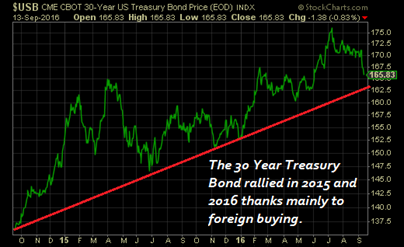
Longer-term readers know that foreign buying of Treasuries has been a massively positive influence on Treasury prices/negative influence on yields.

One of the reasons foreign buyers have gobbled up Treasuries over the past several years was because it was very easy and cheap to hedge out the currency exposure (a German portfolio manager who bought Treasuries was also buying dollars, and that represented an additional risk he or she would want to hedge out, so it became a pure yield play).

But too much of a good thing can become a problem, and in this case the ocean of foreign money flowing into Treasuries, all looking for the same currency hedge, has caused a problem.

For those who follow sports, it’s the same problem bookies have each week when betting the spreads.

In Las Vegas, when too much money goes towards one team, bookies have to adjust the point spread to make a bet on the other team more attractive.

That’s why betting spreads move during the week, as the bookies are always trying to make the amount bet on Team A equal to the amount bet on Team B. That way the bookies have no risk and just collect fees. It’s similar with currency dealers and trading desks.

To bring it back to the markets, if everyone wanted to hedge out the risk of the euro or yen strengthening vs. their Treasury positions, the bets become too one sided and the currency dealers and trading desks have to increase their fees to insulate themselves against losses.

That has been occurring in the foreign exchange markets over the past several months, and at this point, according to reports from Deutsche Bank and Reuters (and I’ve read similar articles from other firms), it now costs so much to hedge out that foreign exchange risk that it has totally offset the additional yield you get in Treasuries over other government debt.

Basically, the “Long Treasuries” trade has become too crowded, and isn’t worth it anymore.

That’s important for advisors and their clients for one simple reason:

It means that a major source of demand for Treasuries has been diminished, which is Treasury negative regardless of what the Fed or BOJ does next week.


Have a Plan in Place if Stocks and Bonds Drop

Let me be clear: If the BOJ disappoints markets next week, both stocks and bonds will drop. But, even if the BOJ does unleash more stimulus, depending on what happens with global bond yields, we still could see Treasury yields rise (or at least not fall very much).

We are committed to making sure our paid subscribers have a strategy to protect client portfolios in either environment, and that’s why tomorrow, we are going to be providing a “Higher Rate Playbook” for them that details (with specific ETFs):


1) How to hedge a higher interest rate driven decline in stocks,


2) Which market sectors will outperform in a higher rate environment, and

3) What parts of the bond market will outperform and underperform in a rising rate environment.

If all we do is help you navigate the next six weeks correctly and help you get properly positioned in client accounts for the fourth quarter, we will have more than covered our subscription cost.

If you don’t have a morning report that is going to give you the plain-spoken, practical analysis that will help you navigate the coming weeks and help you get positioned properly to outperform into year end, then please consider a quarterly subscription to The Sevens Report.

There is no penalty to cancel, no long-term commitment, and it costs less per month than one client lunch!

With thousands of advisor subscribers from virtually every firm on Wall Street and a 90% initial retention rate, we are very confident we offer the best value in the private research market.

I am continuing to extend a special offer to new subscribers of our full, daily report that we call our “2-week grace period.”

If you subscribe to The Sevens Report today, and after the first two weeks you are not completely satisfied, we will refund your first quarterly payment, in full, no questions asked.

Click this link to begin your quarterly subscription today.


Value Add Research That Can Help You Finish 2016 Strong!

Our subscribers have told us how our focus on medium-term, tactical opportunities and risks has helped them outperform for clients and grow their businesses.

We continue to get strong feedback that our report is: Providing value, helping our clients outperform markets, and helping them build their books:

“Thanks for your continued insight; it has saved my clients over $2M USD this year… Keep up the great work!” – Top Producing FA from a National Brokerage Firm.

“Let me know if there is anything else that you need from us. Thanks again for everything. I really enjoy the Report – it is helping me grow my business and stay on top of things.”
– Independent FA.

“Great service from a great company!!” – FA from a National Brokerage Firm.

“Great report. You’ve become invaluable to me, thanks for everything…! – FA from a Boutique Investment Management Firm.

Subscriptions start at just $65 per month, billed quarterly, and with the option to cancel any time prior to the beginning of the next quarter, there’s simply no reason why you shouldn’t subscribe to The Sevens Report right now.

Begin your subscription to The Sevens Report right now by clicking this link and being redirected to our secure order form.


Finally, everything in business is a trade-off between capital and returns.

So, if you commit to an annual subscription, you get one month free, a savings of $65. To sign up for an annual subscription simply click here.


Best,
Tom

Tom Essaye
Editor, The Sevens Report


ECB Preview

The first of the major central bank decisions in September comes tomorrow via the ECB, and from a general standpoint the major question heading into this meeting is:

“Will the ECB ease further, hint at easing further, or stay firmly on the sidelines?”

Given the uncertainty surrounding tomorrow’s decision, I found myself in my home office last night writing our ECB Preview (sent to paid subscribers at 7 a.m. this morning) which explained:

1) What will make the meeting “hawkish” or “dovish” and

2) Provided the anticipated market reaction of stocks, bonds, the dollar, oil and gold for the three possible outcomes: The ECB meets expectations, the ECB is Dovish, or the ECB is Hawkish.

While I was working, my wife came in and asked me what I was doing and I told her, “Writing an ECB Preview,” and she asked, “What does the ECB have to do with stocks?”

In a few quick sentences I explained that the ECB was important because if it doesn’t hint at future easing, that will make German Bund yields go up, which will make Treasury yields go up, and that will make both stocks and bonds go down!

She smiled and told me, “I Can See Why People Subscribe!”

If you’re like me, never in your wildest dreams did you think when you started in this business that you’d have to be focused on what the ECB was doing because it could turn the US stock market.

In fact, I’m not even sure the ECB existed when I started in this business!

But, a Dot-Com bubble burst, financial crisis, QE Infinity and Negative Interest Rates later, here we are, and the simple truth is that if the ECB doesn’t do one specific thing tomorrow at their meeting and press conference, it will disappoint markets—and stocks will drop (more on that later).

We have spent the last few weeks making sure our paid subscribers know the list of six key events facing markets, because those events will cause at least short-term volatility, and knowing these events are looming helps advisors who subscribe to the full, paid edition of The Sevens Report
set the right expectation for clients… so that they aren’t blindsided if any of these events cause a market pullback.

And, if the ECB, BOJ or Fed disappoints markets and causes a spike in bond yields and pullback in stocks, our subscribers will be able to demonstrate to their clients they expected the volatility
and had a plan in place should things get worse.

That’s how advisors (both active and passive managers) use The Sevens Report
to improve client relationships and impress prospects.

Tomorrow’s ECB meeting does have the potential to cause a drop in stocks, so we want to make sure everyone knows

1) What’s Expected,

2) What Will Make the ECB Dovish and

3) What Will Make the ECB Hawkish.

We’ve included an excerpt of that research for you below as a courtesy:

ECB Preview (Sevens Report Excerpt)

To keep things in plain English, the ECB is important to advisors and their clients because the decision will move both the US bond and stock markets.

If the outcome of the ECB meeting is considered “dovish” that will be positive for US stocks
because that ECB decision will pressure German Bund yields lower, and that in turn will drag US yields lower and increase the case for justifying a further multiple expansion in stocks above 2200.

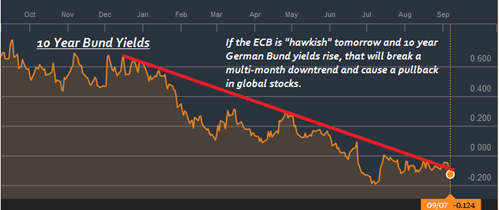
Conversely, if the ECB is taken as “hawkish” that will cause German 10-year Bund yields to likely turn positive, which will push US Treasury yields higher and weigh on US and European stocks. Below we have a guide to what’s expected, what would be considered dovish, and what would be hawkish.

What’s Expected: The ECB Hints at an Extension of QE.
The current ECB QE program ends in March, and most economists expect that Draghi will strongly hint that the current QE program will be extended for a second time, likely till the end of 2017. Likely Market Reaction: Restricted for Paid-Subscribers.

It will Be Hawkish If: There is no hint at a QE extension in December. If the ECB remains in a “Wait and See” mode given the more resilient EMU economy post Brexit, that will disappoint markets. Likely Market Reaction: Restricted for Paid-Subscribers.

It Will Be Dovish If: The ECB announces the extension of QE tomorrow, or hints at both the extension of QE and upcoming changes to the QE program.
To that latter point, one of the current issues with ECB QE is that there is a relative scarcity of bonds to buy in the market, so if the ECB is planning on materially extending QE it could also change the rules regarding what bonds it can buy (likely increasing the pool of corporate and sovereign debt). Likely Market Reaction: Restricted for Paid-Subscribers.

The key takeaway here is that uncertainty surrounding global interest rates is a becoming a more substantial headwind on stocks, and that’s why stocks were down again this morning, as the Bank of England Governor Marc Carney implied the Bank of England may not need to do as much stimulus as expected, post Brexit.

Bottom line, before stocks can move higher, there has to be clarity on the direction of interest rates, and that will only come from the ECB, Fed and BOJ.

If you do not have a morning report that is going to give you the plain English, practical analysis that will help you navigate those central bank events, then please consider a quarterly subscription to
The Sevens Report.
 

There is no penalty to cancel, no long term commitment, and it costs less per month than one client lunch!

With thousands of advisor subscribers from virtually every firm on Wall Street and a 90% initial retention rate, we are very confident we offer the best value in the private research market. 

I am continuing to extend a special offer to new subscribers of our full, daily report that we call our “2-week grace period.”

If you subscribe to The Sevens Report today, and after the first two weeks you are not completely satisfied, we will refund your first quarterly payment, in full, no questions asked.

Click this link to begin your quarterly subscription today.


Volatility Will be an Opportunity for the Informed Advisor and Investor in the 4th Quarter

We aren’t market bears, but we said consistently that things were going to be volatile in 2016, and we were right!

The market is not going to stay as quiet as it was this summer.


How could it, considering the events that are coming over the next few weeks:

  • The ECB Meeting September 8th: Will the ECB hint at more stimulus (bullish) or not (bearish)?
  • The Fed Meeting September 21st: Will the Fed hike rates (very bearish), hint at hiking rates in December (bearish) or stay ultra-dovish (bullish)?
  • The Bank of Japan Meeting September 21st: Will the BOJ adopt “Helicopter Money Light” (bullish), or just do another inconsequential easing like in July (bearish).
  • First Presidential Debate September 26th: Will Trump get back into the race (bearish short term – and this is not a political opinion) or will Clinton maintain a comfortable lead (not bearish).
  • International Energy Forum September 26th: Will OPEC and Non-OPEC members agree on a global production “freeze” (bullish oil) or not (very bearish oil).

Some advisors and investors will be blindsided by the volatility
these events might create, but the advisor who is able to confidently and directly tell their nervous clients what’s happening with the markets and why stocks are up or down, and what the outlook is beyond the near term (without having to call them back), will be able to retain more clients and close more prospects.

We view volatility as a prime opportunity to help our paying subscribers grow their books of business and outperform markets
by making sure that every trading day they know:

1) What’s driving markets

2) What it means for all asset classes, and


3) What to do with client portfolios.

We monitor just about every market on the globe, break down complex topics, tell you what you need to know, and give you ETFs and single stocks that can both outperform the market and protect client portfolios.

All for $65/month with no long term commitment.

I’m not pointing this out because I’m implying we get everything right.

But we have gotten the market right so far in 2016, and it has helped our subscribers outperform their competition and strengthen their relationships with their clients – because we all know the recent volatility has resulted in some nervous client calls.

Our subscribers were able to confidently tell their clients 1) Why the market was selling off, 2) That they had a plan to hedge if things got materially worse and 3) That they were on top of the situation.

That’s our job, each and every trading day. And, we are good at it. We watch all asset classes to generate clues and insight into the near-term direction of the markets, but our most important job is to remain vigilant to the next decline.

While we spend a lot of time trying to identify what’s really driving markets so our clients can be properly positioned, we also spend a lot of time identifying tactical, macro-based, fundamental opportunities that can help our clients outperform.

If you want research that comes with no long-term commitment, yet provides independent, value added, plain English analysis of complex macro topics, click the button below to begin your subscription today.
 

Finally, everything in business is a trade-off between capital and returns.

So, if you commit to an annual subscription, you get one month free, a savings of $65. To sign up for an annual subscription simply click here.
 

Best,
Tom

Tom Essaye
Editor, The Sevens Report



What Will Move Bond Markets

For the past two weeks, we’ve told you via these free excerpts that the markets were entering a critical six-week period that ultimately would decide whether the rally in stocks continues… or reverses.

Well, that six-week stretch of events started with a bang last Friday as Fed Vice Chair Fischer surprised markets by basically saying Friday’s jobs report would decide whether the Fed would hike rates in September.

As a result, bond yields spiked and stocks dropped.

And, if Friday was any indication, we’re in for a wild ride as the markets navigate the remaining 6 key critical central bank/macro events between now and September 26th (more on that below).

We never like to see the markets go down as all of us are generally “long” stocks, but Friday was a good day for us here at The Sevens Report, because it validated what we’ve been saying to our paid subscribers for the past several weeks:

Specifically, that whether stocks resume the July rally or break down from here will depend on the bond market, and as a rule, anything that sends bond yields up will be negative for stocks, and anything that sends bond yields down will be positive for stocks.

While other research publications were simply providing recaps of a dull market during the majority of August, we were consistently telling our subscribers that the bond market is the key and the coming several weeks were going to be critical—and on Friday afternoon (and continuing today), our advisor subscribers were able to demonstrate to their clients they were on top of markets and in control of their portfolios!

In fact, one subscriber wrote in and said it was the “Plain English” analysis of the bond market that’s helped him strengthen a relationship with a high net worth client, and he’s pretty sure that he’s going to get an additional allocation because, as the client said, his other advisors seemed to have “taken August off” given the quiet market.

That’s the kind of feedback that makes the early wake ups and long hours of work worth it, and the best part is that our subscriber only had to spend less than 10 minutes each morning reading our daily macro report. That’s how The Sevens Report
helps advisors grow their business.

Every trading day at 7 a.m. we provide plain English, concise analysis of:

  • Stocks
  • Bonds
  • Commodities
  • Currencies and
  • Economic Data

And, our daily report takes less than 10 minutes to read each day!

Finally, we do it at a cost that’s substantially less than our competition (and less than one client lunch per month), and that’s why we continue to believe we offer the best value in the paid research space!

Given last Friday’s “hawkish” surprise from Fed Vice Chair Fischer, it’s critically important for all advisors to understand what is really driving the bond market
(it’s not a Fed rate hike) because where bonds go from here will determine the next move in stocks.

We’ve included an excerpt of that research as a courtesy.

Understanding What Will Move the Bond Markets (It’s Not Rate Hikes)

The question of when the Fed hikes rates has come back to the forefront for investors, as expectations for a rate hike in September or December have increased following the hawkish comments from last Friday.

But it is very important to understand that while the media will focus on the Fed hike drama, easily the most important thing to understand about the bond market right now is that the Fed has little to no control over whether 10- and 30-year Treasury yields stay in a downtrend (good for stocks), or reverse and start to trend higher (bad for stocks).

Whether the Fed hikes in September, December or 2017 won’t resolve the major issue facing stocks right now, which is the near-term direction of global 10- and 30-year bond yields.

Instead, there are two other central banks that control the direction longer-dated Treasury yields:

  1. The European Central Bank (ECB) and
  2. The Bank of Japan (BOJ)

For US stock and bond investors, what those banks do in September is much, much more important than what the Fed does between now and December.

Now, I said that the Fed doesn’t control longer-term interest rates anymore to a friend this weekend, and he was incensed that I could utter anything so “stupid.”

But, I pointed out that over the past two years, we’ve seen the Fed:

  1. End the QE program and
  2. Hike Fed funds 25 basis points

Yet, during that two-year period, yields on the 30-year Treasury are down 80 basis points, from 3.1% in December 2014 to 2.1% post Brexit, and yields on the 10-year Treasury are also down 100 basis points (or 1%), from 2.3% to 1.33% post Brexit.

CHART

So my question to him was: If the Fed is still in control of longer-term Treasury yields, how can this be possible?

The answer is they aren’t in control any longer as the Treasury market has been overrun by foreign buyers due to the actions of the BOJ, ECB and now BOE.

The reason this is important for advisors and their clients is this:

Between now and year end, whether stocks resume their rally will depend on whether the ECB and BOJ are more hawkish than expectations, not the Fed.

If that happens, yields on Bunds and JGBs (Japanese Government Bonds) will rise and that will cause Treasury yields to rise too, regardless of whether Yellen trots out with a dove on her shoulder and promises to never hike rates again!

The critical bottom line is this: The financial media will be totally consumed with whether the Fed is going to hike rates in September, but from a stock standpoint (specifically whether stocks rally in Q4 or pullback) what the ECB does on September 8th and what the BOJ does on September 21st are much, much more important.

They are in control of longer-dated Treasury yields, and longer-dated Treasury yields will decide the next move in stocks and we will make sure you stay focused on what’s really important in the bond markets over the coming six weeks.

Make Sure You Have the Plain English and Actionable Analysis to Navigate the Next Six Weeks

We will give our advisor and investor subscribers the plain English talking points to help them turn any Fed or central bank-based volatility into an opportunity to demonstrate their knowledge of markets and impress current clients and prospects.

And, we are going to provide that same level of analysis for the remaining 6 key events that are coming in September, events that will decide whether this rally extends into the fourth quarter

  • Friday’s Jobs Report: Will the number increase the odds of a September rate hike (and if so cause more short term declines in stocks).
  • The ECB Meeting September 8th:  Will the ECB hint at more stimulus (bullish) or not (bearish)?
  • The Fed Meeting September 21st:  Will the Fed hike rates (very bearish), hint at hiking rates in December (bearish) or stay ultra-dovish (bullish)?
  • The Bank of Japan Meeting September 21st:  Will the BOJ adopt “Helicopter Money Light” (bullish), or just do another inconsequential easing like in July (bearish).
  • First Presidential Debate September 26th:  Will Trump get back into the race (bearish short term – and this is not a political opinion) or will Clinton maintain a comfortable lead (not bearish).
  • International Energy Forum September 26th:  Will OPEC and Non-OPEC members agree on a global production but (bullish oil) or not (very bearish oil).

If all we do is help you navigate the month of September correctly and help you get properly positioned in client accounts for the fourth quarter, we will have more than covered our subscription costs.

If you do not have a morning report that is going to give you the plain spoken, practical analysis that will help you navigate the coming six weeks, then please consider a quarterly subscription to
The Sevens Report.
 

There is no penalty to cancel, no long-term commitment, and it costs less per month than one client lunch!

With thousands of advisor subscribers from virtually every firm on Wall Street and a 90% initial retention rate, we are very confident we offer the best value in the private research market.

I am continuing to extend a special offer to new subscribers of our full, daily report that we call our “2-week grace period.”

If you subscribe to The Sevens Report today, and after the first two weeks you are not completely satisfied, we will refund your first quarterly payment, in full, no questions asked.

Click this link to begin your quarterly subscription today.

 Value Add Research That Can Help You Grow Your Business in 2016

Our subscribers have told us how our focus on medium-term, tactical opportunities and risks has helped them outperform for clients and grow their businesses.

We continue to get strong feedback that our report is: Providing value, helping our clients outperform markets, and helping them build their books:

“Thanks for your continued insight; it has saved my clients over $2M USD this year… Keep up the great work!” – Top Producing FA from a National Brokerage Firm.

“Let me know if there is anything else that you need from us. Thanks again for everything. I really enjoy the Report – it is helping me grow my business and stay on top of things.” –  Independent FA.

“Great service from a great company!!” – FA from a National Brokerage Firm.

“Great report. You’ve become invaluable to me, thanks for everything…!  –  FA from a Boutique Investment Management Firm.

Subscriptions start at just $65 per month, billed quarterly, and with the option to cancel any time prior to the beginning of the next quarter, there’s simply no reason why you shouldn’t subscribe to The Sevens Report right now.

Begin your subscription to The Sevens Report right now by clicking this link and being redirected to our secure order form.

Finally, everything in business is a trade-off between capital and returns.

So, if you commit to an annual subscription, you get one month free, a savings of $65. To sign up for an annual subscription simply click here.

Best,
Tom

Tom Essaye
Editor, The Sevens Report
WHY STOCKS DROPPED YESTERDAY

Yesterday’s dip in stocks was not because of an EpiPen, regardless of what the financial media said.

Yes, Hilary Clinton’s EpiPen comments did remind everyone of the healthcare induced pullback in 2015, but this time that’s largely a political distraction.

By far the most important thing that happened yesterday was that we learned 8 of 12 Regional Federal Reserve Bank Presidents requested a Discount Rate hike in July.

That’s potentially very important, because it means the chances of a rate hike in 2016 are higher than previously thought—and that is a threat to this market rally.

That’s the real reason stocks dropped yesterday, not some EpiPen political drama.

I included that analysis in the full, paid edition of The Sevens Report
this morning (which was delivered to subscribers at 7 a.m.), and I got some great feedback.

One subscriber, a wealth manager with ML, called and told me that he reads three things every morning: Gartman, The Sevens Report, and some of ML’s research.

He said Gartman had great information, but it was long and he really doesn’t need to know about pricing trends in cotton or the inner workings of Japanese politics.

The ML research was comprehensive, he said, but it was typical “Ivory Tower” stuff that was full of jargon and often tough to discern a clear, concrete takeaway.

He went on to say he subscribes to The Sevens Report
because every day it tells him, in plain English, what’s important in all asset classes: Stocks, Bonds, Commodities, Currencies, Bonds, and Economics.

No jargon, no obscure facts, just the information you need to know, in plain English, every day at 7 a.m.

And, he added that it didn’t hurt that the cost of The Sevens Report
was about 1/10th that of the Gartman Letter!

The truth is, this is a very difficult market, in part because there are unending distractions that take advisors and investors away from the key forces driving all asset classes right now: Global bond yields.

That’s why we consistently bring our subscribers (and you via these free excerpts) back to global bond yields, because they will decide whether stocks break out and extend the rally or break down and suffer a nasty pullback.

That’s why yesterday the most important piece of information was the revelation that at the July FOMC Meeting, for the first time in 2016, a majority of Regional Fed Bank Presidents called for a discount rate hike.

That’s a potential problem for stocks for two reasons:

  • First, recent history implies a majority of Regional Fed Bank Presidents calling for a discount rate hike is a precursor to a Fed Funds rate hike, and
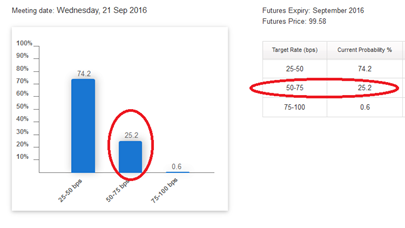
  • Second, the market is still largely ignoring that fact as there is still just a 30% chance of a hike in September and a 50% chance of a hike in December.

Both of those numbers are too low, and both represent a potential risk to this stock market rally.

Understanding the outlook for US and global interest rates is the key to successfully navigating the markets for the rest of 2016, and we’ve included an excerpt of recent rate research as a courtesy.

Demand for a (Discount) Rate Hike Grows (Sevens Report Excerpt)

Easily the most important thing that’s happened so far this week is that a Fed document was released Tuesday that revealed for the first time in 2016, a majority of the Fed’s Regional Bank Presidents requested a reserve rate hike in July.

History tells us that implies that a majority of FOMC officials think the time for a Fed funds rate hike is sooner than later (like in the next month or two). For reference, the last time eight Regional Fed Bank Presidents requested a reserve rate hike was September and October of last year, and the Fed hiked in December.

But the important takeaway for any stock and bond holder is this:

The Fed may indeed be closer to a rate hike than the market expects.

And, that’s starting to be reflected in Fed Fund Futures as they have risen over the past week.

  • Last week, Fed Fund Futures showed just a 20% chance of a September rate hike.
  • Now, Fund Funds Futures reflect a 30% chance of a September rate hike.
  • Last week, Fed Fund Futures showed just a 40% chance of a December rate hike.
  • Now Fed Funds Futures reflect a greater than 50% chance of a December rate hike.

And, despite that, the S&P 500 is less than 1% off the recent highs.

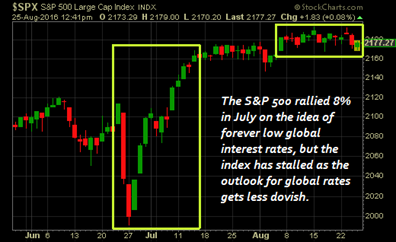
That should be a concern, because the idea of forever-low global rates and no 2016 Fed rate hikes spurred a 7% S&P 500 rally in July, and if that proves to be untrue, then there’s a risk of a pullback.

Bottom line, there is mounting evidence that global and US interest rates may not stay as low as the stock market has currently priced in, and that is a risk to the entire July/August rally. Again, we won’t know the outlook for rates until the end of September. But the bottom line is that markets are very, very complacent with regard to any future rate hikes, and there is growing evidence that a rate hike is in the works.

The Next Six Weeks Will Be Critical for this Rally

For now, this remains a market largely stuck in neutral at the moment and in need of resolution on several key upcoming events before it can break meaningfully past 2200 in the S&P 500, given current valuations.

Specifically, the overhang of global rate uncertainty needs to be resolved before stocks can resume the forever-low-rates rally and extend multiples and valuations beyond current levels.

And, that process will begin tomorrow with Yellen’s Jackson Hole speech.

Generally, it’s expected that Yellen will be (as usual) dovish in her comments tomorrow, and if so, that could provide a short term boost for stocks. But, that’s not going to cause a real breakout in the markets
because what happens to US interest rates is as much a function of global events as it is Fed policy.

The risk tomorrow is that Yellen offers a “hawkish” surprise for markets, and that surprise combines with recent hawkish Fed rhetoric to cause a low volume, potentially sharp decline in stocks.

In tomorrow’s full, subscriber-only edition of the Report, we’re going to detail:

  • What to Expect from Yellen’s Comments
  • What specific comments or phrases will make her speech more “dovish” than expectations, and therefore short-term positive for stocks.
  • What specific comments will make her speech more “hawkish” than expectations, and thus increase the risk of a pullback.
  • And what specific policy will frankly “spook” markets and cause a decline.
  • And, most importantly, what sectors and ETFs will outperform regardless of the speech.

Paid subscribers to The Sevens Report will have this information at 7 a.m. tomorrow, in plain English and it’ll take them only a few minutes to read it, so they will be prepared to quickly and confidently answer any client questions about the Fed, and propose tactical ideas for how to potentially profit from a “dovish” Fed or protect portfolios from a “hawkish” Fed.

We will give our advisor and investor subscribers the plain English talking points to help them turn any Fed or central bank based volatility into an opportunity to demonstrate their knowledge of markets and impress current clients and prospects.

And, we are going to provide that same level of analysis for the remaining 5 key events that are coming in September, events that will decide whether this rally extends into the fourth quarter

  • The ECB Meeting September 8th: Will the ECB hint at more stimulus (bullish) or not (bearish)?
  • The Fed Meeting September 21st: Will the Fed hike rates (very bearish), hint at hiking rates in December (bearish) or stay ultra-dovish (bullish)?
  • The Bank of Japan Meeting September 21st: Will the BOJ adopt “Helicopter Money Light” (bullish) or just do another inconsequential easing like in July (bearish).
  • First Presidential Debate September 26th: Will Trump get back into the race (bearish short term – and this is not a political opinion) or will Clinton maintain a comfortable lead (not bearish).
  • International Energy Forum September 26th: Will OPEC and Non-OPEC members agree on a global production but (bullish oil) or not (very bearish oil).

If all we do is help you navigate the month of September correctly and help you get properly positioned in client accounts for the fourth quarter, we will have more than covered our subscription costs.

If you do not have a morning report that is going to give you the plain English, practical analysis that will help you navigate the coming six weeks, then please consider a quarterly subscription to The Sevens Report.

There is no penalty to cancel, no long term commitment, and it costs less per month than one client lunch!

With thousands of advisor subscribers from virtually every firm on Wall Street and a 90% initial retention rate, we are very confident we offer the best value in the private research market.

I am continuing to extend a special offer to new subscribers of our full, daily report that we call our “2-week grace period.”

If you subscribe to The Sevens Report
today, and after the first two weeks you are not completely satisfied, we will refund your first quarterly payment, in full, no questions asked.

Click this link to begin your quarterly subscription today.

 Value Add Research That Can Help You Grow Your Business in 2016

Our subscribers have told us how our focus on medium-term, tactical opportunities and risks has helped them outperform for clients and grow their businesses.

We continue to get strong feedback that our report is: Providing value, helping our clients outperform markets, and helping them build their books:

“Thanks for your continued insight; it has saved my clients over $2M USD this year… Keep up the great work!” – Top Producing FA from a National Brokerage Firm.

“Let me know if there is anything else that you need from us. Thanks again for everything. I really enjoy the Report – it is helping me grow my business and stay on top of things.” –  Independent FA.

“Great service from a great company!!” – FA from a National Brokerage Firm.

“Great report. You’ve become invaluable to me, thanks for everything…!  –  FA from a Boutique Investment Management Firm.

Subscriptions start at just $65 per month, billed quarterly, and with the option to cancel any time prior to the beginning of the next quarter, there’s simply no reason why you shouldn’t subscribe to The Sevens Report right now.

Begin your subscription to The Sevens Report right now by clicking this link and being redirected to our secure order form.

Finally, everything in business is a trade-off between capital and returns.

So, if you commit to an annual subscription, you get one month free, a savings of $65. To sign up for an annual subscription simply click here.

Best,
Tom

Tom Essaye
Editor, The Sevens Report