


Archive for month: January, 2015
The World Bank Slashes Growth, and Traders Thrash Copper
The World Bank thinks global growth will be slower than originally estimated. On Tuesday, the lender issued its semiannual Global Economic Prospects report, and for global growth bulls the outlook wasn’t very encouraging.
For 2015, the global economy is estimated to expand by 3%, which is down from a projected 3.4% growth rate in June. In 2016, the World Bank thinks growth will come in at 3.3%, which is down from the prior estimate for 3.5% growth.
While most investors would be well served to take the World Bank’s estimates with the proverbial grain of salt, one thing we do know is that traders often take these data projections serious—at least in the short-term. We saw just that in Tuesday trade, as growth concerns weighed on commodities, most notably copper, which traded down nearly 5% in the session.
It is often said that copper has a Ph.D. in global economics, which just means that copper prices are a good indicator of the health of an economy. When the economy is trending lower, then usually we’ll see that reflected in copper prices—and that’s precisely what happened Tuesday, and what’s happened in copper via the iPath DJ-UBS Copper SubTR ETN (JJC). This copper exchange-traded note is down some 17.2% over the past three months, a move that betrays just how fearful traders have become about the prospects for global growth.
More broadly, the spot price of copper has been in a bearish downtrend now really since the spring 2011 highs, but most recently lower energy costs and weak demand specifically out of China, the world’s largest consumer of the industrial metal, have pushed prices down to near six-year lows.
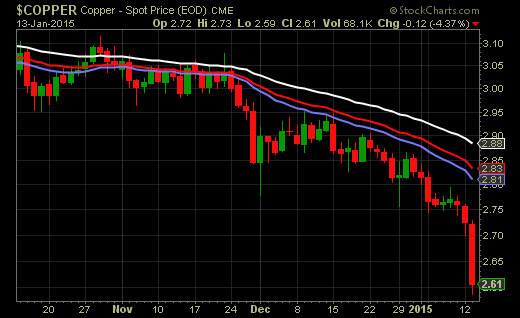
The collapse in “Dr. Copper,” has been somewhat lost in the oil declines, but clearly this is not a good sign for global growth.
Chinese demand for copper is expected to fall again this year, and that presents a very troubling backdrop for the future of copper prices going forward. The bottom line is clear; copper is falling victim to a combination of low production costs (oversupply) and soft demand expectations, which is resulting in a sharp slide to the downside that we think has room to continue going even lower.
So, if you are long this industrial commodity (and I hope you’re not) then now is the time to rethink the “Dr. Copper” bull trade.
Closing Bell Exchange: Oil, Jobs & Wages
Tom Essaye’s recent interview on “Closing Bell” at CNBC.
5 Macro Risks Keeping Stocks Down
Markets by their very nature are risky, but sometimes the macro risks are bigger and more dangerous than the bulls can handle. As we kickoff 2015, I see five big macro headwinds facing stocks—headwinds that are likely to limit upside at least in the near term.
In order of near-term importance, they are: 1) What will ECB QE look like? 2) Can oil stabilize? 3) Will we have another “Grexit” scare? 4) Is there really a global deflation threat or is it just oil? and 5) When will the Fed start to tighten and how will markets react?
Of the five, the first four are almost equal in importance with regards to what stocks do over the coming weeks. And, it’s important to note that European QE concerns now have trumped (or equaled) oil contagion worries as the near-term leading indicator for stocks. This was made evident Friday when articles in Bloomberg and Reuters were largely responsible for the drop in stocks (it wasn’t the jobs report).
Keep an eye on the WisdomTree Europe Hedged Equity ETF (HEDJ), a proxy for European stocks, as this fund’s direction will betray how the market assesses those concerns.
It’s key to realize, though, that beyond the very short term, none of the above should be materially negative influences on stocks.
The ECB may disappoint with initial QE, but the bottom line is the ECB knows it has to expand its balance sheet and provide more stimulus, which is bullish for European stocks over the coming months and quarters.
While we haven’t likely seen the low tick yet, oil appears to be trying to stabilize, as prices at these low levels will likely start to have an impact on marginal producers (so the pace of declines should slow), which is what is important from an “oil contagion” standpoint. The global “deflation” scare is mostly linked to oil prices so when they stabilize, so will inflation statistics. Third, the “Grexit” story is likely overdone (the chances of Greece leaving the EU remain very slim, and we know that from the bond markets).
Finally, the concern about the FOMC raising interest rates is a problem for the April time frame (as we approach the potential June “lift off” in the cost of capital).
The point here is that we are likely to see more near-term volatility until the events above get resolved, but I would view any material dip below 2000 in the S&P 500 as a buying opportunity in domestic cyclicals (banks, retailers and tech specifically) and continue to view European market weakness as offering fantastic longer term entry points.
Bottom line: The near term may be bumpy, but we see no reason to materially alter equity allocations.